





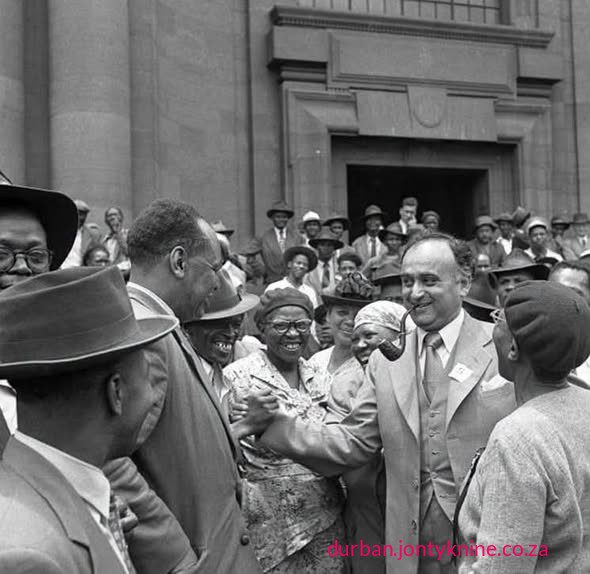
Dr Yusuf Mohamed Dadoo’s vision of a non-racial, socially just South Africa—rooted in unity across racial and class lines, democratic rights for all, and substantive equality—remains a powerful benchmark against which the country’s post-apartheid trajectory is still measured, and one that continues to fall short in critical respects.
Born on 5 September 1909 in Krugersdorp to a Gujarati Muslim trading family, Dadoo trained as a doctor in Edinburgh (qualifying in the mid-1930s) after earlier studies and political exposure in London and India. He returned to practise medicine among the poor while immersing himself in radical politics. Inspired by anti-imperialism, the Russian Revolution, and Marxist analysis, he joined the Communist Party of South Africa in 1939 and rose to leadership in the Transvaal Indian Congress and later the South African Indian Congress. He was a central figure in the Non-European United Front, the 1946 passive resistance campaign against the Asiatic Land Tenure and Indian Representation Act (“Ghetto Act”), support for the 1946 African mineworkers’ strike, the 1952 Defiance Campaign, the Congress of the People that adopted the Freedom Charter in 1955, and the Treason Trial. In exile after 1960 he served as a key ANC and SACP leader, including as SACP national chairman from 1972 until his death from prostate cancer in London on 19 September 1983. He is buried at Highgate Cemetery near Karl Marx.
At the 1955 Congress of the People in Kliptown, Dadoo received the ANC’s highest honour, Isitwalandwe/Seaparankoe (“the one who wears the plumes of the rare bird”), together with Chief Albert Luthuli and Father Trevor Huddleston. This award, drawn from Xhosa tradition recognising exceptional leadership and heroism, underscored his stature across communities.
A pivotal organisational achievement was the 1947 “Three Doctors’ Pact” (Joint Declaration of Cooperation), signed by Dadoo (Transvaal Indian Congress), Dr Monty Naicker (Natal Indian Congress), and Dr A.B. Xuma (ANC). It committed the organisations to joint struggle for full franchise, equal economic and industrial rights, removal of land restrictions, adequate housing, free compulsory education, freedom of movement, and abolition of the pass laws. This formalised non-racial cooperation that helped pave the way for the Congress Alliance and the Freedom Charter’s vision of a South Africa belonging to all who live in it.
Dadoo’s public statements, such as his 1946 remarks at the United Nations, expressed optimism about a “new dawn” of democracy, unity, and catching up with global anti-colonial and democratic currents. Nelson Mandela later praised his early focus (from the late 1930s Non-European United Front onward) on the common degradation of the disenfranchised and on uniting democrats against racism. Oliver Tambo’s funeral oration in 1983 described him as an outstanding leader of the African liberatory struggle, a communist of world prominence, and an internationalist, pledging that the unfinished task would continue.
The vision and the gap today
The core of Dadoo’s vision combined non-racial political democracy with social and economic justice—ending racial hierarchy while addressing class exploitation and inequality. Political non-racialism was substantially achieved with the 1994 democratic breakthrough: universal franchise, a progressive Constitution, formal equality before the law, and the dismantling of statutory apartheid. Black South Africans gained political power; institutions of democratic representation were established; and some social grants and service delivery expanded. Poverty rates have fluctuated and shown periods of decline (for example, notable reductions between the mid-2000s and early 2010s in some measures), and a Black middle class and elite have grown.
Yet the deeper promise of shared prosperity and reduced inequality has proved far more elusive. South Africa consistently ranks among the world’s most unequal countries by both income and wealth metrics. World Bank and related analyses (including work drawing on tax data, surveys, and national accounts) show extreme concentration: the top 10% typically hold around 85–86% of aggregate wealth, the top 1% around 55% in detailed estimates for recent decades, and the bottom half often holding negligible or negative net wealth (debts exceeding assets). Older or differently framed reports have cited even higher top-1% wealth shares in some periods or datasets. Race remains a strong correlate of inequality through its historical effects on education, labour-market access, land ownership, and asset accumulation, even as class differentiation within racial groups has increased. Growth has been anaemic for long stretches, unemployment (especially youth and structural) remains extraordinarily high, spatial apartheid patterns persist in cities, and service delivery failures, corruption, and state capacity weaknesses have eroded public trust.
The text’s reference to a “rightward shift” and “destructive populist streak in black politics” whose mobilisation echoes elements of historical fascist demagoguery points to real tensions. Identity-based or racial-nationalist mobilisations that prioritise sectional grievance over broad non-racial solidarity, or that promise simple solutions without addressing structural economic constraints, can undermine the inclusive, principled non-racialism Dadoo championed. At the same time, critiques of “creeping economic and financial crises” and inequality must reckon with global trends (rising inequality in many countries, technological change, capital mobility) as well as domestic policy choices, institutional performance, and the difficulties of transforming a dualistic, mineral-export-dependent economy with deep historical scars.
Multiple angles and implications
- Historical continuity and rupture: Dadoo’s generation built organisational unity and a moral-political framework under conditions of extreme repression. Post-1994 South Africa inherited that framework but operates under democratic constraints, market forces, and the need to deliver tangible improvements to a majority that was systematically excluded. The Freedom Charter’s economic clauses (nationalisation, wealth sharing) were moderated in the negotiated settlement and subsequent policy; debates over the pace and form of redistribution continue.
- Non-racialism versus lived experience: Formal non-racialism coexists with racialised outcomes and occasional racial rhetoric in politics. Dadoo’s insistence that the Indian community’s future lay in solidarity with the African majority, and that leadership of the struggle belonged with the ANC, remains instructive against both residual minority exclusivism and majoritarian racial populism.
- Class and social justice: As a communist, Dadoo saw racial oppression as intertwined with capitalist exploitation. Contemporary South Africa has expanded a social wage but struggles with job creation, education quality, infrastructure, and productive investment—preconditions for reducing inequality without simply redistributing stagnation.
- Internationalism: Dadoo was an internationalist who engaged anti-colonial and peace movements. Today’s challenges—climate, global finance, migration, geopolitical shifts—require similar breadth, yet domestic politics often turns inward.
- Progress and unfinished business: Political freedom, constitutional protections, and some human-development gains are real achievements of the struggle Dadoo helped lead. Persistent high inequality, weak growth, and institutional decay mean the “better life for all” remains incomplete more than three decades after 1994. Commemorations (centenary events in 2009, 110th in 2019, and ongoing) keep his example alive precisely because the gap is so evident.
Realising more of the vision requires sustained, evidence-based efforts on education and skills, labour-market inclusion, infrastructure, governance and anti-corruption, land and asset reform that expands ownership productively, and a politics that prioritises broad solidarity over sectional mobilisation. Dadoo’s life—medical service to the poor, organisational bridge-building, principled internationalism, and lifelong commitment under repression—offers a standard of seriousness and unity rather than a simple blueprint. The struggle he joined did achieve political liberation; completing the task of social and economic justice remains the unfinished work Tambo invoked at his funeral.