






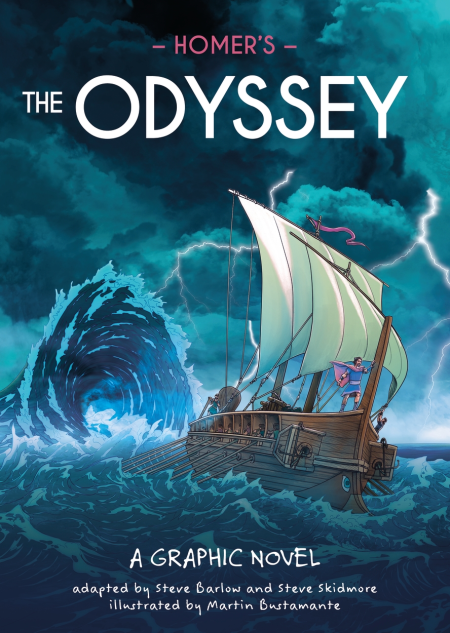
The Odyssey (Ancient Greek: Ὀδύσσεια, Odýsseia) is the second great epic poem attributed to Homer, after The Iliad.
Quick Facts
- Author: Traditionally Homer (though modern scholars debate if the same poet wrote both epics, or if they were composed by different poets in the oral tradition).
- Date: Composed around the late 8th century BCE (roughly 725–675 BCE).
- Form: Epic poem in dactylic hexameter, originally sung/performed orally.
- Length: 24 books (roughly 12,000 lines).
- Main Setting: Mediterranean world in the mythical heroic age after the Trojan War.
Core Story
The poem follows Odysseus (Latin: Ulysses), king of Ithaca, on his long and difficult journey home after the Trojan War.
While The Iliad is about war and glory, The Odyssey is about homecoming (nostos), cunning, loyalty, and survival.
Main Plot Threads:
- Odysseus’ Journey (Books 1–12)
- He has been gone for 10 years since the fall of Troy.
- He faces countless obstacles:
- Cyclops Polyphemus
- Witch-goddess Circe
- Sirens
- Scylla and Charybdis
- The god Poseidon’s wrath
- Calypso (who keeps him captive for 7 years)
- Famous for his cleverness (mētis) rather than just brute strength.
- The Situation in Ithaca (Books 1–4 & 13–24)
- His wife Penelope is pressured by 108 suitors who are eating her out of house and home, assuming Odysseus is dead.
- His son Telemachus (now a young man) sets out to find news of his father.
- The second half of the poem is the famous “revenge” section where Odysseus returns in disguise and slaughters the suitors.
Major Themes
- Cunning vs. Strength — Odysseus is the master trickster.
- Loyalty & Fidelity — Penelope’s faithfulness vs. the disloyalty of many others.
- Hospitality (Xenia) — How hosts treat guests (a major moral code in the poem).
- Fate vs. Free Will — The gods interfere, but human choices matter.
- Identity & Recognition — Odysseus constantly has to prove who he is.
Famous Episodes
- The Trojan Horse (mentioned in flashback)
- Polyphemus and “Nobody” trick
- Circe turning men into pigs
- Descent into the Underworld (Nekyia)
- The Sirens’ song
- Odysseus tied to the mast
- Penelope’s shroud trick
- The bow contest
- Slaughter of the suitors
Cultural Impact
The Odyssey is one of the foundational texts of Western literature. It has influenced:
- James Joyce (Ulysses)
- Dante
- Virgil (Aeneid)
- Modern works like O Brother, Where Art Thou?, The Penelopiad (Margaret Atwood), and countless films and books.