


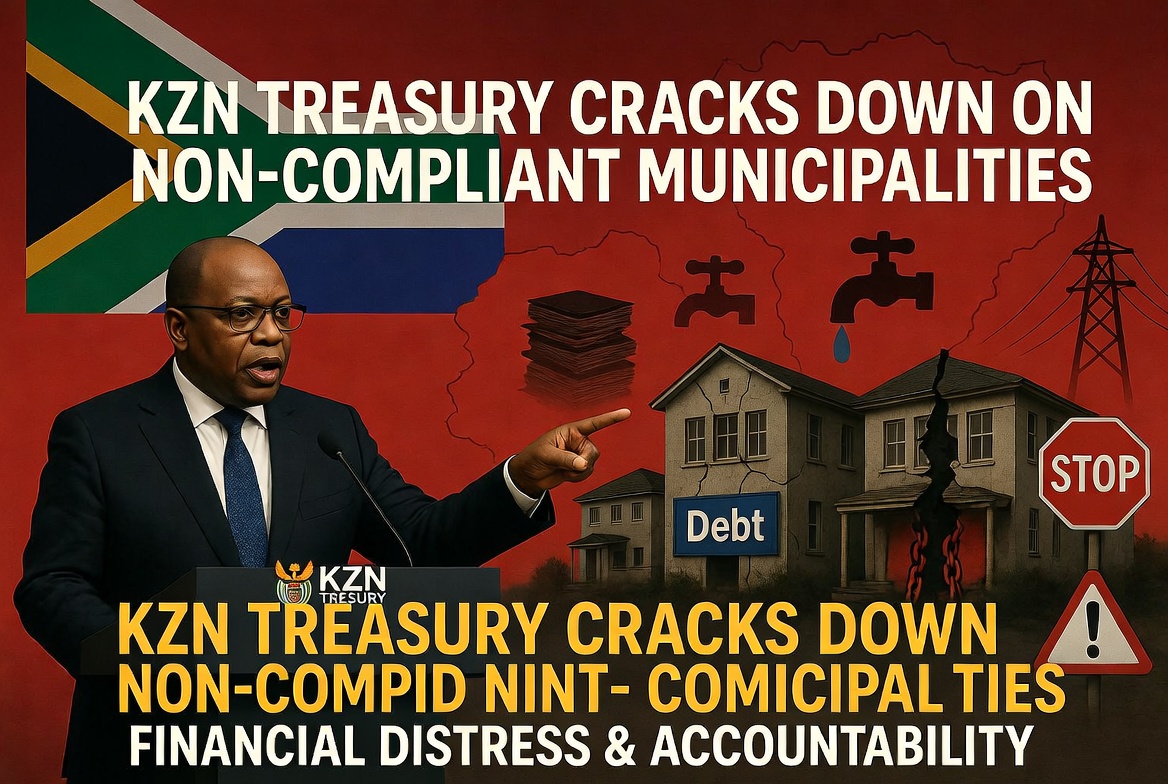
This reflects broader challenges in South African local government, where many municipalities struggle with debt, poor revenue collection, irregular expenditure, and service delivery failures.
Context and Background
South African municipalities operate under the Municipal Finance Management Act (MFMA), which mandates funded budgets, timely creditor payments (e.g., within 30 days), accurate reporting, debt management, and accountability for irregular, unauthorised, fruitless, and wasteful expenditure (UIFWE). Non-compliance often leads to poor audit outcomes, escalating debts to entities like Eskom and water boards, and deteriorating infrastructure and services.
In KZN, with 54 municipalities (including the eThekwini Metro), the situation has been particularly dire. Provincial Treasury reports highlight persistent issues:
- Financial distress: Around 20 municipalities flagged for “serious financial problems” as of early 2026, including uMuziwabantu, Ugu District, Mpofana, Msunduzi, Newcastle, and others. Many struggle with cash flow, where expenditures exceed available funds.
- Debts: Municipalities owe billions to Eskom (e.g., over R3.7 billion province-wide, with large portions over 90 days) and water boards (around R2.7 billion). Conversely, they are owed massive amounts by residents, businesses, and government (R74+ billion, much of it long overdue).
- Expenditure and performance: Low capital spending delays infrastructure projects. UIFWE has risen significantly (e.g., to R15.7 billion in one reported period).
- Governance: Issues include weak supply chain management (SCM), poor record-keeping, refusal of Treasury support, and lack of consequence management for misconduct.
These problems are not new but have intensified amid national fiscal constraints, post-COVID recovery challenges, load-shedding impacts (historically), and political fragmentation in some councils.
Specific Threats and “Non-Negotiables” from KZN Treasury
MEC Rodgers has been vocal, tabling quarterly performance reports and setting firm expectations:
- Suspension of funding: Consideration of invoking Section 216(2) of the Constitution to recommend to National Treasury (Minister Enoch Godongwana) stopping equitable share transfers or other allocations for persistent non-compliance. This has been discussed as early as mid-2025 for repeat offenders.
- Non-negotiables (outlined in May 2026): Credible funded budgets; strict credit control and debt management; full payment of creditors (especially Eskom/water boards within 30 days); accurate, timely reporting; consequence management (disciplinary/criminal action); improved procurement and contract management; stronger political oversight via Municipal Public Accounts Committees (MPACs).
- Interventions: Technical support teams, but withdrawal in cases of non-cooperation (e.g., uMkhanyakude). Redirecting provincial resources (e.g., MEC office savings) to anti-corruption and SCM support.
- Escalation: Referrals for Section 139 provincial administration in extreme cases, though political will is often lacking.
National Treasury has similarly withheld funds from dozens of municipalities countrywide for financial mismanagement.
Implications
Positive potential:
- Forces accountability and better governance.
- Protects the fiscus and could improve service delivery if compliance improves.
- Encourages revenue collection, accurate indigent registers, and ethical leadership.
Challenges and risks:
- Service delivery impact: Withholding funds could worsen water, electricity, sanitation, and infrastructure crises in already struggling areas, disproportionately affecting poor and rural communities.
- Legal pushback: Municipalities like Newcastle have threatened court action against funding freezes.
- Capacity gaps: Many municipalities lack skills, systems (e.g., mSCOA issues), or political stability. Punitive measures without support may fail.
- Data quality: Reports often rely on unaudited or unreliable data, complicating fair assessments.
- Political dimensions: Tensions between provincial oversight and local autonomy; varying party control (ANC, IFP, etc.) can influence cooperation.
Broader Nuances and Edge Cases
- Urban vs. Rural: Metro like eThekwini faces large-scale issues (e.g., capital project delays), while rural districts struggle with basic capacity and debt collection.
- Root causes: Corruption, cadre deployment, weak institutions, economic stagnation reducing revenue bases, and historical underinvestment.
- Success stories: Some municipalities show improvement in compliance (e.g., more signed statements of debt, asset management units), suggesting targeted support works.
- Citizen role: Treasury calls for active citizenry and political will—ratepayers must pay where able, communities should demand accountability.
- National context: Aligns with Auditor-General reports and MFMA compliance trends showing high irregular spending nationwide (hundreds of billions).
Related Considerations
Long-term fixes require structural reforms: professionalising administration, digitising systems, stronger anti-corruption enforcement, economic growth to boost revenues, and clearer delineation of roles between politicians and officials. Short-term, consistent monitoring, graduated interventions (support first, then sanctions), and transparent reporting are key.