

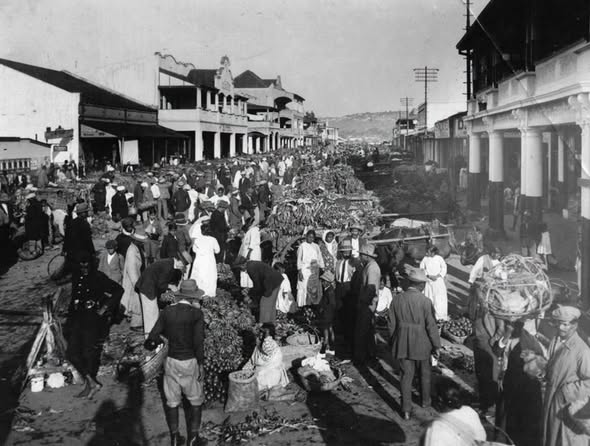
Yes, that’s an accurate historical detail about Durban’s iconic Victoria Street Market (also known as the Indian Market).
What Happened
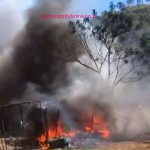
On the evening of Friday, 16 March 1973, a fire broke out around 8:45 pm at the original Indian Market on Victoria Street in Durban, South Africa. The blaze rapidly destroyed much of the market structure. Eyewitness and contemporary accounts describe dramatic scenes: fireworks (likely stocked by traders) exploding in all directions, and green flames flaring from melting copper as the roof collapsed by about 9:45 pm. Two-thirds of the stalls in the affected section (between Cemetery Lane and Queen Street) were gutted.
The market, which had roots in an open-air street trading area from before 1910 and a formal enclosed structure built by the Durban Town Council around that time, was a vibrant hub primarily serving the Indian community but attracting diverse traders and shoppers. It sold a wide variety of goods, including the fish and seafood section that gives it the “Fish Market” association in many references.
Arson Suspicions
Arson was indeed suspected but never conclusively proven. Local reports and trader lore point to suspicious circumstances, with some believing it was deliberate (possibly linked to economic or racial tensions under apartheid). One contemporary note mentions an Indian man appearing in court in connection with the fire. However, the official narrative often settled on a mentally unstable individual or accidental causes, without a definitive resolution or conviction that satisfied all involved.
This ambiguity has kept the event alive in local memory and oral histories, with many posts and accounts repeating the exact phrasing you used.
Immediate Aftermath and Rebuilding
- Impact: Hundreds of traders and workers faced sudden unemployment and hardship. Durban’s mayor at the time, Ron Williams, launched a relief fund.
- Temporary relocation: Traders moved to the Bulk Sales Hall next to the African Market until the early 1990s, creating an unplanned multicultural trading space that subtly challenged apartheid segregation.
- Reconstruction: The current Victoria Street Market building (with its distinctive purple Indian minarets, two storeys, and underground parking) was rebuilt on the original site and reopened in July 1990. It continues as a major tourist and local attraction in the Warwick Junction area, blending Indian, African, and other influences with spices, crafts, fresh produce, meat, and the fish market.
Broader Context
The fire occurred during apartheid, a time of significant tensions around Indian trading rights, public health regulations, racial zoning, and competition in Durban’s markets. The Victoria Street Market’s history reflects struggles between informal traders (many descendants of indentured laborers and market gardeners), the municipality, and broader societal pressures. Its evolution from a “squatters’ market” to a formal (but later destroyed and rebuilt) landmark highlights resilience and cultural blending.
Today, it’s part of Durban’s rich heritage, often called a “melting pot” of cultures. Similar suspicions of foul play have surrounded other historic market fires worldwide (e.g., certain incidents at New York’s Fulton Fish Market), where economic motives or records destruction are sometimes alleged, but proof remains elusive.