



Rossburgh Railway Station, located in Durban, KwaZulu-Natal, South Africa, originated as South Coast Junction and serves as a major historical and operational railway hub.
Early Origins and Construction (Late 19th Century)
The station formed part of the expansion of the Natal Government Railways (NGR) in the late 1800s, during a period of rapid railway development in colonial Natal tied to economic growth, port access, and inland connectivity. Durban’s railways began with the first line in South Africa connecting Durban to the Point in 1860. By the 1870s–1880s, networks extended further.
South Coast Junction (later Rossburgh) was established as a key junction for the main line toward Pietermaritzburg (inland/west) and the branch to the South Coast (south toward Isipingo and beyond). The first section of the Natal South Coast Line, a 7¼-mile branch from South Coast Junction to Isipingo, opened on 15 February 1882. This positioned the junction as a critical divergence point early in the network’s history.
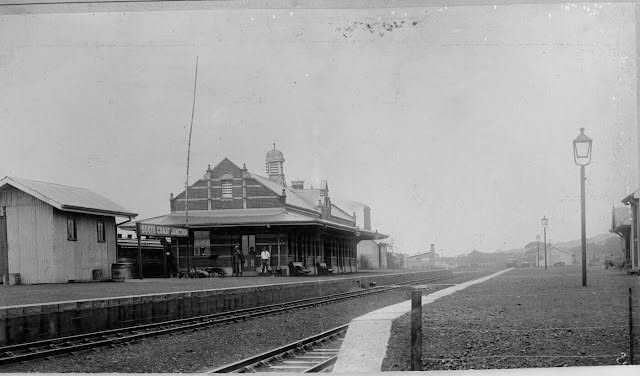
The station was constructed in the late 19th century. Historical images from around 1900 show it as South Coast Junction under NGR. It functioned not only as a passenger and goods stop but also as a depot and material storage area, with stacks of sleepers, rails, and other supplies.
Name Change and Early 20th-Century Developments
The junction was renamed Rossburgh at some point in the early 20th century (exact date varies in sources but post-1900). It underwent significant remodelling due to growing traffic. Improvements began as early as 1906 under NGR, with further alterations when the New Main Line (via Dellville Wood) was introduced around 1921. This shifted the primary divergence of westward (inland) and southbound tracks to nearby Booth (later Booth Junction), about half a mile south.
Rossburgh earned the nickname “Durban’s Germiston” because of its status as the busiest and most complex junction in the Durban area, handling multiple lines, goods yards, and commuter traffic. Its layout evolved repeatedly to manage increasing complexity, including connections to the Bayhead Goods Yard (completed in the 1950s) and later commuter lines like the one to Umlazi.
Mid-20th Century: Electrification, Grade Separations, and Modernization
- Electrification: The Old Main Line (OML) from Rossburgh to Cato Ridge (via Pinetown) was electrified later than some routes. Work started after the New Main Line’s electrification in 1936 but was interrupted by WWII; it resumed in the late 1950s and was energized around May 1959. This supported suburban and mainline services with electric motorcoach sets (e.g., 4M2, 5M2A) and locomotives like Class 1E and 5E1.
- Infrastructure Upgrades: Major grade-separation projects in the 1960s–1970s addressed at-grade crossings for quadruple tracks southward, improving safety and capacity amid growing commuter demand. Steam traction (e.g., Class 14R) persisted for some services, especially during overhead maintenance or diversions.
- Role in Operations: The station/junction supported passenger expresses (e.g., to Johannesburg or Cape Town, sometimes diverted via the OML), suburban services (to Pinetown, Botha’s Hill, etc.), goods traffic, and South Coast routes. It saw heavy use during disruptions, such as a 1970 fire in Dellville Wood tunnels that diverted trains.
Steam specials and commemorative runs, like the 1980 centenary of the Durban–Pietermaritzburg line, highlighted its historical importance, often using Garratts or other preserved power.
Architecture and Physical Evolution
Early structures reflected typical NGR Victorian/colonial railway architecture—functional with some decorative elements common to the era. Photos from ~1900 depict a modest but active junction station. Later remodellings focused on operational efficiency (signalling, tracks, platforms) rather than grand architecture, unlike some central Durban stations. A more modern refurbishment or rebuild occurred around 2009 as part of broader upgrades.
Nearby features included the Rossburgh Hotel (a local landmark) and integration with Durban’s expanding suburbs like Queensburgh.
Later 20th–21st Century Context and Current Role
Post-apartheid, Rossburgh continued as a vital node in Durban’s Metro Rail network, serving commuters to areas like Umlazi, Pinetown, and the South Coast. Challenges included declining passenger numbers in some periods, infrastructure maintenance, and competition from road transport, but it remains operational with modern electric trains.
Upgrades, such as those tied to the 2010 FIFA World Cup preparations, improved stations and rolling stock along corridors including Rossburgh. It supports both legacy freight/passenger functions and urban mobility in eThekwini Municipality.
Broader Historical and Cultural Significance
- Economic Impact: Rossburgh exemplified how railways drove Natal’s (and South Africa’s) industrialization, linking the Port of Durban to hinterlands for sugar, minerals, timber, and goods. Junctions like this facilitated trade and urbanization.
- Heritage Value: As part of South Africa’s early railway network, it connects to the pioneering era of steam and colonial expansion. Groups like the Railway Society of Southern Africa (RSSA) and sites like Soul of A Railway document its operations with photos and histories, preserving stories of locomotives, staff, and passengers.
- Social Nuances: It served diverse communities—commuters from townships, goods workers, and tourists. Local memories include nearby pubs, hotels, and daily life around the station.
- Edge Cases and Challenges: Frequent remodelling reflects the tension between historical infrastructure and modern demands (e.g., electrification, grade separations, safety). Declines in rail usage in South Africa have affected many stations, but junctions like Rossburgh retain resilience due to their strategic location.