






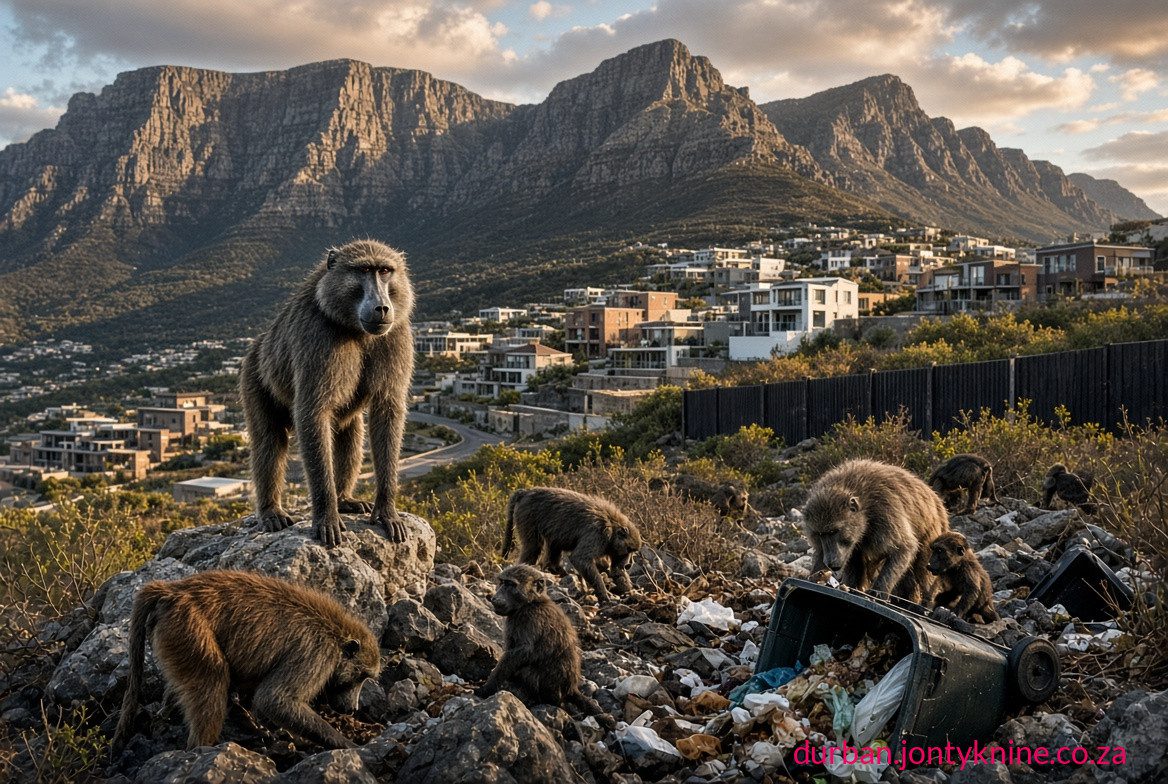
The baboon “problem” (often described as a crisis or escalating conflict rather than a literal epidemic) in the Western Cape centres on the Cape Peninsula near Cape Town, where chacma baboons (Papio ursinus) and expanding human settlements overlap intensively. It involves frequent troop raids into suburbs, property damage, risks to people/pets, high human-caused baboon mortality, and deep disagreements over management. Similar but generally less intense issues occur in other Western Cape areas such as the Overstrand (Hermanus, Pringle Bay, Betty’s Bay, Gordon’s Bay).
Background and Scale of the Problem
Chacma baboons are indigenous to the Cape Peninsula and have lived there for a very long time (genetic evidence suggests nearly 2 million years in the broader region). They prefer low-lying, productive foraging areas and higher ground (cliffs, trees, caves) for roosting. Urban expansion, agriculture (including vineyards), and development have converted much of the preferred low-lying habitat into residential, commercial, and farming land. Cape Town’s population grew substantially (roughly 65% from 2001–2022 to around 4.8 million), while the peninsula baboon population roughly doubled from about 360 animals in ~10 troops around 2000 to over 600 in 16–17 troops by 2024.
Without significant natural predators on the peninsula, numbers grew under earlier monitoring programmes. Troops increasingly entered urban areas for high-calorie human food (refuse, gardens, fruit trees, intentional feeding). This produces:
- Raids and damage: Baboons enter homes, gardens, and businesses; smash windows; raid bins; and cause property damage and mess. Residents report stress, fear (especially for children or pets), and lifestyle impacts.
- Baboon welfare harms: High rates of human-induced deaths and injuries from vehicles, dogs, electrocution on power lines, shooting/poisoning (illegal or otherwise), drowning in pools, and falls. Urban-related deaths rose sharply in recent years (e.g., 33 in 2024 in one report; proportions of urban-caused mortality climbing, with some years seeing the majority of deaths from human sources). Habituation to people leads to poorer health from junk-food diets, behavioural changes, and higher disease risks.
- Social conflict: Polarisation between residents demanding stronger action to keep baboons out and activists/welfare groups prioritising coexistence, non-lethal methods, and criticising removals or euthanasia. Protests, confrontations (including pepper-spray incidents), and legal challenges have occurred.
Earlier management (from the late 1990s/2000s onward) used monitors/rangers with aversive tools (paintballs, noise devices/“bear bangers,” herding), education, and some baboon-proof bins. Population growth was initially seen as a success, but costs rose, tools became less effective as animals habituated, and conflict intensified—especially after disruptions around 2020. Authorities described the situation as “untenable” or a “wicked problem.”
The core drivers are competition for the same preferred low-lying land, easy access to human food attractants, and the practical difficulties of managing highly intelligent, adaptable primates in a fragmented landscape.
Current Management Approach (Cape Peninsula)
A joint task team of SANParks, CapeNature, and the City of Cape Town developed a Cape Peninsula Baboon Strategic Management Plan (finalised around 2023) and a more detailed Final Action Plan (adopted late 2025, with implementation rolling out in 2026). The Cape Baboon Partnership (involving Shark Spotters) handles much of the operational side (rangers, hotline, education).
Key elements include:
- Hard boundaries and exclusion: Northern baboon-proof/electrified fencing (e.g., from Zwaanswyk toward Constantia Nek, with private landowner involvement in places) to keep troops in natural areas and out of urban/farmland zones. Existing successful fences (e.g., Zwaanswyk) serve as models. Power lines may be adjusted underground in places.
- Waste management: Roll-out of thousands of lockable baboon-proof bins (first ~2,200 of a planned 6,000 starting mid-September 2026 in priority areas such as parts of Scarborough, Tokai, Da Gama, Capri, etc.). Enforcement of bylaws on waste and attracting animals.
- Troop removals/relocations: Highly urban-habituated troops that respond poorly to non-lethal deterrents are targeted. Seaforth and Waterfall troops (Simon’s Town area, roughly 50–60 animals combined) are planned for capture, health assessment, male vasectomies, and relocation to a purpose-built sanctuary (trial enclosures on private land near Plateau Road; initially ~1.5 ha, potentially expanded). CT1 and CT2 (Constantia area) are to be moved to the mountain side of the northern fence, with euthanasia for persistent returnees (except dispersing males). Other urban-frequenting groups (e.g., in Gordon’s Bay) have faced similar relocation proposals.
- Population caps: Northern subpopulation max ~250; southern (excluding deep Cape Point troops) max ~175. Exceeding limits for more than six months can trigger reductions via humane euthanasia prioritising chronically ill, injured, or very old animals. Contraception and genetic enrichment are under study. Overall managed population goals aim well below recent peaks while retaining a viable free-ranging presence (Cape Point troops largely left alone).
- Ongoing tools and welfare: Rangers continue where needed, but with reduced long-term reliance on aversive conditioning. Health monitoring, SPCA protocols for suffering animals, education, and community liaison. Infrequent individual or dispersing-male access is treated as more tolerable than regular troop raids.
- Legal/regulatory: New or strengthened urban wildlife bylaws with stronger enforcement against harming baboons or attracting them. Management remains subject to permits, environmental approvals, and ongoing legal challenges from welfare groups.
The plan frames itself as balancing baboon welfare/conservation with resident safety and property rights by prioritising natural-area residency and minimising urban overlap. Implementation costs involve significant fencing, sanctuary infrastructure, and bins (tens of millions of rand referenced in coverage).
Controversies and Differing Perspectives
- Authorities and many affected residents: Argue that prolonged urban living is bad for baboon health and welfare (junk food, high injury/death rates, stress), unsustainable for management budgets, and unfair to people. Hard boundaries + targeted removals are seen as the realistic path to lower conflict. Some view certain troops as no longer “wild.”
- Animal welfare activists, some researchers, and coexistence advocates: Criticise removals and sanctuary life (limited space, no breeding, potential future euthanasia if the facility fails) as effectively a delayed cull or captivity. They argue the root causes are inadequate waste control, human behaviour (feeding, poor securing of properties), and insufficient investment in proven fencing/education. They point to successful coexistence examples elsewhere and historical mismanagement/bureaucracy. Legal challenges and public pressure continue.
- Broader context: Similar tensions appear in Overstrand Municipality areas, with strategic plans, shepherding/aversive tools, and disputes over specific incidents or tools (gel blasters, etc.). National issues with baboons (shooting, poisoning, habitat loss) exist outside the Cape, but the peninsula’s density of people + protected natural areas makes it uniquely intense.
Broader Implications and Outlook
This is a classic human-wildlife conflict case study: intelligent, long-lived animals with high behavioural flexibility meeting rapid urbanisation in a biodiversity hotspot (fynbos, Table Mountain National Park). Solutions involve trade-offs—complete laissez-faire risks more suffering and backlash; heavy lethal control is ethically and legally fraught and can backfire; pure coexistence requires consistent human behaviour change that has proven difficult at scale.
As of late 2026, practical steps (bin roll-outs, fence preparations, sanctuary timelines) are underway, but outcomes depend on implementation quality, funding, compliance, legal processes, and whether fences + waste control sufficiently reduce attractants. Population trends, mortality rates, and resident reports will be key indicators. The situation also raises questions about genetic isolation of the peninsula population, long-term carrying capacity of remaining natural habitat, and whether similar pressures will intensify elsewhere in the Western Cape with further development.
For the most current local details, check official sources such as the City of Cape Town, CapeNature, SANParks, or baboons.org.za (associated with operational partners), as well as recent reporting. Residents in affected areas are often encouraged to use hotlines, join community groups, and secure properties/bins.