




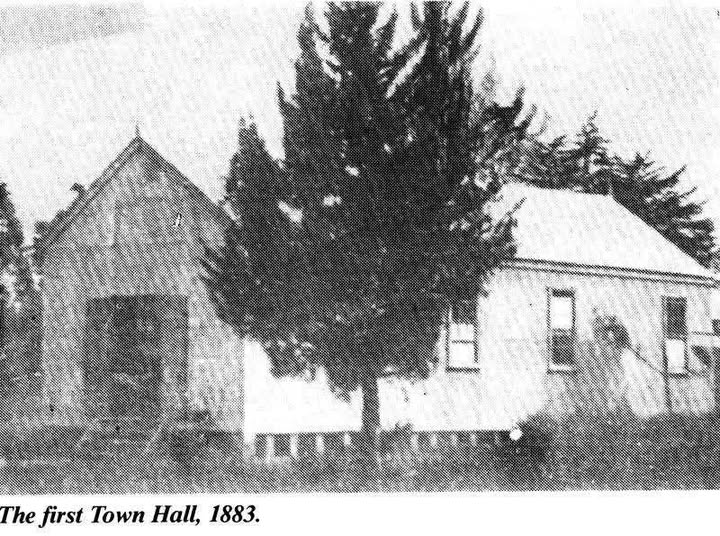
Pinetown’s first Town Hall, built in 1883, was a modest wood-and-iron (or corrugated iron) structure typical of early colonial buildings in Natal, South Africa.
Pinetown (now part of eThekwini Metropolitan Municipality, KwaZulu-Natal) developed in the mid-19th century along the main route between Durban and Pietermaritzburg. Named after Sir Benjamin Pine, it served as a health resort and settlement area in the Victorian era.
Description and Location
Historical photographs depict a simple, functional single-story building with a pitched/gabled roof, white-painted walls, multiple windows, and a veranda or steps. A large tree often appears prominently in front, with an adjacent smaller outbuilding or shed. It had a practical, utilitarian design common for early public structures in growing colonial towns—likely constructed with timber framing and iron cladding for durability in the subtropical climate.
It stood at the corner of Old Main Road (now Josiah Gumede Road) and St John’s Avenue (or nearby Crompton Street area), where a Kia showroom or related developments later stood. Another reference places a later library or municipal functions at the corner of Crompton and Old Main Road.
Functions and Historical Context
The building served multiple community roles, as was common for early town halls:
- Municipal governance: Meetings, administration, and local government functions in a rapidly developing settlement.
- Public library: In 1883, the library was housed in this Pinetown Hall (a wood-and-iron building on the St. John’s corner). It had earlier used other spaces like the village hall.
- Community and cultural use: Likely an auditorium or hall for events, meetings, or even early screenings/movies, reflecting its role as a social hub.
One comment in historical discussions notes it later became associated with the first Methodist Church or its Sunday school.
Broader Context and Legacy
Pinetown grew from a wayside hotel settlement (Wayside Hotel, 1849) into an industrial and residential area. Early public buildings like this Town Hall were essential for civic identity before more permanent structures emerged. Many such wood-and-iron buildings were temporary or adaptable; this one was eventually replaced as the town modernized.
Nuances and edge cases: Exact construction details (e.g., architect, cost) are sparse in public records, as is typical for smaller 19th-century colonial outposts. References often come from local history groups, museums (e.g., Pinetown Museum), or brochures rather than grand archives. A 1995 Pinetown Museum publication or brochure is cited in related discussions. Later civic buildings in the area adopted more substantial materials.
Today, the site reflects urban development—commercial properties have overtaken the original location. Pinetown’s heritage is preserved through local historical societies, Facebook groups (e.g., Durban History and Stories), and references in books on Natal/KZN architecture.