

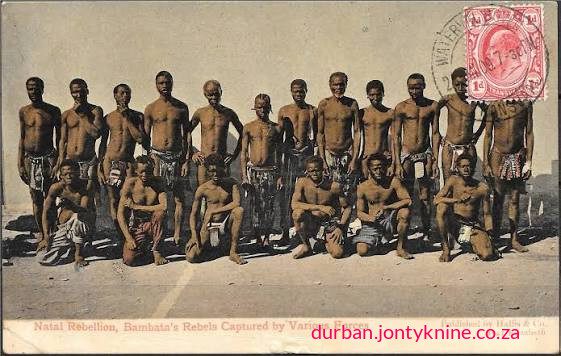
1906 Prisoner of War Wall Last week we wrote about the old Durban Central Prison boundary wall, and this week’s our focus is on another wall and another prison. Located at Addington Beach on the Point is a Prisoner of War wall that was built by men captured during the Bhambatha Rebellion of 1906. In the years following the Anglo-Boer War employers … Read more
The post The Bhambatha Rebellion appeared first on The Ulwazi Programme.
The Bhambatha Rebellion (also known as the Bambatha Rebellion, Zulu Rebellion, or impi yamakhanda — “war of the heads”) was a 1906 armed uprising in the British colony of Natal (modern KwaZulu-Natal, South Africa) against colonial rule, primarily sparked by a new poll tax. It was led by Zulu chief Bhambatha (Bambatha) kaMancinza of the amaZondi (or Zondi) people and represents one of the last major acts of armed African resistance to colonial authority in South Africa before the formation of the Union of South Africa in 1910.
Background and Causes
The rebellion occurred against a backdrop of deepening colonial control, economic hardship, and social disruption following the Anglo-Zulu War (1879) and the annexation of Zululand by Natal in 1887. Zulu people had lost much of their arable land to white settlers (British and Afrikaner), leading to overcrowding on reserves, tenancy on white-owned farms under often harsh conditions, and disruption of traditional livelihoods. An 1896–1897 rinderpest epidemic had devastated cattle herds (killing up to 90% in some areas), compounding poverty. The aftermath of the South African War (Anglo-Boer War, 1899–1902) brought a severe economic depression to Natal, straining the colony’s finances.
In this context, the Natal colonial government under Premier Charles Smythe introduced a poll tax (or head tax) of £1 on all adult males over 18 who were not already paying the existing hut tax. This was highly regressive, disproportionately burdening poorer African households, and was explicitly intended to push more African men into the wage-labour market (mines and farms) by creating a need for cash. Collection began in early 1906 and met widespread resentment. Other grievances included compulsory registration of births and deaths, the 1904 census (viewed with suspicion), land alienation, and general colonial arrogance and police violence.
Resistance began with non-violent protests and refusals to pay at tax stations, but escalated after early clashes, including the killing of two police officers in February 1906. Martial law was declared. Bhambatha, already known among local whites as “Bellicose Bambatha” for prior disputes (including debt, cattle issues, and faction fighting), became a focal point. He had been deposed as chief by the authorities and replaced by his uncle Magwababa; upon returning from consulting the influential Zulu leader Dinuzulu (Dinuzulu kaCetshwayo), he found his position lost and launched armed resistance.
Historians note multiple layers of causation. Material and political factors (tax burden, land loss, economic crisis) were central, but some scholarship also highlights spiritual and cultural dimensions: fears that the census and tax represented further colonial power over people, beliefs about ancestral displeasure, and expectations of supernatural support for resistance. Not all Zulu participated; many chiefs remained loyal or neutral, and rebels were not always a representative cross-section of the population (some analyses suggest they formed a minority within the Zondi, with mixed ages and some coercion involved).
Key Figures
- Bhambatha (Bambatha/Bambata) kaMancinza (c. 1865–1906?): Chief of a branch of the amaZondi in the Mpanza Valley near Greytown. He claimed (disputed) sanction or encouragement from Dinuzulu. Colonial accounts portrayed him as a troublesome local leader whose personal grievances (deposition) drove the revolt more than pure anti-tax principle; Zulu oral tradition and later nationalist memory elevated him as a resistance hero. Official sources claimed he was killed at Mome Gorge; many Zulu believed he escaped to Mozambique.
- Dinuzulu kaCetshwayo: Former Zulu king and influential figure in Zululand. He was accused of complicity (rebels used his war-cry “Usuthu”), tried, and sentenced to imprisonment; he denied directing the rising. His ambiguous role remains debated.
- Sigananda: Aged chief of the Chube (Cube) people in the Nkandla area who joined the rebels, providing a base in the forests.
- Colonial commanders, notably Colonel Duncan McKenzie, led the militia forces that ultimately crushed the uprising. Other participants included various Zulu chiefs and young warriors on the rebel side, and Natal militia, police, and some Transvaal reinforcements on the colonial side. Mahatma Gandhi, then in South Africa, initially supported the colonial side by organising an Indian stretcher-bearer unit but later reflected critically on the events as a “man hunt.”
Course of Events
The uprising unfolded in phases:
- Early 1906: Tax protests and isolated violence (including deaths of police and some settlers). Bhambatha fled to Dinuzulu, returned, and found himself deposed.
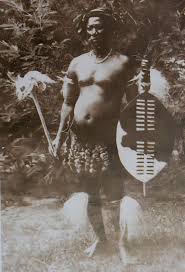
- April 1906 onward (main phase in the middle Thukela/Nkandla region): Bhambatha gathered supporters, ambushed a police party at Mpanza (killing several), and conducted guerrilla operations from the Nkandla forest, joined by Sigananda and others. Rebels used traditional weapons (spears, shields) against modern firearms, artillery, and Maxim guns. They achieved some local successes but could not unite larger forces effectively.
- Climax at the Battle of Mome Gorge (10 June 1906): Colonial forces under McKenzie surrounded and attacked the rebels at dawn, inflicting heavy casualties in what contemporary and later accounts describe as a massacre. Bhambatha was reported killed (his head was cut off for identification and displayed, an act that drew criticism even in Britain). Organised resistance largely collapsed thereafter, with further suppression in the Maphumulo area.
By mid-to-late 1906 the rebellion was over. Martial law and harsh measures (imprisonment, flogging, destruction of homesteads) enforced compliance; by 1907 the tax was collected without major protest.
Outcomes and Casualties
Estimates vary slightly by source, but roughly 3,000–4,000 Zulu were killed, more than 7,000 imprisoned, and around 4,000 flogged. Colonial/military deaths numbered about 30–36. The cost to the Natal government was substantial (around £740,000–£883,000, equivalent to tens of millions in modern terms). Tens of thousands of homesteads were destroyed. Dinuzulu and others faced trial and punishment.
The brutal suppression reinforced white settler solidarity and fears of African resistance, contributing to support for closer union of the South African colonies to secure white supremacy. The Union of South Africa followed in 1910. For Africans, the defeat underscored the overwhelming technological and organisational superiority of colonial forces but also planted seeds of organised political resistance.
Historical Significance and Legacy
The rebellion is remembered as the last major armed Zulu challenge to colonial rule before Union. It inspired later generations of South African resistance fighters. Nelson Mandela referenced it (alongside Isandlwana) as an example of proud refusal to submit, and it featured in anti-apartheid narratives. In 2006, the centenary was commemorated; Bhambatha was posthumously honoured (including the Order of Mendi for Bravery). It is also linked, in some accounts, to the broader context that helped motivate the formation of the South African Native National Congress (later ANC) in 1912, as African leaders sought more effective, non-military forms of organisation after the crushing of armed revolt.
Nuances and debates persist: the relative weight of the poll tax versus longer-term grievances and Bhambatha’s personal circumstances; the exact extent of Dinuzulu’s involvement; whether Bhambatha died at Mome or escaped; the degree of popular support versus coercion or factional dynamics; and the spiritual dimensions of resistance. Contemporary British critics (including a young Winston Churchill, who called Natal “the hooligan of the Empire”) condemned the severity of the repression, while colonial defenders justified it as necessary to maintain order.
In short, the Bhambatha Rebellion was both a specific response to an immediate fiscal imposition amid crisis and a symptom of deeper structural conflicts over land, labour, authority, and dignity under colonial rule. Its military failure was decisive, yet its symbolic power as an act of defiance endured and was later reclaimed in the struggle against apartheid. Spelling of the chief’s name varies across sources (Bambatha, Bhambatha, Bambata, etc.), reflecting different orthographic conventions.