


The demand comes from South Africa First Forum, described as the legal arm of March and March. It was launched in early August 2026 by Jacinta Ngobese-Zuma, the movement’s founder and leader (a former Vuma FM radio presenter based in Durban). This marks the group’s first notable use of formal legal correspondence since its establishment.
Key points from the letter and related developments
The letter highlights foreign nationals residing (and continuing to reside) on Che Guevara Road. It claims this has harmed local businesses through reduced sales and closures, while also driving up crime, including daily robberies of ordinary citizens. The group calls on the municipality to enforce its bylaws by removing the foreign nationals within 14 days and urges relevant government departments to engage the governments of the individuals’ countries of origin so that repatriation occurs at those governments’ expense.
March and March states that the foreign nationals—whether present legally or illegally—remain human beings whose rights must be protected. It suggests that genuine refugees should be moved to refugee camps so that South African citizens can “walk freely in their country.” The letter also addresses broader homelessness in Durban’s CBD and open spaces, arguing that it strips people of dignity, undermines community integration and self-sufficiency, and conflicts with the Constitution’s preamble on improving citizens’ quality of life and unlocking potential. It notes eThekwini’s status as a tourist destination that needs to maintain appearance and attractiveness for investment and jobs.
Municipal response and context of recent clashes
eThekwini mayoral spokesperson Mluleki Mntungwa responded that the demands were misplaced because immigration falls under the national Department of Home Affairs. He said people in the area had undergone verification, none were found to be in the country illegally, and they had been offered the choice of reintegrating into communities or going to the Lindela repatriation centre—but had not chosen either option.
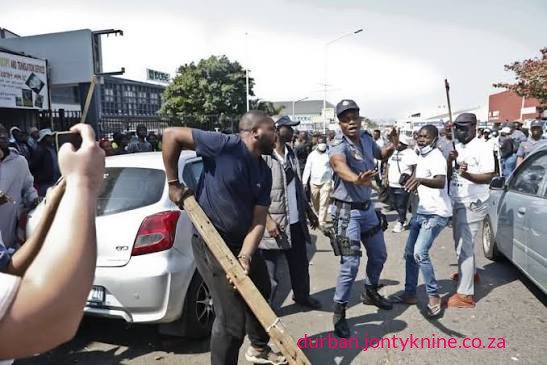
The ultimatum follows a violent confrontation the previous week. March and March members conducted what they described as a “clean-up” operation targeting foreign nationals (mainly documented refugees and asylum seekers from countries such as the DRC, Burundi, and Rwanda) living in makeshift conditions on the sidewalks outside the Home Affairs Refugee Reception Office. Tensions escalated into clashes involving thrown objects; a foreign national was arrested after a police officer was struck with a rock. Police used stun grenades, tear gas, and rubber bullets to restore order. The group had indicated plans to return to the site.
Che Guevara Road has a longer history of issues with informal settlements, vagrancy, substance use, and crime under the M4 freeway bridge and nearby areas. Municipal clean-up operations have occurred repeatedly (including earlier in 2026), often with temporary results as people return. Businesses and residents have complained about safety, traffic obstruction, and the area’s impact on the city’s image.
Broader background on March and March
Founded around March 2024–2025 and led by Ngobese-Zuma, the movement campaigns for prioritising South African citizens in access to jobs, public services (healthcare, education, housing), and security; stronger border control; consistent enforcement of immigration laws; and action against undocumented or illegal presence. It uses the slogan Abahambe (“They must go”) and has organised marches, protests, and campaigns nationwide, including a symbolic 30 June 2026 deadline that drew significant attention and a presidential response. It claims tens of thousands of supporters and presents itself as a non-xenophobic, law-and-order civic effort focused on illegal immigration rather than legal migrants.
Critics and reporting (including from outlets such as Daily Maverick and GroundUp) have linked it to broader anti-immigrant sentiment, noted associations or parallels with groups like Operation Dudula, documented instances of violence or intimidation at related protests (including property damage, assaults, and at least some fatalities in copycat or parallel actions), and questioned claims about crime rates or resource impacts. The movement has also faced scrutiny over funding, leadership ties, and whether its actions cross into xenophobia or Afrophobia. Supporters view it as a legitimate response to real pressures on public services, unemployment, and crime in a country with high inequality and governance challenges.
Implications and nuances
This legal step represents an evolution from street protests and “clean-ups” toward formal pressure on local government, potentially setting up further court or administrative action if the 14-day window passes without satisfactory response. Immigration enforcement in South Africa is primarily a national competence (Home Affairs), while municipalities handle bylaws on public space, homelessness, and local order—creating jurisdictional friction visible in the city’s reply. Human rights considerations (refugee protections, non-refoulement principles, and constitutional rights) intersect with practical concerns about overcrowding of public spaces, business impacts, and public safety. Similar tensions around informal settlements, refugee reception centres, and urban management appear in other South African cities and reflect wider debates on migration, service delivery, and social cohesion.
The situation remains fluid: verification processes, offers of alternatives (reintegration or Lindela), ongoing municipal homelessness efforts (including planned shelters), and potential further mobilisation by March and March or counter-groups will shape outcomes. Official responses emphasise legal status verification and existing processes rather than wholesale local-level repatriation.