




primarily between 13 and 15 January 1949. Black South Africans (largely Zulu) targeted Indian South Africans, resulting in significant loss of life, widespread destruction, and long-term communal trauma. It is often described as one of the deadliest episodes of racial violence during the apartheid era (second only to another major massacre).
Background and Causes
Durban in the late 1940s had a complex racial and economic landscape under segregationist policies. Indians (many descended from indentured laborers brought in the 19th century) had established a significant commercial presence, particularly in trading and small businesses serving African customers. Africans faced severe restrictions: inability to own property in urban areas, poor housing in shantytowns (like Cato Manor), low wages, and frustration from rapid urbanization and post-WWII economic pressures.
Underlying tensions included:
- Economic competition and grievances: Allegations of Indian “black-marketeering,” high rents (“shacketeering”), and perceived snobbery or humiliation of Africans by some Indians.
- Broader racial hierarchy under white rule, which positioned Indians somewhat above Africans in certain economic spheres while both groups suffered under discriminatory laws.
- Political context: Recent Indian independence (1947) and international attention to racial issues raised expectations and anxieties. Anti-Indian sentiment had been stoked in some African political circles.
Analyses emphasize that while a specific incident sparked the violence, it channeled deep frustrations from poverty, urbanization, and the broader system of white domination. It was not primarily a spontaneous “race riot” between equals but a one-sided pogrom against a vulnerable minority, with some evidence of organization among African groups and passive or active encouragement from some whites.
The Spark and Timeline
Thursday, 13 January 1949 (Initial Clashes): The riots began in the afternoon/evening in Durban’s Indian commercial heartland around Victoria Street and Grey Street. A commonplace altercation occurred when an Indian shopkeeper (Harilal Basanth or similar accounts name a shop assistant) assaulted a 14-year-old African youth (George Madondo) over a cigarette or minor dispute, reportedly pushing him through a glass window. News of the incident spread rapidly among Africans, leading to attacks on individual Indians, stoning of Indian vehicles, and looting of stores. Crowds chanted slogans like “Usuthu!” (a Zulu rallying cry). Violence was initially limited but involved some organization within Zulu communities. Police intervention was slow, and the unrest subsided somewhat after a few hours with rain helping to disperse crowds.
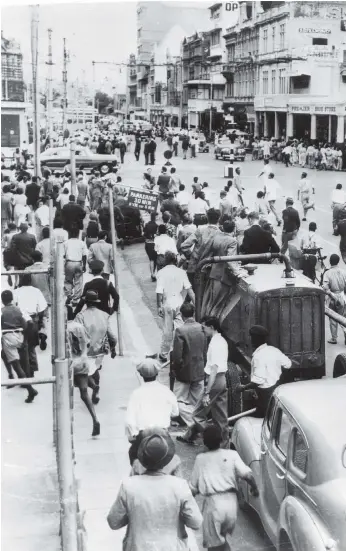
Friday, 14 January 1949 (Peak Violence): This was the most intense day. African leaders and groups from areas like Cato Manor organized rioters from worker hostels, ingoma dancing troupes, and boxing clubs. Large crowds (“hordes” or “impis”) armed with improvised weapons (sticks, stones, knives, etc.) swept through the Indian business district in a “human cyclone.” Looting and destruction escalated, with Europeans reportedly cheering, inciting attackers, or joining in the looting in some cases.
Violence spread to suburban and peri-urban areas like Cato Manor, Clairwood, Jacobs, Overport, and Stamford Hill. Rioters attacked homes, shops, and people: burning buildings (often using paraffin), looting, murder, rape of Indian women and girls, and killings of Indians of all ages. Many poorer Indians living alongside Africans in mixed shantytowns were hit hardest. Indian retaliation occurred sporadically (some armed Indians fired back), but Indians were largely on the defensive. Police and later military forces eventually intervened more forcefully, using firearms that killed additional rioters. By evening and night, the situation was chaotic, with refugees fleeing and fires widespread.
Saturday, 15 January 1949 and Aftermath: Order was largely restored by military and police reinforcements, though isolated incidents continued, including some in Pietermaritzburg. Some reports noted later Indian reprisals against Africans.
Casualties and Damage
Official figures:
- Deaths: 142 (87 Africans, 50 Indians, 1 European/white, 4 unidentified). Some of the injured later died.
- Injured: 1,087 (541 Africans, 503 Indians, 11 Coloureds, 32 whites).
- Property: Hundreds of buildings destroyed (e.g., 1 factory, 58 stores, 247 dwellings) and thousands damaged (2 factories, 652 stores, 1,285 dwellings). Looting was rampant.
Around 40,000 Indians became temporary refugees, many fleeing to camps or safer areas. This displacement devastated communities, leading to economic ruin, family breakdowns, and a wave of suicides among Indians due to trauma, loss, and humiliation.
Official Response and Inquiry
The Smuts government (pre-National Party consolidation) deployed police and troops. A Riots Inquiry Commission was established, but it was criticized for lacking Indian or African members, restricting cross-examination, and producing a report seen as superficial or biased toward excusing systemic issues while blaming “frustration” without deep structural analysis. It failed to satisfy calls for accountability or reconciliation.
Long-Term Impact
- Communal Relations: Deepened distrust between African and Indian communities in Natal/Durban for generations. It became part of collective memory and mythology on both sides—Indians recalling victimhood and trauma, some African narratives framing it as resistance or economic assertion. It hindered early non-European unity efforts but also highlighted the need for alliances (influencing later ANC-Indian Congress cooperation).
- Political: Weakened some moderate leadership and boosted more assertive African politics. It exposed failures of segregation and contributed to debates on race relations ahead of full apartheid implementation.
- Social/Economic: Destroyed Indian businesses and presence in some mixed areas. Many Africans faced backlash, reinforcing stereotypes and justifying tighter controls.
The 1949 Durban Riots remain a stark example of how colonial-era divisions, economic pressures, and weak governance could ignite devastating communal violence. Historians view it as rooted more in systemic frustrations than inevitable racial hatred, though its scars influenced South African politics and society for decades.