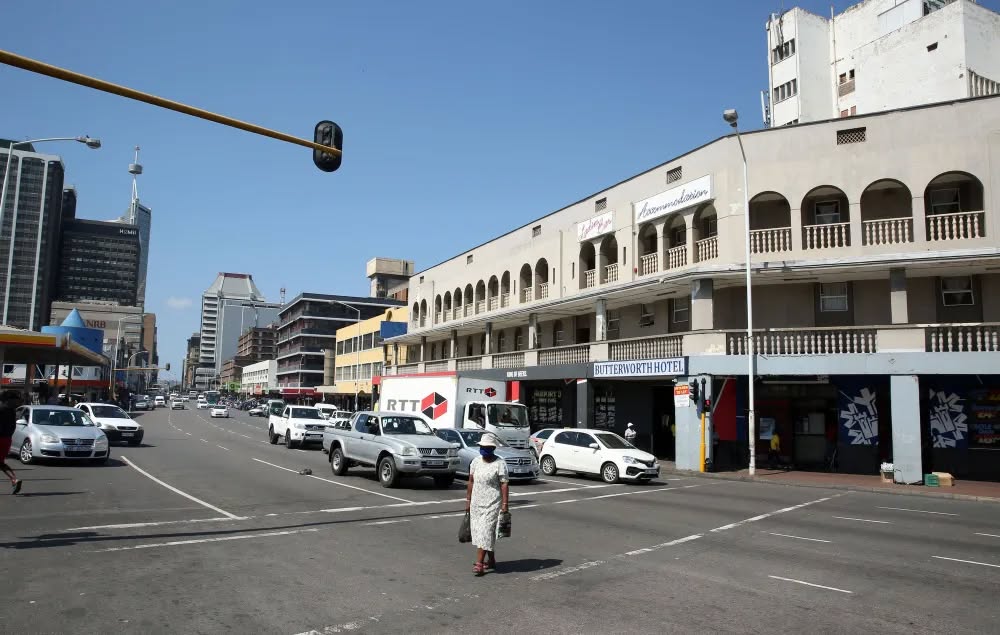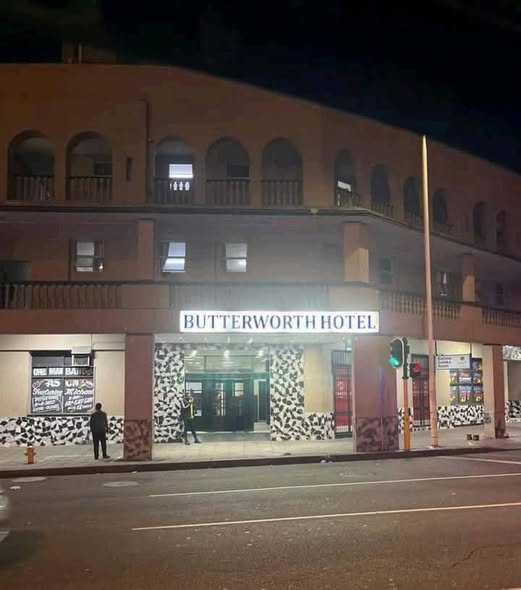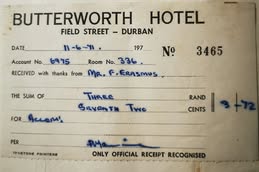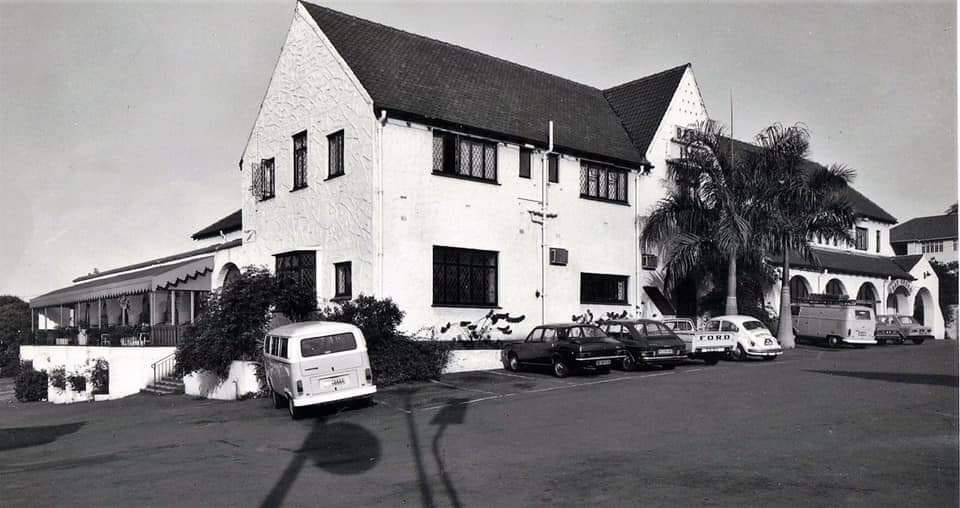



Butterworth’s Hotel (also referred to as Butterworth Hotel) in Durban is a long-standing private hotel in the city’s central business district, originally built in the late 1890s on the corner of what is now Joe Slovo Street (formerly Field Street) and Soldier’s Way, around the same time as the Durban railway station.
It was promoted in early advertisements as one of the finest private hotels in South Africa. Features highlighted included about 70 bedrooms; spacious reading, writing, commercial, billiard, and sitting rooms; electric lighting and cooking; excellent cuisine; and “trained servants.” It operated under the personal supervision of Mrs Butterworth. Local historian Gerald Buttigieg has described it as a notable establishment in its era. A National Archives of South Africa postcard depicts the Ladies Sitting Room, underscoring its early 20th-century amenities and social spaces.
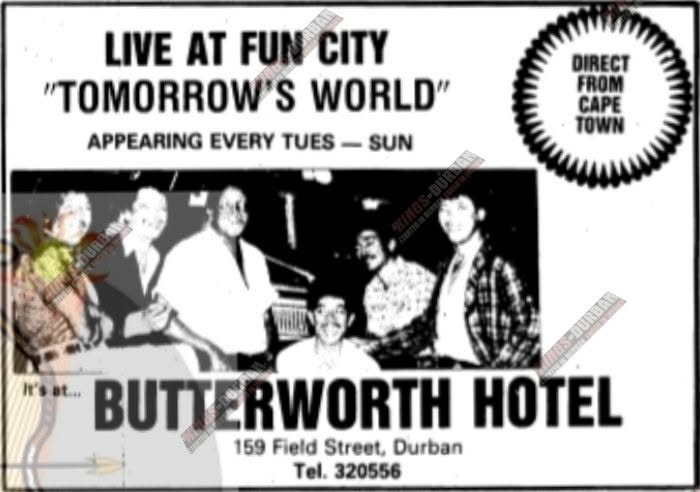
In its mid-20th-century heyday (especially the 1960s and 1970s, when it was owned by George Kahn), the hotel was a popular venue for dining, entertainment, and functions. Amenities and venues associated with it included:
- The nightclub Le Macabre, notable for coffin-shaped tables and resident band the Bats.
- The Caprice, an à la carte restaurant remembered by some patrons as among the best in town (e.g., a mid-1960s engagement celebration meal with multiple courses, wine, and a cigar for around R10, served with silver, lace tablecloths, and quality crockery).
- The Magnolia Room for functions and wedding receptions.
- The Ming Chou Chinese restaurant.
- Durban’s first official steakhouse (with hand-painted murals recalled by at least one local family).
- A ballroom featuring what some described as the city’s first sprung dance floor, with carpets printed with orchid designs.
- Later, the bar hosted Durban’s first legal strip joint, with performer Glenda Kemp and her python named Oupa (who also did a fire-eating act).
A 1965 Durban directory listed room rates of roughly R1.20 per day for a single (R1.30 with bath) or R1.05 per person for a double (R1.25 with bath). The hotel’s Victorian facades have since been removed.
As of reporting around 2020, the building continued to operate as a hotel but had declined significantly in reputation and appearance, with little remaining of its former grandeur. It was widely perceived as a venue associated with the sex trade; a 2014 Durban metro police raid resulted in the arrest of 55 women on alleged prostitution charges. Listings and social media references into the 2020s still identify a Butterworth Hotel at or near 159 Joe Slovo Street / Field Street in Durban Central, sometimes advertising accommodation alongside other services.
Context and notes: This is distinct from unrelated “Butterworth” entities in or near Durban (such as the mid-20th-century Butterworth Productions company that manufactured electric geysers and hospital equipment on First Avenue) or the town of Butterworth in the Eastern Cape. Detailed primary records beyond contemporary press reminiscences, directories, advertisements, and local historian accounts appear limited in readily available online sources; much of the narrative draws from community memories shared via groups like “Durban Down Memory Lane” and the 2020 Independent on Saturday “Then & Now” feature. The hotel illustrates broader patterns in Durban’s urban and hospitality history: early colonial/Edwardian-era private hotels near transport hubs that thrived with dining and entertainment amenities through the mid-20th century, followed by later physical and reputational changes amid shifts in the CBD.