






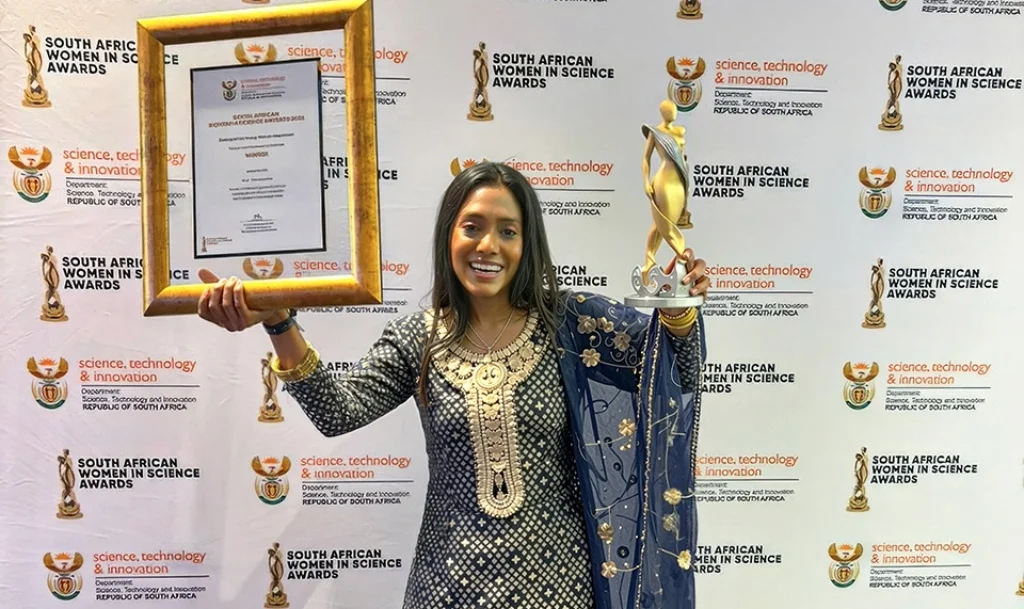
has received the Distinguished Young Woman Researcher Award (in the Natural and Engineering Sciences category) at the 23rd South African Women in Science Awards (SAWiSA), while her team’s novel compounds aimed at restoring antibiotic effectiveness have entered Phase 1 human clinical trials.
The awards ceremony took place on or around 20 August 2026 in Johannesburg (at the NH Hotel Sandton), under the theme of placing women at the centre of science, technology and innovation. SAWiSA, organised by the Department of Science, Technology and Innovation, recognises excellence among South African women researchers and aims to inspire the next generation. Naicker, aged 41 and originally from Chatsworth in Durban, is described as one of South Africa’s youngest full professors in synthetic chemistry.
Research focus and approach
Her work targets antimicrobial resistance (AMR)—often called a “silent pandemic”—in which bacteria evolve mechanisms that render antibiotics ineffective. This is especially relevant in South Africa, where it complicates everyday infections, making treatments longer, more expensive, and sometimes less successful.
Rather than solely developing entirely new antibiotics, her multidisciplinary team (combining synthetic chemistry, microbiology, and biochemistry) focuses on compounds that protect or restore the activity of existing ones. Naicker has described this as creating a “shield” against bacterial defences: if bacteria produce enzymes or other mechanisms that inactivate an antibiotic, the new compounds aim to block that defence so the older drug can work again. Key areas include antibacterial drug discovery, metallo-β-lactamase inhibitors, radiopharmaceuticals, and hybrid imaging agents. The goal is practical impact—reviving useful antibiotics that have been in use for years.
The novel compounds have advanced to Phase 1 clinical trials. These early-stage human studies primarily assess safety, dosing, and how the body processes the compound (pharmacokinetics), rather than efficacy against infections. Progression from laboratory ideas to this stage is significant, though full clinical development remains lengthy and uncertain, with further phases needed for efficacy, larger safety data, and regulatory approval if successful.
Background and career
Naicker’s interest in science began with hands-on chemistry experiments in school, supported by a physics teacher who encouraged questioning and discovery, and by her parents who valued education. She earned an MSc cum laude in 2008 and a PhD in 2011 from UKZN. After a postdoctoral fellowship in Denmark under renowned chemist Professor K.A. Jørgensen, she returned to South Africa in around 2013 to build local research capacity, citing the country’s strong scientific talent and the need to address problems relevant to the continent and beyond.
She holds an NRF C1 rating, has authored more than 130 peer-reviewed publications, one patent, and three book chapters, and has contributed to mentoring resources such as Dear Woman in STEM. Previous recognitions include the South African Chemical Institute Raikes Medal, the NRF Research Excellence Award for Early Career/Emerging Researchers, the UKZN Vice-Chancellor’s Research Award, and the John C. Warner Early Career Researcher Prize. She has supervised more than 35 postgraduate (master’s and PhD) students, serves as Editor-in-Chief of the South African Journal of Chemistry, is a member of the South African Young Academy of Science and an affiliate of the African Academy of Sciences, and is the outgoing Chair of the South African Chapter of the Organization for Women in Science for the Developing World (OWSD).
Broader context and implications
AMR is a major global health threat that can turn previously manageable infections into serious or life-threatening ones. Approaches that restore older antibiotics could help preserve the existing antibiotic arsenal, potentially reducing reliance on a limited pipeline of new drugs and addressing challenges particularly acute in low- and middle-income settings. Naicker has emphasised the interdisciplinary nature of the problem: chemistry creates the molecules, microbiology tests activity against resistant bacteria, and biochemistry explains mechanisms.
Her return to South Africa and focus on local capacity-building, mentorship, and visible role-modelling (especially for young women from communities like Chatsworth) align with efforts to retain and grow scientific talent on the continent. She advises young scientists to seek international experience but not to assume that success requires staying abroad permanently, and she stresses providing concrete opportunities and door-opening support beyond encouragement.
This development represents a notable step for South African and African-led drug discovery efforts against AMR. Phase 1 entry is encouraging but marks only the beginning of a long translational path; success would depend on subsequent trial results, manufacturing, regulatory processes, and real-world effectiveness. Related work at UKZN and partner institutions (including collaborations noted in earlier reports on β-lactamase inhibitors) underscores ongoing local contributions to the global AMR challenge.