




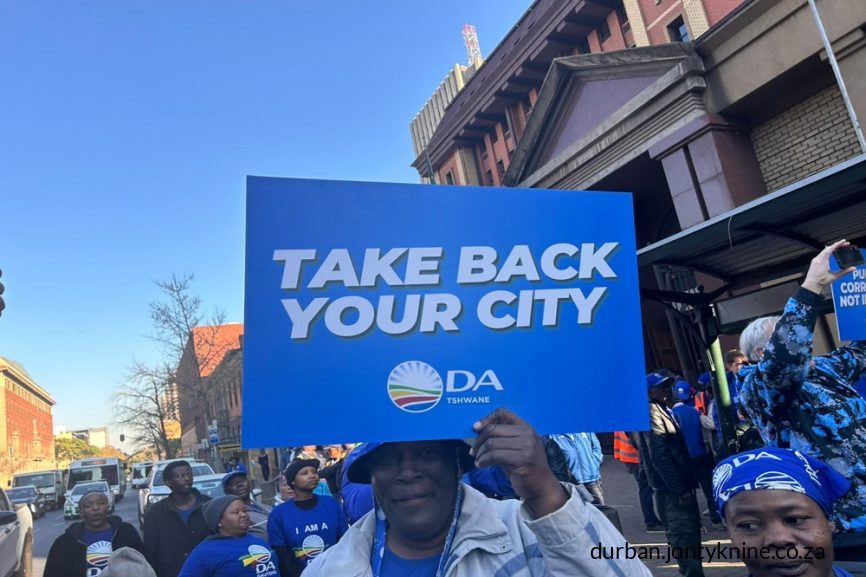
On 31 August 2026, the party formally unveiled its slate of ward councillor candidates in Durban. This forms part of a broader national effort in which the DA submitted candidate lists for all 257 municipalities and 4,484 wards ahead of the Independent Electoral Commission (IEC) deadline.
Key details of the announcement
- Full coverage of the metro: The DA is fielding candidates in every one of eThekwini’s 112 wards (increased from 111 following the Municipal Demarcation Board process; the extra ward is in the northern region, with some boundary adjustments involving neighbouring uMkhambathini).
- Candidate mix: Approximately 65% are new candidates and 35% are returning councillors. Party leaders emphasised rigorous assessments to ensure candidates understand community challenges.
- Mayoral candidate: The candidates will support Haniff Hoosen, the DA’s eThekwini mayoral candidate (announced in September 2025). Hoosen is a former MP, previous eThekwini councillor, and long-time party figure who has prioritised fixing water and sanitation infrastructure, tackling non-revenue water losses, recovering municipal debt, and improving basic services.
- Statements from leadership: DA KwaZulu-Natal Chairperson Dean Macpherson described the team as drawn from business, faith-based organisations, civil society, legal and financial professionals, project managers, community activists, and some defectors from other parties. He stressed that the selection process involved listening to voters and communities rather than maintaining the status quo, with the goal of “getting eThekwini working.” Haniff Hoosen’s statement similarly highlighted competence, accountability, diversity reflecting the city’s demographics, and a focus on high-quality service delivery.
Broader political context in eThekwini
eThekwini is KwaZulu-Natal’s only metropolitan municipality and a high-stakes battleground. It has faced well-documented service delivery problems, including severe water and sewage issues (high non-revenue water rates, widespread leaks, and infrastructure failures), infrastructure decay, and governance challenges under successive ANC-led or coalition arrangements since the 2021 local elections.
- The ANC, which previously dominated the metro, has stated aims of regaining full control, protecting its existing ward councillors (reported around 74 of the then-configuration), increasing proportional representation seats, and securing a large vote target (figures such as 1.2 million have been mentioned by regional leaders). It currently operates in coalition arrangements.
- The uMkhonto weSizwe Party (MKP) is widely viewed as a major contender in KZN and eThekwini, with some analyses and DA commentary positioning it as a primary rival in the metro.
- Other parties, including the IFP (which has named Mkhuleko Hlengwa as its mayoral candidate), are also contesting.
- Recent by-elections have shown mixed results, with the DA retaining or strengthening some positions (e.g., strong performance in Ward 64/Montclair area) while facing competition elsewhere.
The DA has framed its campaign around proven governance records elsewhere (such as in uMngeni), practical fixes to water systems, debt recovery, anti-corruption measures, and restoring basic services so that “the city works for all.” It has also highlighted defections of some former ANC councillors to its ranks as evidence of shifting local dynamics.
Implications and outlook
Contesting every ward signals the DA’s ambition to maximise both ward wins and proportional representation seats, potentially positioning it for a stronger role in any post-election coalition or even a leading position if vote fragmentation occurs among other parties. Local government elections use a mixed system (half ward-based, half proportional representation), so broad geographic coverage matters for overall council composition.
Challenges for any party include voter turnout, the impact of boundary changes on registration and voting stations, service delivery frustrations that could drive protest votes or abstention, and the multi-party fragmentation typical of KZN politics. Polling and analyst commentary around mid-2026 suggested significant shifts in support levels compared with 2021, though outcomes remain uncertain until election day.
This announcement is part of the intensive pre-election period of candidate finalisation, manifesto launches, and campaigning leading up to 4 November 2026. Residents are encouraged by the IEC to confirm their registration and voting stations, particularly in areas affected by the recent ward delimitation.