




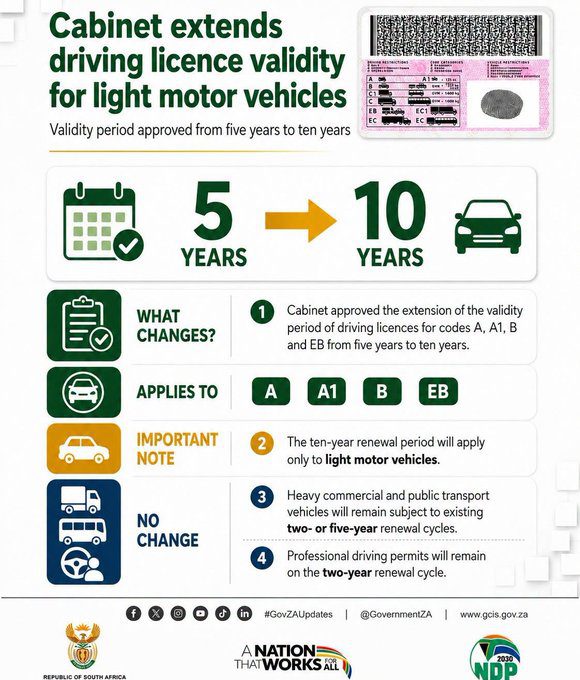
Organisation Undoing Tax Abuse (OUTA) has welcomed Cabinet’s approval of extending ordinary (light motor vehicle and motorcycle) driving licence card validity from five to 10 years, describing it as a long-overdue reform that reduces administrative burdens without harming road safety.
On 30 July 2026, Cabinet approved the change for licence codes A, A1, B and EB. Heavy commercial and public transport vehicle licences remain on existing two- or five-year cycles, and Professional Driving Permits (PrDPs) stay on a two-year cycle. The decision follows a study by the Road Traffic Management Corporation (RTMC) recommending the extension to align with international best practice, improve administrative efficiency, cut renewal frequency for motorists, and ease pressure on the licensing system.
Transport Minister Barbara Creecy and Deputy Minister Mkhuleko Hlengwa welcomed the move. Implementation requires legislative amendments (specifically to regulation 108 of the Road Traffic Regulations). Until those take effect, motorists must continue renewing expired cards under the current five-year rules.
OUTA’s Position and Advocacy
OUTA, a civil society organisation focused on tax abuse, corruption, and efficient public administration, has pushed for a 10-year validity period since around September 2020 (amid COVID-19 disruptions and licensing backlogs). It presented research and recommendations to then-Transport Minister Fikile Mbalula in 2022 and continued advocating under subsequent ministers.
OUTA CEO Wayne Duvenage called the approval “almost six years overdue” but “a victory for motorists and for common sense,” arguing that the five-year cycle wasted time and money without improving safety. Key points from OUTA include:
- International comparison: Research across 35 countries in six regions found an average licence validity of about 8.5 years (ranging from 3 to 20 years). Longer periods are common in many places with better or comparable road safety outcomes.
- No link to higher fatalities: OUTA found no evidence that longer validity for ordinary licence cards correlates with higher road fatality rates. Road safety, in its view, depends primarily on effective law enforcement, properly trained and responsible drivers, roadworthy vehicles, and safer roads/infrastructure—not how often an administrative card is renewed.
- Practical problems with the five-year system: A 2021 survey of nearly 3,700 motorists highlighted frustration with online booking, long queues, poor service, and reports of bribery. Frequent renewals also strained card production (including past printing failures and backlogs).
OUTA has asked the Department of Transport for clarity on the implementation timeline and whether the 10-year period will apply only to newly issued cards or also to those already in circulation. It has urged prompt publication of amendments and transitional arrangements to avoid confusion.
Broader Context and Related Views
The RTMC study underpinned the government’s rationale, emphasising efficiency and international alignment. Arrive Alive (a prominent South African road safety information platform) has reported the Cabinet decision factually, noting the same scope and the need for legislative changes.
Earlier proposals had floated an eight-year period (supported by some groups such as the Public Servants Association as a practical step, while still preferring 10 years). Cabinet ultimately approved 10 years for the specified light-vehicle codes.
This fits a longer pattern of debate in South Africa about balancing administrative burden, system capacity (including card production), and safety considerations. Critics of shorter cycles have long pointed to queues, costs, and inefficiencies; supporters of more frequent renewals sometimes emphasise opportunities for eyesight or fitness checks, though OUTA and the RTMC findings indicated that ordinary card renewal frequency itself is not a primary safety driver for light vehicles.
In short: A major civil society voice (OUTA), drawing on road-safety-related research and efficiency arguments, has strongly backed the 10-year renewal for ordinary licences. Cabinet has approved it in principle, but practical changes await legislation, so the current five-year process continues for now. Motorists should monitor official Department of Transport updates for the effective date and transitional rules.