


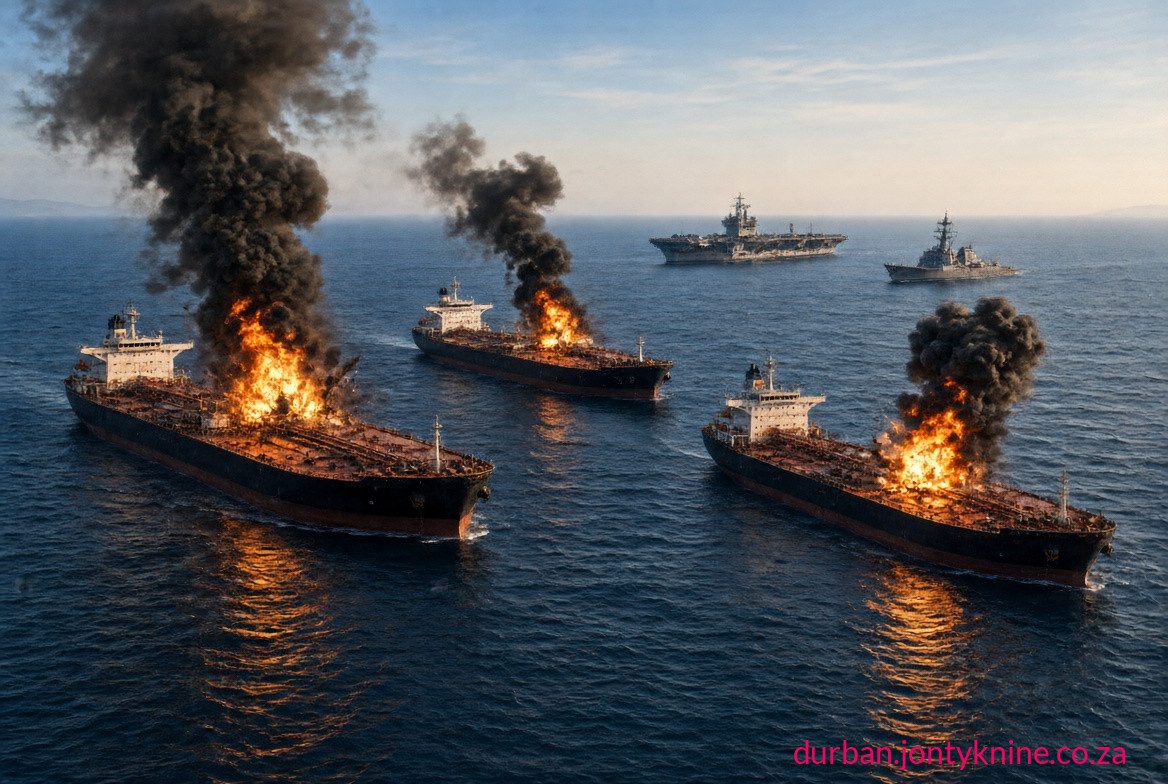
U.S. Central Command (CENTCOM) described the action as retaliation, stating that a U.S. aircraft carrier and a guided-missile destroyer successfully evaded the “unprovoked” attacks with no American personnel injured.
CENTCOM reported that it “permanently disabled” the IRGC-linked crude oil carriers M/T Downy (off Kharg Island) and M/T Stark 1 (near Jask), and “completely destroyed” the unladen M/T Kylo in the Gulf of Oman after directing its crew to abandon ship. The vessels were described as part of a “multibillion-dollar shadow network” that funds the IRGC and its regional proxies. CENTCOM Commander Adm. Brad Cooper stated: “Let the message to the IRGC be clear: If you shoot at two of our ships, we will impose an even higher economic cost — taking out three of yours. We will not hesitate to defend American forces, and if necessary, destroy Iran’s limited and exposed oil fleet.” Defense Secretary Pete Hegseth echoed this on social media, saying if Iran shoots at U.S. ships, the U.S. will destroy and sink their oil tankers.
Iranian state media and outlets confirmed strikes (including one near Kharg Island reported earlier by Tasnim), stating crews evacuated with no casualties reported on the vessels. Iran’s Foreign Ministry condemned the attacks as “illegal and aggressive,” a violation of the UN Charter (Article 2(4)), a “war crime,” and a threat to international peace and commercial shipping. Iranian military spokesmen warned of “more severe” responses against U.S. vessels if the naval blockade or attacks on Iranian ships continued. Iran’s state broadcaster later claimed Tehran targeted three oil tankers on an “unauthorized” Strait of Hormuz route and three “American ships” or affiliated vessels in response (unverified independently at the time of initial reports).
Broader Context of the Conflict
This incident fits into a months-long U.S.-Iran confrontation that began with U.S.-Israeli strikes on Iran around late February 2026. Key elements include:
- Iranian efforts to assert control over the Strait of Hormuz (a critical chokepoint for roughly 20% of global oil trade pre-conflict), including attacks or threats against non-compliant commercial shipping, mine-laying concerns, and demands related to routing or fees.
- A U.S. naval blockade on Iranian ports aimed at economic pressure, alongside escorts for commercial vessels and strikes on IRGC-related capabilities (missile/drone sites, radars, small boats, etc.).
- Periods of relative calm interspersed with tit-for-tat exchanges, including a June 2026 memorandum of understanding (MOU) that temporarily eased some restrictions on the strait but later frayed amid disputes over control, compliance, and further incidents. Fighting resumed more actively in periods such as July and late August/early September 2026.
Kharg Island is strategically vital as it handles a large share (often cited around 90%) of Iran’s crude exports. The targeted tankers operated in the “shadow fleet” used to evade sanctions. U.S. statements framed the strikes as calibrated economic and deterrent measures rather than direct attacks on major onshore infrastructure (despite prior threats regarding Kharg). Video footage released by CENTCOM showed strikes and explosions on the vessels; radio warnings to crews were reported in some coverage.
Implications and Reactions
- Military/Strategic: The episode underscores a “tanker-for-tanker” or asymmetric cost-imposition approach by the U.S., aiming to raise the economic price of Iranian attacks on U.S. or commercial shipping while avoiding (or delaying) full-scale escalation against Iran’s more heavily defended assets. Iran’s targeting of major U.S. warships (including an aircraft carrier) marks a notable risk tolerance. Both sides have incentives to manage escalation given the costs of broader war, but repeated exchanges risk miscalculation.
- Economic/Energy Markets: Renewed hostilities have contributed to elevated oil prices and risk premiums. In the period around these events, Brent crude traded in the mid-to-high $90s range at times, with weekly gains noted amid impaired or uncertain Strait of Hormuz flows (actual transit volumes remain debated between official claims of recovery toward pre-war levels of ~20 million barrels/day and independent trackers showing disruption). Diesel prices in the U.S. hit record highs in related reporting. Global supply chains, insurance costs, and inflation pressures remain sensitive to any sustained disruption.
- Diplomatic/Political: The conflict has strained regional stability, affected U.S. domestic politics (with midterms approaching in some reporting), and involved allies/partners in Gulf states. Iran frames U.S. actions as aggression and blockade; the U.S. frames its operations as defensive of forces and freedom of navigation while applying pressure on the IRGC’s funding streams.
- Human/Operational Notes: Crews on the struck tankers were reportedly warned and evacuated with no confirmed casualties from the tanker strikes themselves. Separate claims (e.g., regarding civilians in other incidents) have circulated but require independent verification. Maritime safety warnings and insurance challenges persist in the region.
Coverage is consistent across major outlets (NPR, CNN, Washington Post, BBC, Reuters, Stars and Stripes, etc.), primarily drawing from the CENTCOM statement, Iranian state media responses, and released video/audio. As with any active conflict, details can evolve with additional confirmation, claims, or de-escalatory/diplomatic moves. The situation remains fluid, centered on control of the Strait of Hormuz, deterrence dynamics, and the economic costs each side is willing to impose or absorb.