



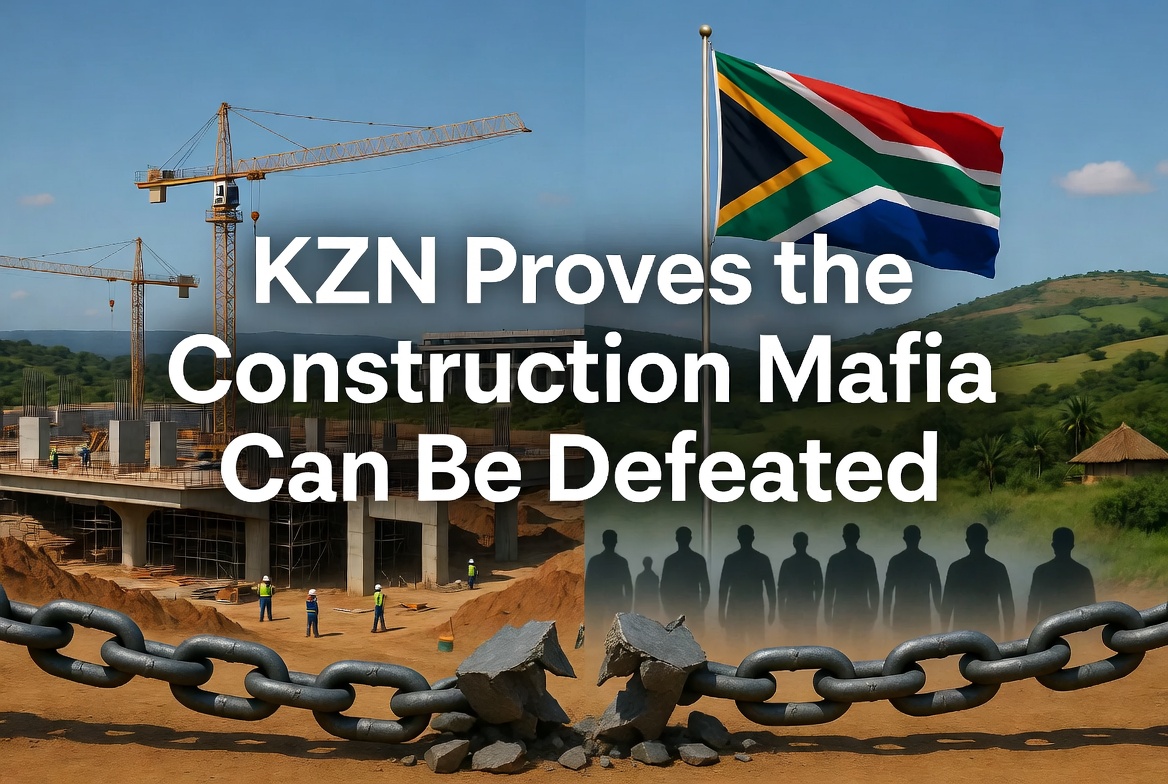
The “construction mafia” (often self-styled as local “business forums”) emerged prominently in KZN and spread nationally. These groups typically disrupt construction sites through protests, intimidation, threats, or violence, demanding 20-30% of project value in subcontracts, “protection” fees, or jobs—frequently without contributing meaningful work. This has led to delays, cost overruns, abandoned projects, and lost economic opportunities.
Nationally, over 180 infrastructure projects worth around R63 billion were affected between roughly 2019–2024. The problem evolved from crude site invasions (sometimes involving armed groups) to more sophisticated tactics like front companies, manipulated community structures, and collusion.
Evidence of Progress in KZN
KZN was long considered the epicentre. Key metrics from government reports (Public Works and Infrastructure Minister Dean Macpherson and KZN MEC Martin Meyer) highlight the turnaround:
- Disruptions plummeted: From over 60 incidents per month (public + private sector) to fewer than 10. As of early 2026, there were reports of full months with zero disruptions on provincial projects.
- Arrests and convictions: Nationally, over 770 cases of extortion/intimidation reported since the November 2024 Durban Declaration. This led to 241 arrests and 176 convictions, with a significant portion in KZN.
- Broader enforcement: 52 contractors blacklisted for collusion or related issues. Improved police response, hotlines, private security coordination, and faster interventions.
MEC Meyer explicitly declared the mafia “defeated” in KZN after a year-long push, noting projects are now largely on track and such stories have largely disappeared from headlines.
What Contributed to Success?
Several interconnected factors appear to have worked:
- Durban Declaration (Nov 2024): A pact between government, police (SAPS), industry, and other stakeholders for coordinated action.
- Integrated Social Facilitation Framework (ISFF): Recently Cabinet-approved national policy to standardise lawful community engagement, prevent hijacking of projects by criminals, and create transparent channels for local participation (e.g., skills training, legitimate subcontracting).
- Political will and operational changes: Consistent messaging of “no negotiation with extortionists,” dedicated police oversight per province, blacklisting, lifestyle audits, and SIU involvement. Strong local leadership in KZN (e.g., Meyer and police commissioner Nhlanhla Mkhwanazi) was credited.
- Private sector reporting: Contractors encouraged to report rather than pay up, backed by quicker state response.
This multi-pronged approach—enforcement + prevention + legitimate inclusion—seems more effective than earlier fragmented efforts.
Nuances, Edge Cases, and Caveats
- Not total victory: Officials (including Macpherson) repeatedly caution against declaring the war won. Disruptions persist or have shifted in Gauteng (e.g., Randfontein, Vaal) and elsewhere. Criminals adapt—moving to subtler infiltration via front companies or “legitimate” business structures.
- National vs. provincial: KZN’s gains are standout, but the problem originated and spread from there. Sustained results depend on consistent political will, resourcing, and non-partisan application.
- Root causes: High unemployment, inequality, and weak service delivery create fertile ground for exploitation of “community participation” mandates. Pure repression without economic alternatives risks backlash.
- Economic implications: Success here frees up infrastructure spending (critical for growth, jobs, and services). Delays previously inflated costs and eroded investor confidence. However, over-securitisation raises project costs too.
- Political dimensions: Debates exist around links to tender corruption, political patronage, or “cartels.” Some earlier narratives downplayed or reframed the issue. Progress under the current administration (post-2024 changes) highlights what targeted governance can achieve, but long-term success requires insulating projects from political interference.
Broader Lessons
KZN demonstrates that organised crime preying on public infrastructure is not invincible when the state, police, business, and communities align on rule of law + structured inclusion. Key principles: rapid response, zero tolerance for violence/extortion, professional facilitation, and consequence management (arrests, blacklisting).
Challenges remain—adaptation by criminals, uneven provincial performance, and underlying socio-economic drivers. Scaling this nationally while addressing Gauteng hotspots and preventing spillover into other sectors (e.g., retail, logistics) will test sustainability.
Overall, this is a positive, evidence-based development for South Africa’s construction sector and infrastructure goals. Continued vigilance, transparency in reporting, and economic opportunity programs will determine if it becomes a lasting model.