



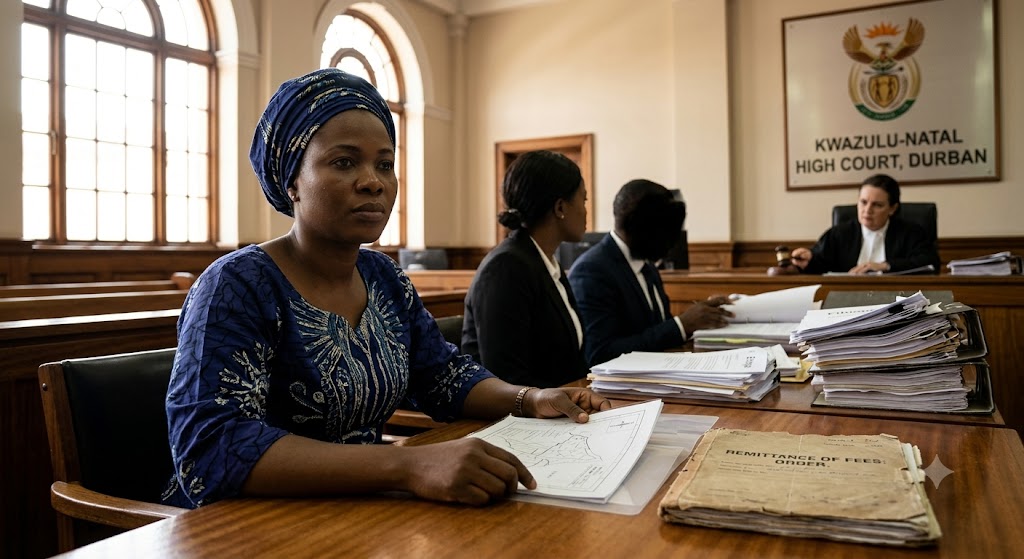
The case is Uduogu v Minister of Home Affairs and Others (2026-083830) [2026] ZAKZDHC 37, decided on 22 July 2026 by Acting Judge P. Wallis. Applicant Chetachi Christie Uduogu, a Nigerian citizen, sought an order compelling the Department of Home Affairs (and related respondents) to grant her a “good cause” interview so her refugee claim could be assessed. She also sought broad interdictory relief restraining arrest, detention, or deportation related to her immigration status.
By the time the matter was argued, Home Affairs had already agreed to facilitate the interview (to be conducted within 60 days before the Immigration Services Inspectorate), leaving primarily the question of costs. The judge nevertheless examined the merits because of the unusual costs order ultimately made against the legal representatives.
Key problems with the application papers
The founding affidavit showed multiple serious defects, many of which mirrored problems in an earlier similar case (Dogiso v Minister of Home Affairs and Others [2025] ZAKZDHC 25) involving the same attorneys:
- Factual and drafting errors: A section was headed “Conflict in Ethiopia” while discussing unrest in Nigeria. The affidavit stated Uduogu was born in Nigeria but claimed she was a victim of war crimes by the Ethiopian military. Counsel could not explain the contradictions when asked.
- Vague and unsupported allegations: Claims of persecution in Nigeria were broad generalisations with no specific incidents, no identification of the town she fled, and no explanation why she could not seek safety elsewhere in Nigeria (a large country with a substantial population and economy). Arrival details were incomplete: she claimed to have arrived by air in 2018 “without a transit visa,” but gave no date, airport, or airline, and attached no passport copy. A transit visa would not ordinarily be required if South Africa was the final destination.
- Delay explanation: She said she attended the Durban refugee reception office in March 2018, was turned away as fully booked, returned monthly and was “chased away,” and that the centre later closed during Covid. An application was allegedly submitted via an NGO in February 2023, but no copy of the application or confirmatory affidavit from the NGO was provided. Nothing further appears to have occurred until January 2026, when she was told a good-cause interview was required.
- Translation issues: Uduogu stated her English was poor and the affidavit had been translated. The interpreter’s certificate listed fluency in Swahili, French, Kirundi, Lingala and Kinyarwanda (primarily Central/East African languages), but the papers did not clearly identify the language used for Uduogu or confirm she was sufficiently fluent in it, nor did they adequately establish proper translation of the full affidavit or instructions.
The interdictory relief was also defective: it sought final relief without establishing a clear right, improperly referenced the balance of convenience, purported to bind non-parties (e.g., SAPS or the Border Management Authority) without joinder, and was framed perpetually regardless of the outcome of any refugee application.
Court’s reasoning and order
Judge Wallis held that the affidavits failed to provide a sufficient factual basis for the relief claimed. Absent the respondents’ consent and the special protective position of asylum seekers, the application would have failed. Home Affairs had acted appropriately and with a degree of empathy. The applicant had not been well served by her legal advisers.
The same attorneys had previously been criticised in Dogiso for similar defective applications and had not improved. Legal practitioners owe duties to the court and to clients to present work competently (now reflected in the Code of Conduct under the Legal Practice Act). The deficient preparation burdened the court and the State’s resources and risked harming the client.
The court therefore ordered:
- Home Affairs to afford Uduogu a good-cause interview within 60 days (with the Minister and Director-General to enable compliance).
- No costs order between the parties.
- The applicant’s counsel (T. Holtzhausen) and attorney (Roy Singh Attorneys, Durban) may not recover any fees from her relating to the application and must repay any fees already paid.
The judge referenced authority (including Venter v Bophuthatswana Transport Holdings) supporting deprivation of fees for dereliction of duty in preparing court papers, and noted that costs de bonis propriis (personally against the practitioners) could have been considered if sought by the State.
Broader context and implications
This is an unusual and strong judicial response to repeated poor-quality work in asylum-seeker litigation. South African courts have emphasised the vulnerability of asylum seekers and the need for careful handling of their matters (including under principles protecting constitutional and public-interest litigants from adverse costs in certain cases). At the same time, the judgment underscores that template-driven, error-ridden papers undermine the administration of justice, waste court and state resources, and fail clients who may already be in precarious positions.