




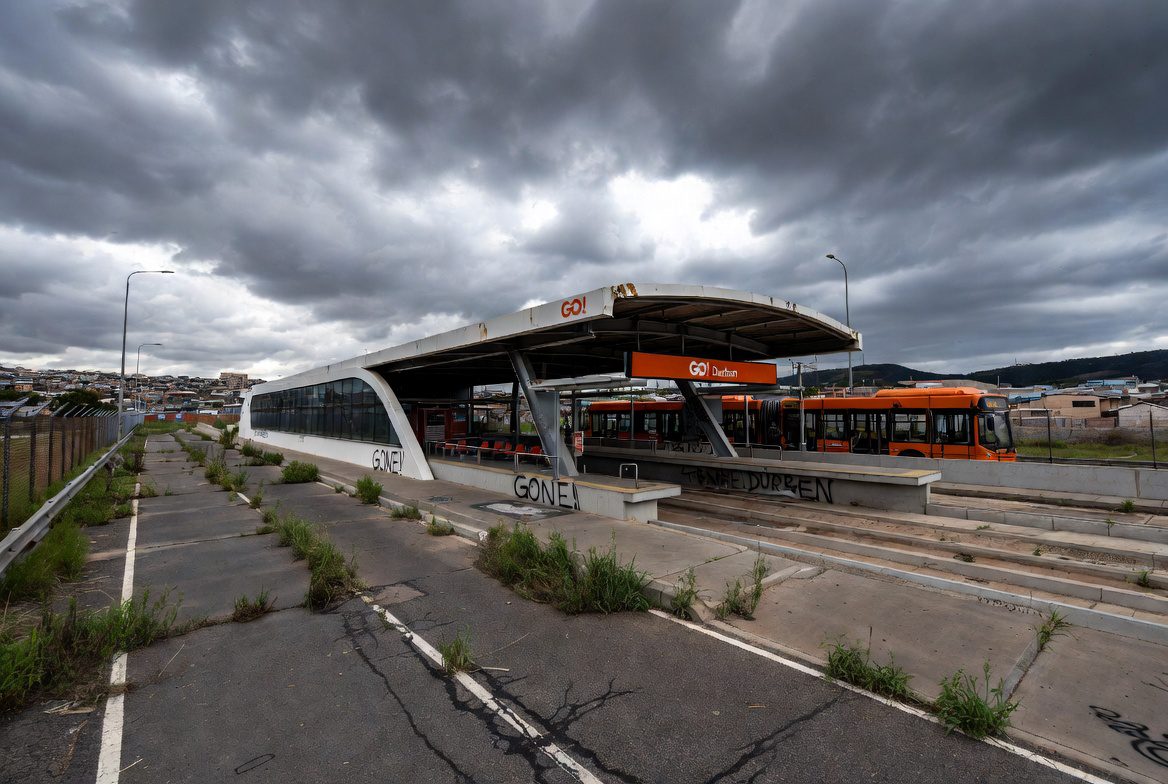
GO! Durban (often derisively called “Gone! Durban”) is eThekwini Municipality’s long-delayed Integrated Public Transport Network (IPTN) / Bus Rapid Transit (BRT) project. After more than a decade (planning roots going back further) and roughly R9 billion spent—mostly from the national Public Transport Network Grant (PTNG)—it has produced extensive infrastructure (especially stations and lanes on the C3 corridor) but almost no operational bus services, leaving empty, vandalism-prone stations that continue to cost ratepayers millions for security and maintenance.
Project Background and Ambitions
The project was framed as a transformative solution for Durban’s public transport challenges. It aimed to deliver a modern, integrated system of trunk (dedicated right-of-way) corridors, feeder services, stations, terminals, depots, fare systems, and universal access features. Goals included reliable scheduled services (short waits at peak), long operating hours, better connectivity to jobs, hospitals, education and services, reduced reliance on minibus taxis and private cars, and eventual integration with rail and non-motorised transport. By 2030 the vision was high coverage (up to ~85% of residents with good access) and a more liveable city.
Municipal council approved the IPTN (branded GO! Durban) around April 2012, with earlier planning and national policy push for IRPTNs/BRTs dating to the mid-2000s/2010. Phase 1 prioritised corridors such as C3 (Bridge City/KwaMashu–Pinetown), C1 (Bridge City–CBD), C9 (Bridge City–uMhlanga via Cornubia), and an Inner City Distribution Service, with further corridors and rail support planned later. Original total cost estimates were substantially higher (figures of R22 billion or more circulated for the full network).
What Was Built and Spent
Approximately R9 billion (some reports cite figures approaching or exceeding R10 billion in broader accounting) went into land acquisition, stations and terminal infrastructure, dedicated lanes/right-of-way works, depots, fare management systems, professional services, and limited fleet procurement. The C3 corridor (Pinetown–Bridge City area) advanced furthest; stations were built and some infrastructure completed years ago (target operational dates in the late 2010s were missed). A number of buses were acquired (reports mention around 20–22 or more orange buses arriving around 2019), along with related drivers in some cases, but they largely did not enter scheduled GO! Durban service—some were reportedly integrated into other municipal services or left in poor storage conditions where they deteriorated.
Visible results for the public have been limited: completed or partially completed stations stand empty, some incomplete or leaking, and dedicated lanes unused by the intended fleet. Ongoing municipal spending on security, cleaning, and maintenance of idle facilities has been substantial—examples cited include roughly R2.3 million monthly in some periods, or cumulative figures such as ~R187.5 million over about 75 months from late 2019 for security and upkeep on the near-complete C3 route and stations.
Core Reasons for Failure and Delays
Multiple interlocking factors explain the stagnation:
- Taxi industry negotiations and ownership disputes: The biggest recurring blockage. Minibus taxi operators (dominant in South African urban transport) feared loss of routes and livelihoods. Deadlocks arose over vehicle ownership/equity in Vehicle Operating Companies (VOCs), operating contracts, compensation, and licence issues. A notable impasse around 2021 on the C3 corridor involved operators demanding controlling interest while the municipality sought the same or structured inclusion. Promises of compensation reportedly complicated matters further. Without full industry buy-in, services could not launch under national policy frameworks that emphasise operator inclusion and negotiated contracts. Multiple “tactical adjustments,” refined strategies, and stakeholder engagement processes followed, with mixed or limited success; National Department of Transport endorsement was sometimes incomplete.
- Planning, management, and institutional weaknesses: Repeated strategy revisions, cost escalations, revised plans, and broken timelines. Critics (across opposition parties) point to poor planning from the outset, weak project management, political instability across successive mayoral administrations, over-reliance on consultants (with further millions allocated even for recent reviews of contracts rated poorly), and insufficient early focus on affordability and operational sustainability. Construction disruptions (including from local business forums or “mafias” seeking opportunities, and community actions) added friction in earlier years.
- Funding shifts and performance pressure: The PTNG funded much of the capital outlay. After years of limited operational progress, the National Department of Transport and National Treasury moved to reduce the grant over subsequent years (reports of multi-billion-rand national cuts, with funds redirected partly toward passenger rail priorities). Allocations were withheld or reclaimed in some years due to non-performance; warnings were issued that further delays risked permanent stopping of funds. This forced an “affordability-led” pivot: scaling back ambitions, prioritising a single corridor (C3 first), reviewing operational/business plans, service levels, fleet needs, and the city’s own funding exposure (including potential extra rates revenue contributions for early operational shortfalls). Ratepayers already fund a portion of broader public transport costs and now shoulder more of the idle-infrastructure burden.
- Other contributing issues: Incomplete infrastructure on some elements, fleet readiness gaps, alignment problems with national priorities and the Transport Act, and the broader national context in which many BRT/IPTN projects have underperformed relative to investment (attracting far fewer daily users than minibus taxis overall). Some stations or facilities have been repurposed temporarily (e.g., one terminal considered or used for other civic purposes).
Current Status (as of mid/late 2026)
Councillors from multiple parties (ActionSA, DA, UIM and others) have sharply criticised the project in recent council discussions. ActionSA’s Zwakele Mncwango suggested renaming it “Gone! Durban,” highlighting empty stations, absent buses, and no return on investment. DA councillor Lyndal Singh described it as synonymous with delays, escalating costs, revised plans, and broken promises, calling the shift to a revised model an admission that the original strategy failed and criticising further consultant spending (e.g., R22.9 million cited for another review). UIM’s Jay Singh questioned why affordability only became central after R9 billion was already spent and why the vision is now scaled back to essentially a single prioritised corridor.
The municipality’s latest reports emphasise a revised corridor-based Phase 1 strategy with C3 (Bridge City–Pinetown) as the initial operational priority, followed (subject to affordability, readiness, PRASA recovery, and funding) by C1, C9, and inner-city services. Actions include identifying affected operators for VOC formation, contractual work, a Public Transport Operations Grant transition framework, and six-month priority steps for operational readiness. There have been reports of renewed engagement with the taxi industry and targets for C3 services potentially in the 2026/27 financial year (or earlier aspirational dates in some statements), contingent on completed negotiations, fleet readiness, and final checks. Mayor Cyril Xaba and officials have expressed optimism about progress and stakeholder cooperation while acknowledging past unhappiness with delays.
National parliamentary oversight committees have also scrutinised the project, stressing that expensive infrastructure should not be left fallow and urging procurement of fleet and movement within the remaining funding window before further wind-downs.
Broader Implications and Context
The project illustrates common challenges in South African urban public transport reform: the difficulty of integrating a powerful, largely informal minibus-taxi sector into formal, capital-intensive systems; the risks of building expensive dedicated infrastructure before securing operational models and operator agreements; political and administrative continuity problems; and tensions between ambitious national grant-funded visions and local fiscal/operational realities. Ratepayers face ongoing opportunity costs (money tied up in idle assets that could address potholes, water leaks, electricity, sanitation, or safety). Commuters still rely heavily on existing taxi, bus, and limited rail options, which themselves face reliability and capacity issues.
While some infrastructure has lasting potential value if services eventually start, the decade-plus of delays, cost overruns relative to delivered outcomes, and repeated strategy resets have turned GO! Durban into a prominent symbol of under-delivery. Whether the latest affordability-focused, single-corridor push and taxi engagements succeed in launching meaningful services remains to be seen; past missed deadlines and unresolved structural issues (especially operator inclusion and sustainable funding beyond the declining PTNG) leave significant uncertainty. Official municipal and national transport sources, council reports, and multi-party councillor statements provide the primary public record of these developments.