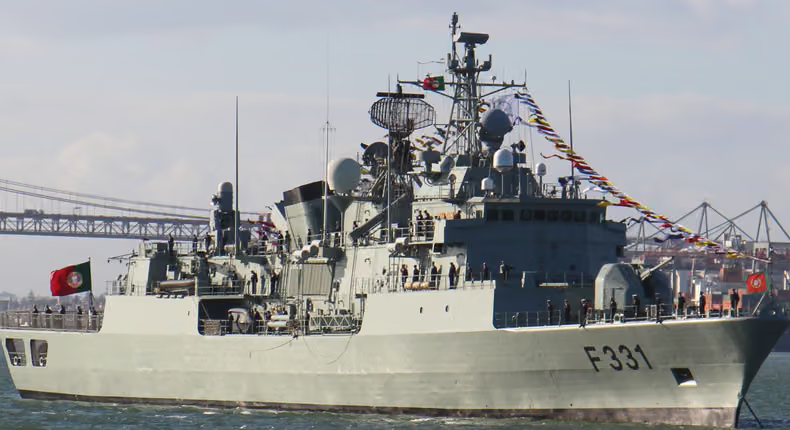
The exercise began on Friday (around 28–29 August 2026) at the Nigerian Navy Ship (NNS) Beecroft Jetty in Apapa, Lagos. It brings together Nigerian Navy assets (ships, helicopters, Special Boat Service elements, and the Western Naval Command’s Mission Control Centre) with the Portuguese frigate, plus inter-agency participation from the Nigerian Army, Air Force, Police, Customs Service, and National Drug Law Enforcement Agency (NDLEA). Activities focus on maritime interdiction operations, air-sea coordination, communication drills, ship manoeuvres, and mission-planning exercises.
Chief of the Naval Staff Vice Admiral Idi Abbas (represented by Flag Officer Commanding Western Naval Command, Rear Admiral Abubakar Mustapha) framed the drills within the Navy’s Total Spectrum Maritime Strategy. This strategy treats threats such as sea robbery, oil theft, illegal fishing, and trafficking in persons, weapons, and drugs as requiring transnational solutions. The exercise builds directly on Coastal Grip I (conducted earlier with the Spanish Navy) under the European Union’s Support to Western African Integrated Maritime Security (SWAIMS/SWAIM) project, which Portugal is now implementing.
Portugal recently donated two Rigid Hull Inflatable Boats (RHIBs) to the Nigerian Navy in July 2026 and trained/equipped 28 Nigerian Special Forces personnel for high-speed intercepts and special operations. The current exercise is designed in part to test that training and equipment. These donations form part of a larger EU-backed SWAIMS programme (valued in the range of €10–15 million overall for the region), which has provided RHIBs, forensic/crime investigation equipment, and capacity-building support across the 12 ECOWAS coastal states to improve maritime domain awareness, law enforcement, search-and-rescue, and interoperability.
Context on Nigeria’s naval ranking
Nigeria is widely described as Africa’s strongest naval power by total fleet size in the 2026 Global Firepower (GFP) assessment. It ranks 22nd globally with approximately 152 naval assets (predominantly ~132 patrol vessels suited to littoral and coastal operations, plus limited numbers of other types such as mine warfare ships and at least one frigate). This places it ahead of Egypt (~149 vessels, 23rd globally) and Algeria (~111 vessels). The ranking reflects quantity of hulls rather than advanced blue-water capabilities (Nigeria lacks aircraft carriers, submarines, destroyers, or a large inventory of major surface combatants). Overall military strength rankings place Nigeria third in Africa (behind Egypt and Algeria) and in the mid-30s globally.
This fleet composition aligns with Nigeria’s operational priorities in the resource-rich, high-threat Gulf of Guinea: protecting offshore oil infrastructure, countering piracy/sea robbery and crude oil theft, combating illegal, unreported and unregulated (IUU) fishing, and addressing trafficking. Nigeria has also advanced regional leadership through the inauguration of a Combined Maritime Task Force (CMTF) for the Gulf of Guinea (headquartered in Lagos, involving partners such as Ghana, Liberia, Sierra Leone, Côte d’Ivoire and The Gambia), described as an African-led permanent formation for more proactive responses.
Broader Portuguese and European involvement
The NRP Álvares Cabral (a Vasco da Gama-class frigate) is deployed on Portugal’s “Iniciativa Mar Aberto 2026” (Open Sea Initiative), a multi-month mission focused on maritime security, cooperative security, and engagement along the West African coast and with CPLP (Community of Portuguese Language Countries) partners. The deployment supports EU Coordinated Maritime Presences concepts and the SWAIMS programme. Portugal has conducted similar training and exercises with other regional navies (e.g., Ghana) during this deployment.
The Gulf of Guinea remains strategically important for regional economies, global shipping, energy supplies, and fisheries. While piracy incidents have declined significantly in recent years (with Nigeria previously removed from high-risk lists through sustained operations and cooperation), residual challenges—oil theft, IUU fishing, and other transnational crimes—persist and require continuous multinational and inter-agency responses. Joint exercises like Coastal Grip II, capacity donations, and frameworks such as the Yaoundé Architecture and ECOWAS maritime strategies form part of the ongoing effort to build local capabilities and collective response.
In summary, the arrival of the Portuguese warship and the five-day Coastal Grip II exercise represent a concrete step in operational cooperation between Africa’s largest (by hull count) navy and a European partner under EU-supported programmes, aimed at practical interoperability gains against shared maritime security threats in the Gulf of Guinea.