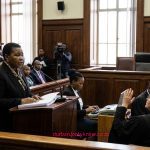


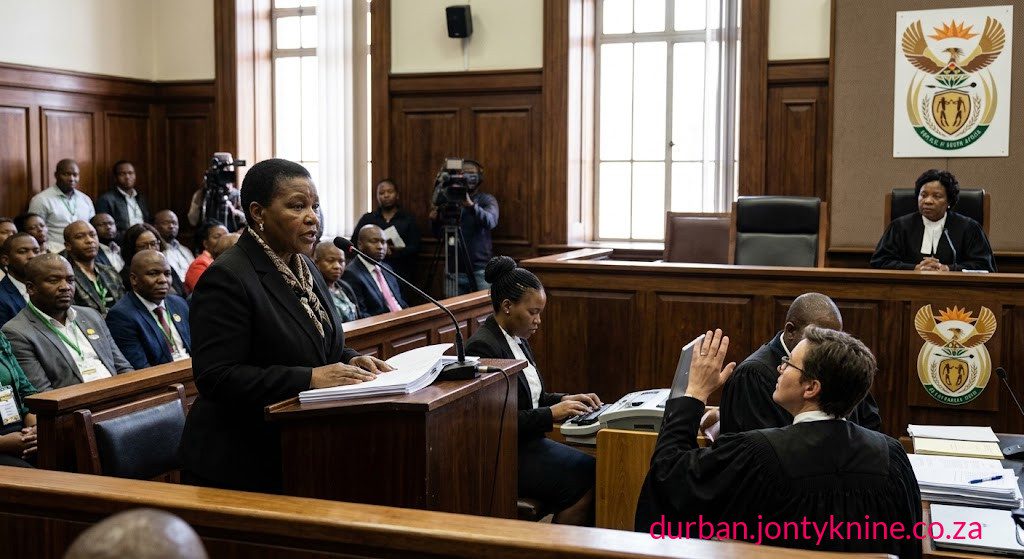
in a corruption and money-laundering trial linked to alleged payments of roughly R4.5 million (with about R2.1–R2.15 million said to have been received in cash) from SANDF logistics contractor Nombasa Ntsondwa-Ndhlovu of Umkhombe Marine between December 2016 and July 2019.
She faces 12 counts of corruption and one count of money laundering, all of which she has pleaded not guilty to. The trial proper began in late July 2026. The state closed its case in early August after calling more than 15 witnesses. Mapisa-Nqakula’s legal team then brought a Section 174 application for discharge (seeking acquittal without her having to present a defence). On 7 September 2026, Judge Mashudu Munzhelele dismissed that application, finding that the state had established a prima facie case requiring her to answer. She began testifying that same day and continued on subsequent days, including 9 September 2026.
Background and the allegations
Mapisa-Nqakula served as Minister of Defence and Military Veterans from 2012 to 2021. The case originates from a criminal complaint by UDM leader (and later Deputy Defence Minister) Bantu Holomisa. Ntsondwa-Ndhlovu, who has indemnity under Section 204 of the Criminal Procedure Act and is the state’s key witness, has testified that after her company secured (and later had replaced) substantial SANDF logistics contracts—including a suspended R104-million contract replaced by a R79-million one—Mapisa-Nqakula began soliciting cash payments.
The state alleges a total of about R4.55 million was requested across multiple occasions, with roughly R2.15 million paid in cash. Much of the money is said to have funded renovations and improvements at Mapisa-Nqakula’s Bruma, Johannesburg home (costs estimated around R1.7–R1.8 million, including furniture). Evidence has included cash withdrawals correlating with alleged payment timelines, WhatsApp messages (with references to coded language such as “impepho,” “padkos,” or a “wig”), meetings at places including an airport hotel and her home, and corroborating testimony from Ntsondwa-Ndhlovu’s family members, retired military officers (including her husband, former deputy surgeon-general Noel Ndhlovu), and professionals involved in the renovations. One disputed incident involves a wig allegedly used to conceal or accompany a R300,000 cash handover.
Mapisa-Nqakula resigned as National Assembly Speaker and MP in April 2024 and handed herself over to police after failing to block her arrest. She has consistently maintained her innocence, describing the resignation as allowing her to focus on clearing her name rather than an admission of guilt.
Defence application and the court’s ruling
After the state closed its case, the defence argued that the evidence was insufficient for a reasonable court to convict. They highlighted contradictions in Ntsondwa-Ndhlovu’s evidence (as a single Section 204 witness subject to cautionary rules), claimed much supporting testimony was hearsay derived from her, questioned the authenticity and completeness of WhatsApp messages (some allegedly deleted, with issues around who extracted them), and contended that even if money changed hands there was no clear quid pro quo—no proven link showing Mapisa-Nqakula used her official position to benefit the contractor in return for payments. They noted Ntsondwa-Ndhlovu’s own evidence that Mapisa-Nqakula did not directly secure the contracts.
Judge Munzhelele rejected the discharge application. Key reasons included that the state had established prima facie evidence (including circumstantial evidence of gratification used for renovations and payments to contractors) directly implicating the accused; that it was inappropriate to discharge at this stage when the evidence warranted a response; that not every credibility dispute needed final resolution yet; and that digital evidence could not simply be dismissed. The judge found the evidence, taken as a whole, capable of supporting an inference of knowledge that payments constituted gratification linked to her official position and influence. The trial therefore proceeded to the defence case.
Mapisa-Nqakula’s testimony
Since taking the stand (from 7 September onward, continuing as of 9 September 2026), Mapisa-Nqakula has denied receiving any money from Ntsondwa-Ndhlovu. She has described their relationship as personal and spiritual rather than corrupt. She testified that they bonded over shared callings as traditional healers/sangomas, discussing practices (with “impepho” meaning the actual herb/incense used in rituals, not a code for money) during meetings, including one at the InterContinental Hotel at OR Tambo. She has acknowledged meetings and communications but insisted money and tenders were not discussed in a corrupt context.
On the disputed wig, she said she genuinely requested a light, small hairpiece after admiring Ntsondwa-Ndhlovu’s style at an event (noting she does not normally wear wigs due to ancestral/spiritual reasons and usually wears a doek), followed up on it, and received an actual wig—not one concealing cash. She has addressed phone conversations (including one about a tender withdrawal) and other interactions, maintaining that any requests or discussions were not for bribes and that she paid for her own home renovations (including with salary-related funds, per some related evidence). She has denied instructing intermediaries or using coded language for illicit payments.
Broader context and implications
The case highlights longstanding concerns about tender processes, influence, and accountability in South African defence procurement. Umkhombe Marine’s contracts and the shift from a suspended larger deal to a replacement one form a key backdrop. Corroborative evidence (family members accompanying cash deliveries, renovation details, financial trails) has been central for the state, while the defence has stressed single-witness caution, inconsistencies, and the absence of a clear official act in exchange for payments.
As of 9 September 2026, Mapisa-Nqakula remains in the witness box giving her version. The trial will continue with further testimony, cross-examination, and potentially other defence witnesses before closing arguments and judgment. Outcomes could range from acquittal to conviction on some or all counts, with significant implications for her reputation, political legacy, and broader public confidence in anti-corruption efforts involving high-profile figures. Proceedings remain subject to the presumption of innocence; the court’s eventual assessment of credibility, the weight of circumstantial evidence, and the existence (or lack) of the required corrupt intent and quid pro quo will be decisive.