





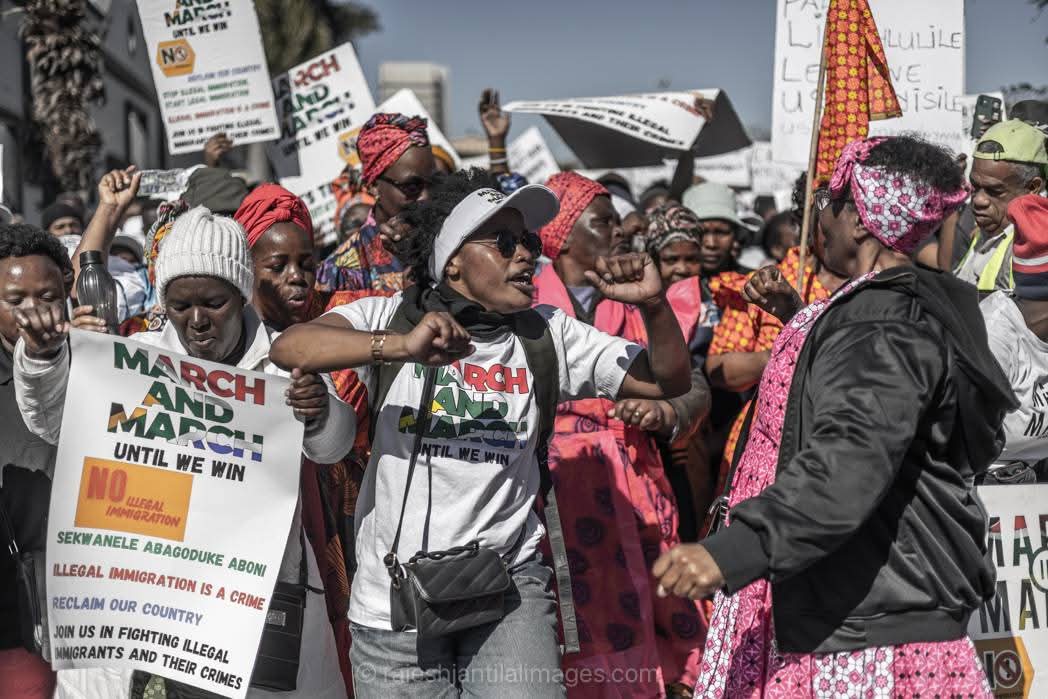
It has been organizing ongoing protests, including weekly Thursday marches, to pressure the government for stricter enforcement of immigration laws, border control, deportation of undocumented foreigners, and addressing related issues like crime, unemployment, and strain on public services.
Your statement appears to summarize a recent development in their campaign. Here’s a corrected, clarified version with context:
Corrected/Polished Version: “As the March and March movement continues its campaign against illegal immigrants and sustains its call for the government to act decisively on the issue, it has reiterated that the organisation is not xenophobic.”
Background and Activities
- Leadership: Founded/led by Jacinta Ngobese-Zuma (a former radio personality). The group started in Durban around 2024 and has expanded nationally.
- Key Demands: Stronger immigration enforcement, targeting undocumented migrants (often using the slogan “Mabahambe” – “They must go”), crackdowns on businesses employing them, and linking this to broader problems like high crime and job competition for South African citizens. They announced weekly nationwide protests to maintain momentum after a major “30 June” deadline push.
- Recent Actions: Protests in places like Durban, Pretoria, Johannesburg, and other areas. Some marches have been large (thousands participating), with reports of associated arrests, sporadic violence, looting, and tensions. The group distances itself from violence while continuing advocacy.
The “Not Xenophobic” Claim
The movement consistently argues that its focus is strictly on illegal/undocumented immigration and rule-of-law issues, not race, nationality, or foreigners in general (i.e., they support legal migrants and distinguish between documented and undocumented). Leaders like Ngobese-Zuma have publicly denied xenophobia accusations.
Nuances and Counterpoints:
- Supporters’ View: Many participants see it as legitimate frustration with government failures in border management, service delivery, and crime. South Africa faces real challenges with undocumented migration, strained infrastructure, and competition for resources. Framing it as “citizen-first” advocacy resonates in communities feeling economic pressure.
- Critics’ View: Detractors, human rights groups, and media often label it (and similar groups like Operation Dudula) as xenophobic. Protests have coincided with violence against foreigners (including deaths and displacement, particularly targeting African migrants). Rhetoric can blur lines between “illegal” and broader anti-foreigner sentiment, and some incidents involve indiscriminate targeting.
- Broader Context: South Africa’s immigration debates are complex. High unemployment (~32-42% depending on metrics), inequality, crime, and porous borders fuel tensions. Political parties have engaged with these concerns variably, sometimes amplifying them. Xenophobia has historical precedents in the country (e.g., past outbreaks of violence).
Implications
- Positive Potential: Sustained, peaceful pressure could push for better policy — e.g., improved visa enforcement, asylum processing, border security, and integration strategies that prioritize citizens without violating human rights.
- Risks: Escalation into widespread violence, vigilantism, economic disruption (e.g., attacks on businesses), diplomatic strains with neighboring countries, and stigmatization of all migrants. Distinguishing legal enforcement from scapegoating is key to avoiding cycles of unrest.
- Government Response: Authorities have made arrests during protests and acknowledged concerns but emphasize rule of law and anti-xenophobia measures. Long-term solutions require addressing root causes: governance failures, economic growth, and regional stability.
This is a highly polarized issue in South Africa right now (as of July 2026). The movement’s claim of non-xenophobia is a core part of its messaging, but outcomes depend on how protests unfold, government action, and whether focus remains narrowly on legality.