





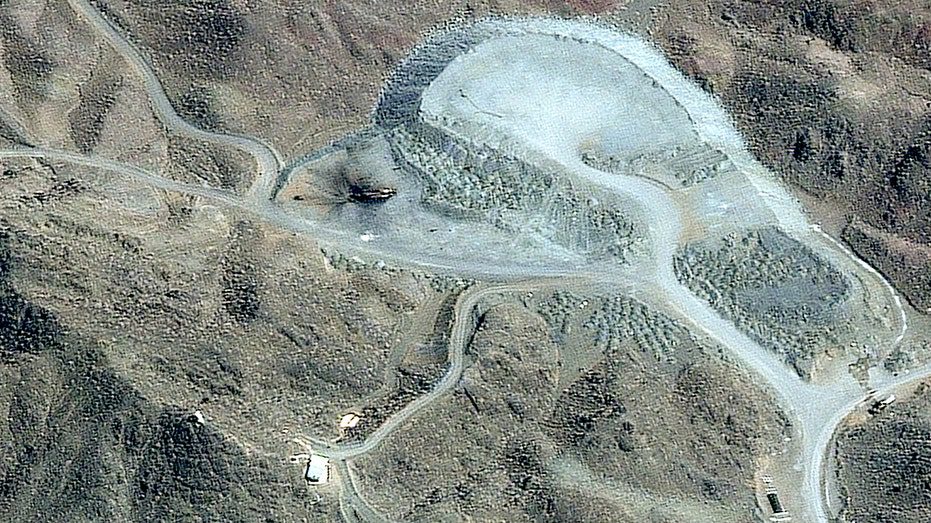
A prominent U.S. research organization focused on monitoring Iran’s nuclear activities has raised concerns about a restricted underground facility in the Zagros Mountains, which remains inaccessible to international inspectors. Known as Pickaxe Mountain, the heavily secured site has not been visited by personnel from the International Atomic Energy Agency (IAEA), fueling doubts about Iran’s compliance with the terms of a memorandum of understanding established with the Trump administration. On February 28, 2026, the U.S. and Israel initiated Operation Epic Fury, targeting Iran’s nuclear and missile infrastructure.
Analysts at the Washington-based Institute for Science and International Security (ISIS) emphasize that suspending construction at Pickaxe Mountain and permitting IAEA access would serve as a meaningful indicator of Iran’s willingness to move away from a history of concealment. Spencer Faragasso, a senior fellow at ISIS specializing in Iran, North Korea, and nuclear proliferation, stated on X: “Important update by us at @TheGoodISIS. The continued activity at Pickaxe Mountain is deeply troubling. Work has progressed consistently since at least 2020. In my assessment, this represents an Iranian contingency plan—if talks collapse, they could be left with a nearly completed nuclear site. Our analysis suggests Pickaxe is likely large enough to house an enrichment facility.”
Iran has previously used sites in Natanz, Fordow, and Isfahan for uranium enrichment, a critical step in developing nuclear weapons. Faragasso added, “If Iran is genuinely committed to diplomacy, halting construction at Pickaxe Mountain would be a credible gesture of goodwill. But how much trust can one place in a regime known for its brutality and duplicity?”
The institute released a detailed assessment based on satellite images from late June 2026, showing persistent operations at Pickaxe Mountain. It noted visible vehicle movement along roads leading to the western tunnel entrances, suggesting ongoing construction and reinforcement of the site—activities that appear to violate the MOU’s requirement to maintain the status quo at nuclear-related facilities.
Meanwhile, the IAEA did not respond to a detailed inquiry from Fox News Digital in late June regarding potential inspection efforts at Pickaxe Mountain. Satellite data analyzed by ISIS also revealed minimal activity at Natanz: access points to underground enrichment chambers remain unrepaired, personnel entrances are still destroyed, and vehicle access routes are heavily damaged. A single vehicle was spotted near the Pilot Fuel Enrichment Plant (PFEP), which was destroyed in June 2025 and later concealed by Iran.
At Esfahan, no significant activity was observed as of June 29, 2026, with tunnel entrances remaining sealed with earth. At Fordow, located within a mountain north of Qom, Iran installed passive defensive structures—earthen and rocky mounds—on access roads between May 10 and May 18. The precise alternating placement of these barriers forms chicanes, designed not to block but to slow down vehicle movement toward the tunnels. Follow-up imagery from June 21 confirmed these structures remain in place, and tunnel entrances continue to be backfilled.
Fox News Digital sent questions to the State Department and the Iranian Mission to the United Nations.