






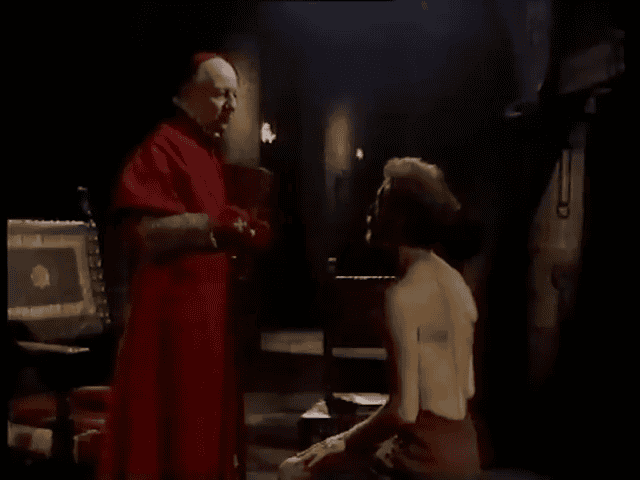
The Grand Inquisitor captures Christ on his return to earth, a performance by Mr Gielgad hard to be matched
“The Grand Inquisitor” is a celebrated story-within-a-story (described by its fictional author as a “prose poem”) from Fyodor Dostoevsky’s final novel, The Brothers Karamazov (1880). It appears in Book V (“Pro and Contra”), Chapter 5, and is widely regarded as one of the most profound and influential passages in modern literature for its exploration of freedom, human nature, faith, authority, and the problem of suffering.
Context in the Novel
The Brothers Karamazov centers on the dysfunctional Karamazov family in a provincial Russian town: the dissolute father Fyodor Pavlovich and his sons—passionate, sensual Dmitri (Mitya); intellectual, skeptical Ivan; and gentle, spiritually inclined Alyosha (Alexei), a novice monk under the elder Zosima. The plot revolves around familial conflict, a murder, and deep philosophical and religious debates.
The Grand Inquisitor episode occurs during a conversation between Ivan and Alyosha in a tavern. It follows the chapter “Rebellion,” in which Ivan rejects the world God has created because it is built on the suffering of innocents—especially children. Ivan cannot accept a harmony purchased at such a price and “returns his ticket” to God. He then offers his poem as a further illustration of his doubts about divine love and human capacity.
Ivan, an atheist or at least a profound skeptic, invents the tale to challenge Alyosha’s faith. Dostoevsky uses the brothers as archetypes: Ivan embodies rational, Western-influenced intellectualism and rebellion; Alyosha represents lived Orthodox Christian faith, active love, and humility. The novel as a whole stages a confrontation between these worldviews, with the Inquisitor legend forming a key part of Ivan’s case against a benevolent God who prioritizes free will.
Summary of the Tale
The story is set in Seville during the height of the Spanish Inquisition in the 16th century. Christ returns quietly to Earth “in the same human image in which he walked among men fifteen centuries earlier.” The people immediately recognize him through his gentle compassion. He heals the sick and raises a dead child, drawing adoring crowds who throw flowers and cry hosannas.
The Cardinal Grand Inquisitor—a nearly 90-year-old, austere figure who has just overseen the burning of nearly a hundred heretics—sees the disturbance, orders Christ’s arrest, and has him imprisoned. That night the Inquisitor visits the silent prisoner in his cell and delivers a long, impassioned monologue.
He explains that Christ has come to “interfere” with the Church’s work. The Church no longer needs him; in fact, it has corrected his fundamental error. Drawing on the three temptations of Christ in the wilderness (Matthew 4), the Inquisitor argues that Christ wrongly rejected Satan’s offers:
- Bread (turning stones into bread): Christ chose spiritual freedom over material security. The Inquisitor claims people will always follow whoever feeds them. The Church provides earthly bread and thereby wins obedience.
- Miracle (casting himself from the Temple to be saved by angels): Christ refused spectacle and mystery that would compel belief. People crave the miraculous and the enigmatic to quiet their doubts.
- Authority (ruling the kingdoms of the world): Christ rejected political power and earthly dominion. The Church has accepted it, ruling in Christ’s name but according to the principles Christ rejected.
According to the Inquisitor, free will is an intolerable burden for the vast majority of weak, rebellious, and suffering human beings. Most people cannot bear the responsibility of choosing between good and evil; they long to surrender their freedom to someone who will decide for them, feed them, and relieve their conscience. Christ’s high estimation of humanity was a tragic mistake that condemned the weak to damnation or misery. The Church, by contrast, has compassionately taken up the burden of freedom itself. It rules through miracle, mystery, and authority, giving people the happiness of obedient children while the elite few (like the Inquisitor) bear the secret knowledge that they are working with the Devil’s principles for humanity’s good. The Inquisitor is even willing to be damned for this “love.”
Christ remains completely silent throughout. At the end he approaches the old man and kisses him gently on the lips. The Inquisitor shudders, opens the door, and tells him to go and never return. Christ leaves into the dark city.
When Ivan finishes, Alyosha is deeply affected. In a parallel gesture of love and forgiveness, he kisses Ivan. Ivan is delighted by the response, though the brothers’ deeper conflict remains unresolved.
Central Themes and Philosophical Depth
The core tension is freedom versus security (or happiness). Christ values human dignity and the freedom to choose freely, even at the cost of widespread failure, doubt, and suffering. The Inquisitor prioritizes universal happiness and order, even if it requires deception, coercion, and the suppression of genuine spiritual freedom. This is not a simple good-versus-evil binary; the Inquisitor presents himself as a tragic humanitarian who understands human weakness better than Christ does.
Dostoevsky links this to broader critiques:
- Organized religion and authoritarianism: The Roman Catholic Church (and by extension any hierarchical institution claiming absolute spiritual or political authority) is portrayed as having abandoned Christ’s original teaching. Many interpreters see the Inquisitor as a stand-in for the atheistic socialism and utilitarian ideologies rising in 19th-century Europe and Russia—systems that promise material welfare and collective happiness at the expense of individual conscience and freedom.
- Human nature: Are people capable of bearing freedom? The Inquisitor’s pessimistic anthropology (most humans are weak “sheep”) contrasts with Christ’s optimistic one. Dostoevsky himself believed freedom was essential to authentic faith and moral growth, even though it entails suffering and the possibility of evil.
- The problem of evil and theodicy: Building on “Rebellion,” the legend questions whether a God who grants radical freedom (and thus permits horrific suffering) can still be called loving. Christ’s silent kiss can be read as an answer that transcends rational argument—unconditional love rather than intellectual justification.
- Silence and response: Christ’s refusal to argue, followed by the kiss, is one of literature’s most powerful non-verbal replies. It affirms love over power and refuses the terms of the Inquisitor’s utilitarian calculus. The Inquisitor is moved but not converted; the kiss “burns in his heart” yet he remains committed to his path.
Interpretations vary. Some see the chapter as Dostoevsky’s strongest case against God (Ivan’s knockout punch). Others view it as ultimately affirming Christ, because the Inquisitor’s logic, however compelling, is revealed as loveless and totalitarian. Mikhail Bakhtin emphasized the dialogic, internally conflicted nature of the text—Ivan is arguing with himself as much as with Alyosha. The legend has been read as a prophecy of 20th-century totalitarianism, a critique of both ecclesiastical and secular power, and a meditation on the perennial human temptation to trade liberty for comfort.
Literary and Cultural Significance
Dostoevsky considered the chapter central to the novel. It has been excerpted and published independently, analyzed endlessly, and adapted in various forms. Its influence extends into philosophy (existentialism, political theory), theology, psychology, and literature. Later thinkers and writers have returned to its dilemmas when confronting authoritarianism, utopianism, or the modern hunger for certainty amid freedom’s burdens. Recent discussions even connect it to contemporary issues such as technological systems that promise to relieve people of decision-making.
The episode’s power lies in its ambiguity and emotional force. It does not resolve the questions it raises; instead it stages them with dramatic intensity, forcing readers to confront the same “pro and contra” that torment Ivan. In the larger architecture of The Brothers Karamazov, it is counterbalanced by the teachings and life of Elder Zosima and by Alyosha’s path of active love, suggesting that Dostoevsky’s ultimate answer lies not in abstract argument but in lived Christian practice—though the novel never simplifies the struggle.
In short, “The Grand Inquisitor” remains a profound examination of what it means to be human: whether we can (or should) bear the weight of freedom, what price we are willing to pay for security and happiness, and whether love can answer the most devastating intellectual challenges to faith.