



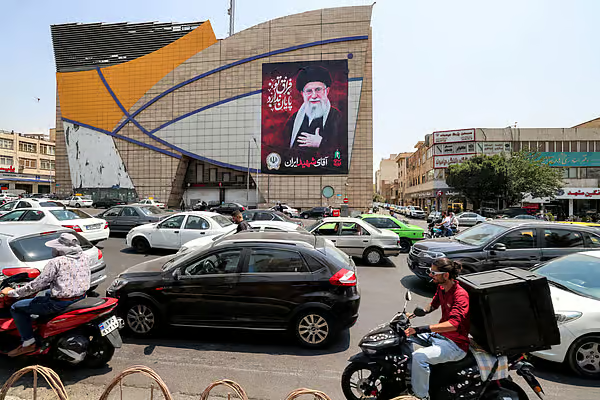
On Sunday, August 16, 2026, Iranian Army Commander-in-Chief Major General Amir Hatami publicly stated that anyone who kills or captures and hands over “invading American military personnel” would receive a reward equivalent to $30,000 (or about 5 billion tomans, an informal Iranian currency unit). The reward would be doubled (to $60,000) if carried out by an Iranian woman.
The offer was framed as a response to a “large number of requests” from Iranians wanting to participate in what Hatami and state media described as “financial jihad” or financial support for the military effort. Additional incentives reportedly include buying the weapon used at double its market value, replacing it with a new one, and potentially displaying the original weapon in a museum.
Key Context and Details
- Source and wording: The announcement came via Iran’s state news agency IRNA (and was widely reported by outlets including AFP, Times of Israel, South China Morning Post, Telegraph, India Today, and others). Hatami referred to “invading” or “aggressor” American personnel and did not specify locations, timelines, or operational details. He also reiterated Iran’s demand that the US leave the Middle East and claimed American forces no longer have permission to enter the Persian Gulf, Gulf of Oman, or Strait of Hormuz.
- No known US ground presence inside Iran: Multiple reports note that there has been no sustained deployment of US ground forces on Iranian territory during the ongoing conflict (which began with US and Israeli strikes on Iran around February 28, 2026). The main exception was a large-scale US rescue operation in April 2026 to recover a downed F-15 weapons systems officer, involving roughly 200 troops and over 170 aircraft. US personnel have been targeted (and some killed) at bases elsewhere in the region, such as in Jordan and Iraq.
- Broader conflict backdrop: The announcement occurs amid a protracted, intermittent confrontation that included an April ceasefire after ~40 days of fighting, a June framework for peace talks that later collapsed, and ongoing friction especially around the Strait of Hormuz. Iran has framed the bounty as both a deterrent and a way to channel public support.
Nuances and Implications
This kind of public bounty is more rhetorical and propagandistic than a practical operational plan in the current environment, given the lack of accessible US ground forces inside Iran. It serves domestic purposes (mobilizing public sentiment, signaling resolve, and responding to reported citizen interest) while escalating external rhetoric. Similar historical precedents exist in various conflicts where states or groups have offered rewards for enemy personnel, but the gender-specific doubling of the reward is a distinctive element highlighted across coverage.
The practical enforceability is limited: verification of any claimed action, payment logistics under sanctions, and the high risk to any individual attempting such acts would all pose major barriers. US responses (if any official ones have been issued beyond the lack of immediate public comment noted in some early reporting) would typically treat this as hostile propaganda rather than a credible new threat vector for forces not currently on Iranian soil.
In short, the headline accurately reflects statements by Iran’s army chief as reported by Iranian state media and confirmed across international outlets on August 16–17, 2026. It fits a pattern of heightened anti-US rhetoric during the current Middle East conflict rather than indicating an imminent, concrete campaign against US soldiers on the ground in Iran.


![On Friday, 10 July 2026, three murder suspects were fatally shot during a brief, intense gun battle with law enforcement on the M25 highway in KwaMashu, Durban. [1, 2]](https://www.durban.jontyknine.co.za/wp-content/uploads/2026/07/three-murder-suspects-were-fatally-shot.jpeg "On Friday, 10 July 2026, three murder suspects were fatally shot during a brief, intense gun battle with law enforcement on the M25 highway in KwaMashu, Durban. [1, 2]")