






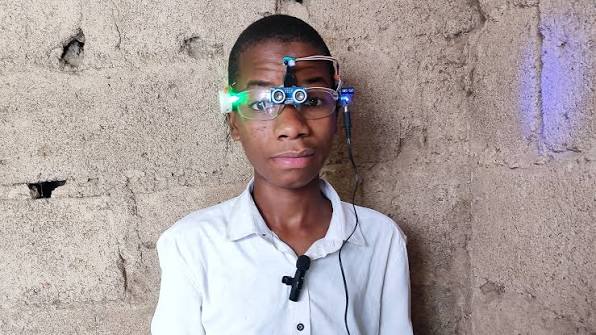
The project began around 2023 after Aminu observed mobility challenges faced by visually impaired people in his community. Early prototypes relied primarily on ultrasonic and infrared sensors to detect nearby objects and provide audio alerts (beeps or similar signals). These were built from locally available electronic components with limited resources and no formal institutional funding or advanced engineering facilities. A visually impaired person in his community tested an early version and provided feedback that shaped improvements, such as smaller components, a wireless switch, better alerts, and design refinements.
Key Features of the Current Version
The newer iteration (Glass V2 / AI Smart Glass) integrates artificial intelligence, sensors (and in some descriptions a camera), and GPS. Core capabilities include:
- Real-time obstacle detection (objects such as walls, poles, cars, or people in the wearer’s path). Alerts come via vibration and/or an alarm/sound so the user can adjust course.
- Location awareness and tracking via GPS. If the wearer becomes lost, the system can send their location to a caregiver’s phone via WhatsApp or email.
- The ability for the user to move without relying solely on a traditional white cane or human guide.
Aminu has described the device as combining AI, sensors, and GPS specifically so the wearer can “detect things in front of them, avoid obstacles, and know their location.” He has publicly shared videos of the system in action, including a recent real-world test with a visually impaired person who responded positively. The hardware has been associated with an ESP32 microcontroller in some accounts of the handmade prototypes.
Voice Technology Development
Aminu is actively working on the next stage: adding AI-powered voice interaction. The goal is for the glasses not only to detect and alert about obstacles, but to describe the surroundings verbally (e.g., identifying what is ahead, providing contextual information about the environment). This would move the device from primarily a detection-and-alert system toward a more conversational assistive companion that helps users understand their environment through spoken descriptions.
Broader Context and Impact
Aminu’s work has drawn attention online (particularly after posts on X/@inventorkhalifa), coverage from Nigerian and international outlets, and earlier interest from Nigeria’s National Commission for Persons with Disabilities. He has also pursued other inventions (such as radio-related projects and agricultural tools). He continues to seek technical and financial support to move beyond prototypes toward wider testing, refinement, and eventual production, with the aim of making the technology more accessible.
This fits into a wider landscape of assistive technology for visual impairment in Africa and globally. Other efforts include phone-based LiDAR apps (such as EyeGuide in Nigeria), multi-language AI glasses projects (for example in South Africa), and commercial systems that offer richer computer-vision descriptions or navigation. Aminu’s approach is notable for its low-resource, locally built origins, emphasis on practical obstacle avoidance plus caregiver location sharing, and the progression toward voice description—features particularly relevant in environments where expensive imported devices may be less accessible.
Limitations to keep in mind: Public information is based largely on the inventor’s demonstrations, social-media posts, and secondary reporting. Detailed independent technical specifications, rigorous third-party clinical testing, battery life, accuracy rates under varied conditions (night, rain, crowded streets, etc.), production costs, and long-term durability have not been widely documented in peer-reviewed or major technical publications. Scaling from functional prototype to reliable, affordable product remains a significant engineering, manufacturing, and regulatory challenge for any assistive wearable.
Overall, the project exemplifies grassroots African innovation addressing a real accessibility need with progressive integration of sensors, GPS, AI, and emerging voice capabilities. Aminu continues refining the system and seeking partnerships to advance it.