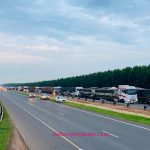




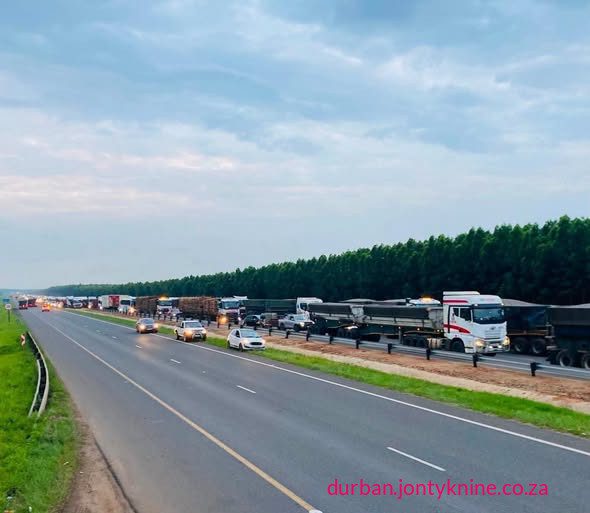
The severe truck congestion on the N2 near Richards Bay (including at the R34 offramp and southbound lanes) is a multi-year, systemic logistics crisis driven primarily by the collapse of South Africa’s rail freight system, compounded by port processing bottlenecks, road infrastructure that was never designed for current volumes, and operational inefficiencies at staging and access points. The image matches widely reported scenes of long lines of heavy trucks (often coal or bulk mineral haulers) occupying lanes, forcing private vehicles into oncoming traffic or causing multi-day delays.
Root Cause: Rail Network Failure and Shift to Road
South Africa’s rail system, operated mainly by state-owned Transnet Freight Rail (TFR), was designed to move bulk commodities such as coal, chrome, and ferrochrome from mines in Mpumalanga, Limpopo, and surrounding areas to the Port of Richards Bay. A single long export coal train can replace hundreds of trucks (estimates commonly cite 200–400 trucks per train depending on configuration).
Key rail problems include:
- Widespread theft and vandalism of infrastructure, especially copper cables for signalling, power, and telecoms. This has caused frequent line closures, reduced capacity, and unreliable scheduling. Incidents have been extensive (historically hundreds of kilometres stolen annually in peak years), though security interventions (drones, intelligence, partnerships with miners, and gradual replacement of copper with less valuable alternatives) have reduced incidents significantly in recent years—e.g., reports of ~50% drops in some periods.
- Declining network availability and reliability: Since around 2017, availability has fallen sharply (reports of ~52% drop in some analyses), reliability has declined, and practical capacity on critical sections has been severely constrained (e.g., far fewer 200-wagon trains per day than designed).
- Locomotive shortages, maintenance backlogs, signalling failures, and derailments.
- Result: Rail volumes on the Limpopo/Mpumalanga–Richards Bay corridor dropped more than 30% from peaks (e.g., from ~78.5 million tonnes in 2015/16 to ~52.6 million tonnes in 2023/24 for key commodities). Coal exports via Richards Bay Coal Terminal (RBCT) fell to multi-year lows around 47 million tonnes in 2023 before partial recovery.
Exporters responded by shifting massive volumes to road. Truck entries at the port exploded—from far lower numbers a decade earlier to over 303,000 trucks in the 2024 financial year (nearly 6,000 per week on average). Roads like the N2 (Ermelo to Pongola/Richards Bay area) were built decades ago for roughly 200 trucks per day; they now face ~2,500 or more, causing rapid pavement failure, potholes, dust (especially coal residue), accidents, and congestion.
There have been credible reports and concerns about organised interests (sometimes described as “truck mafias” or related criminal elements) benefiting from the road shift and potentially contributing to rail sabotage, though the dominant drivers remain Transnet’s operational and security failures plus underinvestment.
Port and Staging Inefficiencies Amplify the Problem
The Port of Richards Bay (and specifically facilities handling bulk exports) was not engineered for this volume of road freight. Key issues include:
- Limited processing capacity at gates, terminals, and stockpiles. Trucks often wait hours or days; manual systems and poor coordination mean arrivals exceed what can be handled smoothly.
- Gate Zero and staging facilities: Introduced to manage queues (opened ~December 2024 in some reports), these have drawn heavy criticism. Transporters pay access fees (around R157 per truck in reports), yet conditions are often poor (unpaved gravel, standing water, tyre/vehicle damage, inadequate sanitation). Industry groups have demanded audits, paving, better facilities, and digital booking systems, arguing the setup adds cost and delay without solving throughput. Queues frequently spill back onto the N2 because there is nowhere else to stage legally or practically.
- Booking/permit systems exist but are imperfectly enforced or coordinated with mines and transporters; trucks still arrive in surges.
- Internal port roads and access routes (e.g., Newark Road upgrades ongoing) suffer damage and capacity limits. Coal dust and environmental complaints have led to access restrictions at certain gates.
The result is trucks occupying multiple lanes, emergency shoulders, and sometimes forcing cars into opposite-direction lanes—exactly as described and shown in the photo. Delays of a day or more for drivers (with limited facilities) are common during peaks. Local municipalities (uMhlathuze) and traffic authorities run contingency plans and 24-hour shifts, issue fines, and try to manage flow, but they cannot fix upstream rail or port capacity.
Broader Context, Impacts, and Partial Progress
Demand spikes (e.g., higher global coal prices at various points) make the problem worse by increasing the incentive to move product by any means. The economic cost is high: higher logistics expenses for exporters, damaged roads (Sanral has highlighted accelerated deterioration), safety risks, pollution (coal dust), community disruption, and lost export potential (Richards Bay has far higher theoretical capacity if rail worked properly—estimates of 80+ million tonnes possible under better conditions).
Recent improvements exist but are incomplete:
- Rail security gains, better locomotive availability, maintenance execution, and some signalling work have lifted coal volumes (RBCT exports rose to ~52–58 million tonnes range in 2024–2025 periods, with further targets toward 60–65+ million tonnes). Transnet and partners aim higher (e.g., corridor targets of 61–70 million tonnes in coming years) with network upgrades and private-sector involvement.
- Port-side road upgrades (Newark Road) and staging attempts continue.
- However, residual truck volumes remain high enough to cause recurring N2 blockages, especially during surges, maintenance, or demand peaks. Full recovery of rail to historic reliable levels has not yet occurred, and road dependency persists.
In short, the scene in the photo is the visible symptom of a broken freight logistics chain: rail was supposed to carry the bulk of this traffic efficiently and safely, but years of theft, under-maintenance, capacity loss, and related failures forced an unsustainable shift to trucks. The port and surrounding roads cannot absorb that volume without chronic congestion, safety risks, and infrastructure damage. Solving it requires sustained rail recovery (security, rolling stock, signalling, private participation), better digital coordination of truck arrivals, proper staging infrastructure, and road rehabilitation—progress is underway but the backlog and structural problems remain significant.