


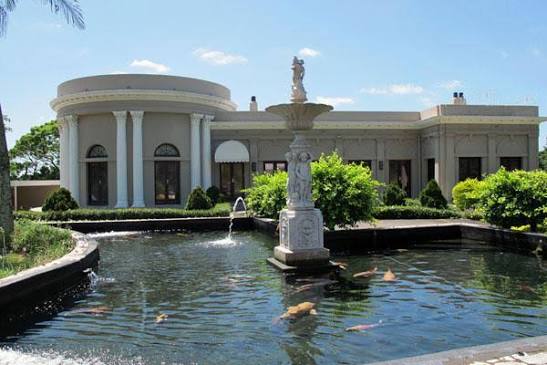
Capricorn (also known as the Glass House, Spookhuis, or Round House) is a distinctive mansion on Fields Hill (Tracy Watts Road) in Pinetown, KwaZulu-Natal, South Africa, built in 1936 by the eccentric German-born businesswoman Georgia Anna Boediker (later known as Shanghai Lil or Mrs Gale).
It stands as a local landmark overlooking Pinetown, visible from the road, and has long fascinated residents due to its unusual architecture, the mystery surrounding its owner, wartime rumours, and persistent local legends. The property is extant (still standing) and has served various commercial uses in later decades.
Origins and Construction
Georgia Anna Boediker was born in Bavaria in 1891, the daughter of William Boediker (died 1937) and Barbara H. Boediker (died 1946). She arrived in Durban from Korea in 1929. For about a decade she ran the Arts and Crafts shop at 457 West Street, specialising in Oriental ornaments, textiles, and artefacts imported from the Far East (including camphor wood boxes from Hong Kong). She was a tall, striking, unconventional woman who customarily wore Chinese-style clothing, a single earring, and drove a large American Lincoln car. Locals nicknamed her “Shanghai Lil.” She never married, lived largely alone (with Pekingese dogs, cats, and two servants, George Mabele and Elizabeth), and was known for refusing conventional social norms—she even addressed the mayor simply as “Payne.” She later adopted the surname Gale after her English diplomat/merchant stepfather, who had spent years in Korea.
In 1933 she purchased an existing property at 23 Tracy Watts Road on Field’s Hill. The site had previously housed St Elizabeth’s, a girls’ school that was a forerunner of St Mary’s DSG in Kloof, and formed part of the inheritance of one of Jack Field’s daughters. She rebuilt it as a replica of a wing of Frederick the Great’s Sanssouci Palace near Potsdam, Prussia. The architect was Wilfred (or Wilfrid) Stonehouse Payne of the firm Payne & Payne. Construction was completed in 1936 at a cost of £12,000 (a substantial sum at the time). She named the house Capricorn.
The house was originally painted blue and white (matching the historic colours of Sanssouci). Key features included:
- Three entrance halls with marble floors.
- Two large circular lounges, one known as the Mirror Room (or music room): approximately 10.5 metres in diameter with a domed ceiling about 9 metres high, South African marble pillars, rose-tinted mirrors, German oak floors, and a lime-green lacquered Steinway piano decorated with Chinese scenes.
- A second lounge with walls of silk and camphor wood (from her imported boxes), plus a marble-and-onyx fireplace with a 1937 painting by Ernie Stokoe above it.
- Four marble fireplaces overall; an old-fashioned kitchen with marble floors (the only room with windows—four of them).
- 31 teak double doors leading to the garden, but very few windows.
- Intricate exterior relief work.
- Décor blending Chinese, German, French, and Austrian influences.
- Nearly all materials imported except the South African marble used for floors, fireplaces, and pillars.
- A garden with three swimming pools (or a shallow pool, fishpond, birdbath, and pergolas in some accounts), a large rainwater tank (reflecting her fear of water shortages), a self-contained guest cottage, garage, and other outbuildings.
- Notably, during her lifetime the upper and lower levels were not internally connected; access between them required going outside.
Over time it acquired popular nicknames: Glass House (perhaps from the light or reflective qualities of the round rooms and doors), Spookhuis (Afrikaans for “haunted/ghost house”), Round House, and Shanghai Lil’s. One rumour claimed it had been considered for a brothel by someone named Rosy Dry, but the layout was unsuitable.
Wartime Rumours and Local Legends
Boediker’s German origins, Asian connections, flamboyant style, and isolated hilltop location made her a target of intense local speculation, especially after World War II began in 1939 (when she was technically an enemy alien, though no official action appears to have been taken against her). Rumours claimed Capricorn served as a safe house for German spies; that she monitored Allied shipping movements in Durban Harbour from the property or nearby “Spy Hill” in Wyebank; and that she operated a hidden radio transmitter to report to Berlin. The area was sometimes called Spy Hill. No evidence of these activities was ever produced.
Other persistent legends included a solid gold Buddha statue buried on the grounds or hidden in a wall panel; treasure concealed in the kitchen; underground rooms or passages; a ditch around the house containing silver-coloured snakes; the murder of a Chinese man whose body was buried under a pool; and opium smuggling via her camphor wood import boxes. Again, no supporting evidence emerged. She was known to be generous, helping people in Durban and Pinetown, and in her final years was fond of a young neighbour, Jeffrey Nicholson (who lived with his parents in the guest cottage), playing music for him and letting him swim.
Later Years, Death, and Aftermath
Boediker suffered health problems from late 1950 and a stroke in December. A second stroke led to her admission to Parklands Nursing Home in Durban on 4 January 1951; she died around 6 January 1951 at age 60. She was buried in Stellawood Cemetery on a rainy day, attended by about 40 friends (mostly women). Remarkably, she left no photographs of herself. She died intestate (without a signed will), so her estate took time to settle. A public auction of contents was held at Capricorn on 17 July 1953 (attended by around 200 people); the house itself had been auctioned the previous week. The Steinway piano sold for 350 guineas (valued at £600). The property later sold for £7,500, with proceeds reportedly going to her siblings.
Subsequent Ownership and Use
After her death the property changed hands multiple times (accounts mention only a handful of owners in the decades that followed). It was used as a restaurant for a period (with rooms given names such as the Queen’s Ballroom for breakfast buffets and King Fred’s Room as a waiting area; a “secret room” associated with the radio rumour became a wine cellar in one description). The restaurant venture was relatively short-lived. More recently it has served as office and warehouse/business premises. By the 2000s–2010s it was described as lemon-yellow in colour in at least one account. It remains a private property visible from the road on Fields Hill but is not open to the public. Local interest and legends (including the golden Buddha) have continued into the 21st century.
Architectural and Cultural Context
The design deliberately evoked European (specifically Prussian) grandeur while incorporating extensive imported Asian and European materials and a highly unconventional layout that prioritised the circular rooms, multiple exterior doors, and limited windows. Architect Wilfred Stonehouse Payne (1876–1958) was a prominent Durban practitioner with a long career that included hospitals and other buildings; Capricorn is one of the more distinctive residential commissions associated with his firm. The house’s isolation on the hill, striking form, and association with a flamboyant, independent foreign woman who defied local norms ensured it became a focus of folklore in the conservative Durban/Pinetown area of the mid-20th century.
In short, Capricorn is both a concrete architectural artefact of 1930s Durban high-society eccentricity and a vessel for decades of rumour, wartime paranoia, and local storytelling. Primary detailed accounts draw especially from research by Anne Lehmkuhl published in The Witness (2007) and subsequent local historical write-ups that build on it.