






The 1937 Master’s Thesis: Switching Theory
At 21, while working on Vannevar Bush’s differential analyzer at MIT, Shannon observed that electromechanical relays have two stable states (open/closed). He had just encountered Boolean algebra (true/false, 1/0). His thesis, “A Symbolic Analysis of Relay and Switching Circuits,” demonstrated that the two systems are mathematically isomorphic: any Boolean expression can be realized as a network of switches, and any switching circuit can be reduced to a Boolean formula.
This was not merely an analogy. It supplied the first rigorous design method for complex logic circuits and proved that the entire apparatus of propositional logic could be embodied in hardware. Howard Gardner’s assessment that it may be the most important master’s thesis of the century is widely shared among historians of computing. Every subsequent digital computer—from the relay-based machines of the 1940s through vacuum tubes, transistors, and integrated circuits—rests on that insight. Without it, the leap from analog calculation to programmable digital machines would have been far slower and more ad-hoc.
Cryptography and Perfect Secrecy (1945/1949)
During World War II, Shannon worked at Bell Labs on classified problems, including contributions to SIGSALY (the scrambled-voice system used by Roosevelt and Churchill). In a 1945 memorandum (declassified and published in 1949 as “Communication Theory of Secrecy Systems”), he gave the first rigorous definition of perfect secrecy: a cipher is perfectly secret if the ciphertext yields no information about the plaintext beyond its a-priori probability. He proved that the one-time pad (and only systems informationally equivalent to it) achieves this absolute security against an adversary of unlimited computational power.
This transformed cryptography from an empirical craft into a mathematical science. It supplied the conceptual foundation later used in the design of DES, AES, and modern notions of semantic security. The same paper also introduced the idea of measuring the “key entropy” required for security—an early appearance of the entropy concept that would soon dominate his public work.
The 1948 Paper and Information Theory
“A Mathematical Theory of Communication” (Bell System Technical Journal, 1948) is the founding document of the field. Shannon defined information quantitatively via the entropy formula
H=−∑p(x)logp(x)
(with the logarithm base determining the unit—bits when base 2). He showed that this quantity is the average number of binary digits needed to encode messages drawn from a given source, established the existence of a channel capacity C that is both an upper bound on reliable communication rate and asymptotically achievable with suitable coding, and unified the previously separate domains of telegraphy, telephony, and radio under a single mathematical framework.
Contemporary reactions were mixed precisely because the paper sat at the intersection of engineering and pure mathematics; some mathematicians found the engineering motivations distracting, while some engineers found the abstractions forbidding. Its influence proved decisive. Robert Lucky’s characterization of it as among the greatest works “in the annals of technological thought” reflects the consensus that later emerged.
Direct Lineage into Modern AI and Machine Learning
Shannon’s entropy is not a historical curiosity; it is operational inside today’s systems:
- Cross-entropy loss, the workhorse training objective for classification and language modeling, is the cross-entropy between the true distribution and the model’s predicted distribution. Minimizing it is equivalent to maximizing the likelihood of the data under the model.
- Information gain in decision trees is the reduction in Shannon entropy achieved by a split.
- Perplexity, the standard evaluation metric for language models, is simply 2H (or eH depending on the base), an exponentiated cross-entropy.
- Rate-distortion theory, mutual information, and the information bottleneck principle all descend directly from the 1948 framework and appear in modern representation learning and compression research.
Thus every time a neural network is trained with cross-entropy, Shannon’s formula is being evaluated inside the computational graph.
Early AI Experiments
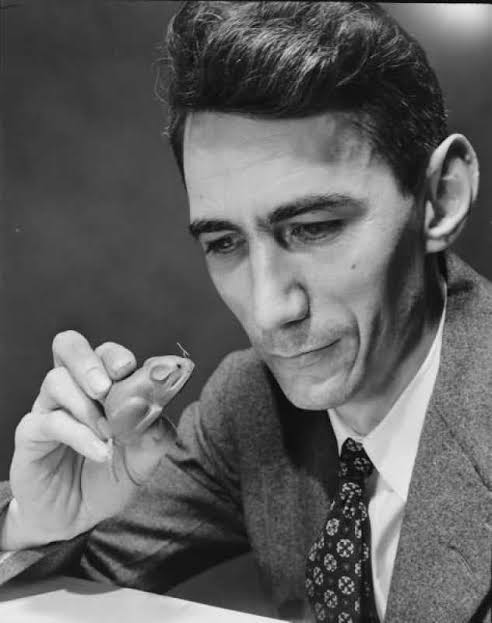
In 1950 Shannon built Theseus, a magnetized mechanical mouse that learned to navigate a reconfigurable maze by trial-and-error, stored the successful path in a relay memory, and could then traverse it rapidly. Mazin Gilbert’s remark that Theseus “inspired the whole field of AI” is slightly hyperbolic but captures its symbolic importance: it was an early demonstration of machine learning by reinforcement in a physical environment. The same year he published “Programming a Computer for Playing Chess,” the first serious paper on computer chess, introducing the minimax idea with limited depth and evaluation functions. He was also one of the organizers of the 1956 Dartmouth Summer Research Project on Artificial Intelligence—the meeting that coined the term “artificial intelligence” and launched the field as a self-conscious discipline.
Personality and Later Life
Shannon’s eccentricity was not ornamental; it was continuous with his curiosity-driven method. He rode a unicycle through Bell Labs corridors (sometimes juggling), built a flame-throwing trumpet, a rocket-powered Frisbee, and foam shoes for walking on water, and named his home Entropy House. When asked about motivation he consistently answered that financial reward was irrelevant; he simply wanted to understand how things worked. The 1985 Brighton conference anecdote—where he was treated like a visiting Newton and responded by juggling—illustrates the quasi-mythic status he had acquired among communication engineers.
He died in 2001 after a long decline from Alzheimer’s disease. The irony that the man who quantified information should lose the ability to process it has been noted by nearly every biographer.
Naming of the Claude Models
Anthropic’s decision to name its family of models “Claude” is an explicit homage to Shannon. The choice underscores that the statistical and information-theoretic foundations of modern large language models are not accidental; they are direct intellectual descendants of the 1948 paper and the entropy concept.
Broader Implications and Nuances
Shannon’s work is often presented as pure triumph, yet several nuances repay attention:
- He deliberately restricted the 1948 theory to the technical problem of reliable transmission, explicitly setting aside semantic and pragmatic questions (“the semantic aspects of communication are irrelevant to the engineering problem”). Later fields—semantics, pragmatics, philosophy of information—had to be developed separately.
- The channel-capacity theorem is an existence result; practical codes that approach capacity required decades of subsequent work (turbo codes, LDPC, polar codes).
- Perfect secrecy is information-theoretic and therefore absolute, but it demands keys as long as the message and never reused. Computational cryptography (one-way functions, public-key systems) trades absolute security for practicality and is the dominant paradigm today.
- Shannon himself was modest about priority. He acknowledged earlier contributions (Nyquist, Hartley) and was careful not to overclaim.
In short, the 32-year-old who published a paper that initially puzzled both engineers and mathematicians supplied the conceptual operating system of the digital age. The bit, the entropy formula, the capacity theorem, the reduction of logic to switching circuits, and the information-theoretic treatment of secrecy remain the invisible infrastructure of computing, communication, cryptography, and machine learning. The naming of an AI system after him is less a marketing flourish than a recognition of intellectual lineage.