


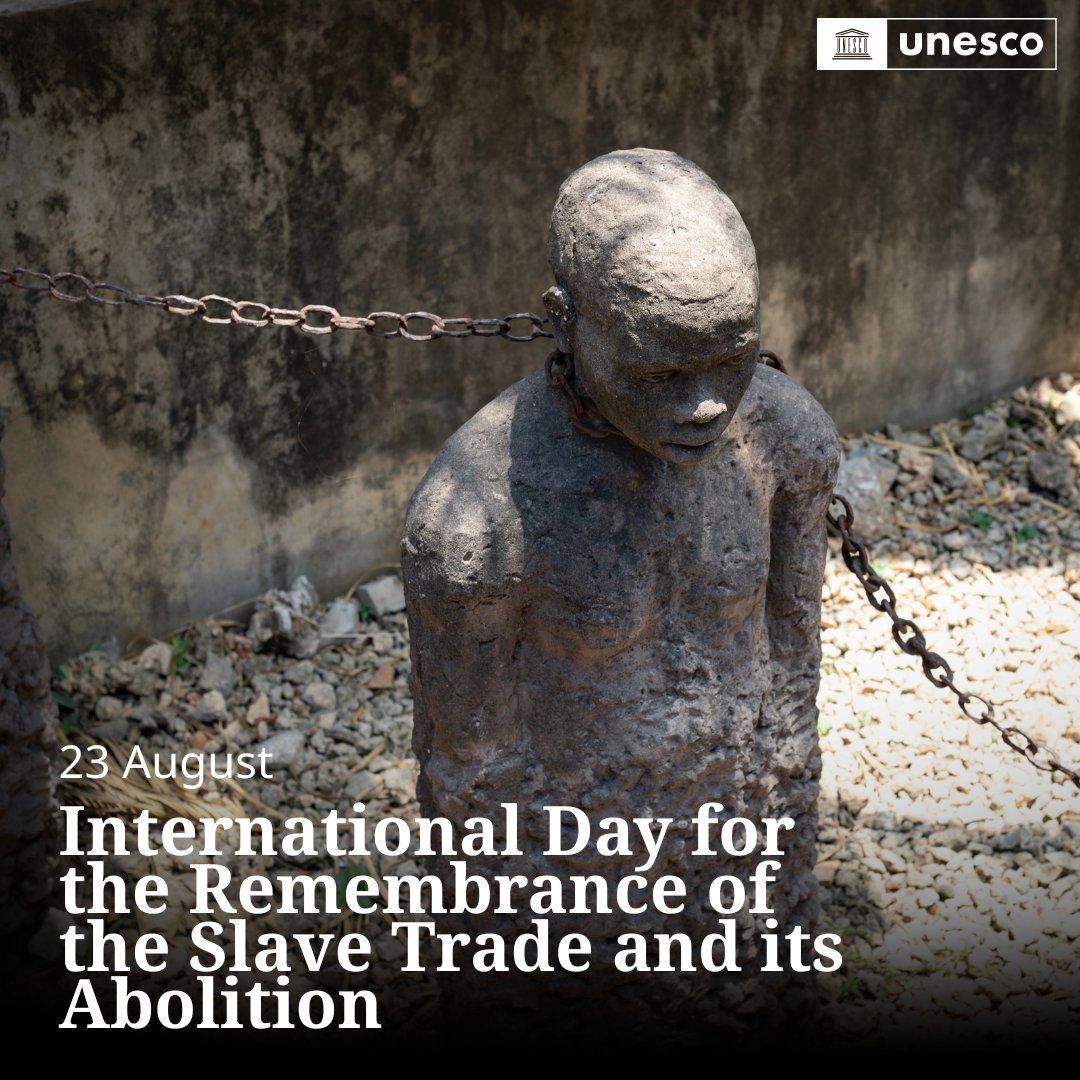
Why August 23?
The date commemorates the night of 22–23 August 1791, when enslaved people in the French colony of Saint-Domingue (present-day Haiti) began a major uprising. This revolt became a central catalyst in the Haitian Revolution, which ultimately abolished slavery there and established Haiti as the first independent Black republic in 1804—the only state founded by people who freed themselves from slavery through successful armed resistance.
UNESCO formally designated the day in 1997 (Resolution 29 C/40). It was first observed in Haiti in 1998 and on Gorée Island (Senegal) in 1999. The goal is to inscribe the tragedy of the transatlantic slave trade in collective memory, examine its causes, methods, and consequences, and analyze the interactions it created among Africa, Europe, the Americas, and the Caribbean. It also serves as a platform for reflection on ongoing forms of exploitation, racism, and discrimination that stem from this history.
A related but distinct UN observance is the International Day of Remembrance of the Victims of Slavery and the Transatlantic Slave Trade on 25 March (linked to the 1807 British Abolition of the Slave Trade Act).
Scale and Nature of the Transatlantic Slave Trade
Between the 16th and 19th centuries, European powers and their colonial systems transported an estimated 10–12.5 million Africans across the Atlantic (figures commonly cited from databases such as SlaveVoyages). Roughly 10.7–11 million survived the Middle Passage. The trade formed one leg of the triangular trade: European goods to Africa, enslaved people to the Americas, and plantation commodities (sugar, coffee, tobacco, cotton, etc.) back to Europe.
Major European participants included Portugal/Brazil, Britain, France, the Netherlands, Spain, and others. The peak occurred in the 18th century. The trade and the system of chattel slavery it fed were racialized, hereditary, and commercialized on an unprecedented scale. Enslaved people were treated as property; the violence of capture, the Middle Passage, and plantation life produced enormous mortality and trauma. Resistance took many forms—day-to-day defiance, marronage (escape and independent communities), cultural retention, and large-scale revolts such as the one in Saint-Domingue.
The trade devastated regions of West and Central Africa demographically, socially, and economically while generating wealth that helped finance European industrialization and colonial expansion. Its legacies include the African diaspora across the Americas and Caribbean, profound cultural syncretism (music, religion, language, cuisine), and enduring racial hierarchies and inequalities.
Forms of Remembrance and Memorialization
Remembrance takes many concrete forms worldwide:
- Museums and sites of memory: International Slavery Museum (Liverpool, opened 23 August 2007), Cape Coast and Elmina Castles (Ghana), Gorée Island (Senegal), sites in Brazil (e.g., Salvador), the International African American Museum (Charleston, South Carolina), and many others. UNESCO’s “Routes of Enslaved Peoples” programme (formerly Slave Route Project) links these places and supports research, education, and heritage preservation.
- Monuments: The Ark of Return (permanent memorial at UN Headquarters in New York, unveiled 2015, designed by Haitian-American architect Rodney Leon); London’s planned The Wake (a large bronze cowrie-shell sculpture by Khaleb Brooks at West India Quay, expected around 2026); monuments in Rotterdam, Mauritius (Le Morne Slave Route Monument), and numerous Caribbean and African locations.
- Annual events and education: Walks of Remembrance (e.g., Liverpool), lectures, performances, school programmes, and cultural festivals. Cities and institutions with historical ties to the trade (ports such as Liverpool, Bristol, Nantes, Bordeaux, Amsterdam, Lisbon, etc.) often host specific commemorations. National Museums Liverpool, the National Maritime Museum (Greenwich), and many others run dedicated programmes on or around 23 August.
- Broader initiatives: UN Outreach Programme on the Transatlantic Slave Trade and Slavery; UNESCO educational materials; academic research; community-led memorials; and cultural expressions (music, literature, visual arts) that keep memory alive.
Remembrance is not uniform. In some places it emphasizes victimhood and trauma; in others, resistance, survival, and cultural creativity; in still others, the need for historical honesty as a foundation for addressing contemporary racism and inequality. Debates continue over curricula, public monuments, formal apologies, and reparations.
Broader Context and Contemporary Relevance
Slavery and the trade in enslaved people existed in many societies long before the transatlantic system (including within Africa, the Islamic world, Europe, and elsewhere). The transatlantic trade stands out for its scale, duration, racial ideology, and integration into the emerging capitalist world economy. Abolition was gradual and uneven—driven by economic shifts, evangelical and Enlightenment ideas, slave resistance, and political pressure—and was followed in many places by systems of coerced labour, segregation, and discrimination.
Today the day is also framed as a call to confront modern forms of exploitation, human trafficking, and racial injustice. UNESCO and UN messages often stress that understanding this history is essential to building more just societies and to recognizing the equal dignity of every person.
In short, 23 August is both a specific historical memorial to the 1791 uprising and a global invitation to remember the millions affected by the transatlantic slave trade, honour those who resisted, study its causes and consequences, and reflect on its living legacies. Events, exhibitions, educational resources, and public discussions take place in many countries on or around this date.
Slave trading and slavery in what is now South Africa were concentrated in the Cape Colony and formed a central part of its colonial economy from the mid-17th century until the 1830s. It belonged primarily to the Indian Ocean slave trade networks rather than the much larger transatlantic trade.
Scale and Numbers
Historians estimate that roughly 60,000–63,000 enslaved people were imported into the Cape between the establishment of the Dutch East India Company (VOC) settlement in 1652 and the effective end of the external slave trade around 1808. Robert Shell’s widely cited figure is approximately 63,000 (sometimes refined to about 62,964 in detailed calculations). Some broader estimates that include later “prize negroes” (Africans liberated from intercepted slave ships and indentured at the Cape) push the total of first-generation arrivals higher, toward 70,000–80,000 when counting the period up to the mid-19th century.
At the time of formal emancipation, the enslaved population stood at roughly 36,000–39,000 (around 38,000–38,400 in the early 1830s). The enslaved population grew through a combination of continued imports and limited local births, but high mortality rates meant the colony depended heavily on ongoing importation for much of the period. By the late 18th century, slaves often outnumbered free burghers (settler colonists).
VOC-sponsored slaving voyages themselves delivered a relatively modest number—around 4,300 people on roughly 39 expeditions (mostly to Madagascar). The majority of imports arrived through private trade by company officials, free burghers, foreign ships (including Portuguese vessels), and other commercial channels.
Origins of the Enslaved
Cape slaves came from a wide range of Indian Ocean and adjacent regions, reflecting the VOC’s trading network. Approximate overall proportions of the ~63,000 imported (Shell’s breakdown) are:
- African continent (mainly Mozambique and the East African coast): ~26.4%
- Indian subcontinent (including Bengal, South India, Sri Lanka): ~25.9%
- Madagascar: ~25.1%
- Indonesia / Southeast Asia (Java, Sumatra, Celebes, etc.): ~22.7%
There was chronological variation:
- Early years included some West Africans (e.g., from Angola or Dahomey, often via captured Portuguese ships in 1658).
- The early-to-mid 18th century saw heavy reliance on India and Southeast Asia.
- Later decades (especially after the 1780s) shifted more toward Mozambique and Madagascar.
- Company voyages focused heavily on Madagascar; private and foreign trade diversified the sources further.
This multi-origin character distinguished Cape slavery from many New World plantation systems that drew more uniformly from West and West-Central Africa.
Nature and Role in the Colony
Slavery underpinned the Cape’s labour system from the 1650s onward. The VOC initially used Company-owned slaves (housed in the Slave Lodge in Cape Town) for docks, farms, and public works. Free burghers increasingly bought slaves for domestic service in Cape Town and for labour on grain, wine, and pastoral farms in the interior. By the 18th century the Cape was a true slave society: slavery shaped the economy, law, social hierarchy, and daily life.
Conditions were often harsh. Mortality was high, family formation was constrained, and resistance took forms such as desertion, individual defiance, and occasional larger uprisings (notably in 1808). Some runaways joined Khoisan groups or formed maroon communities. Indigenous Khoikhoi and San peoples were also subjected to various forms of coerced labour and dispossession, though this was not always formalised as chattel slavery under the same legal framework as the imported slaves.
Abolition
Britain occupied the Cape permanently from 1806. The British Slave Trade Act of 1807 ended the external trade (enforced from 1808), after which only internal trading of existing slaves was permitted. Full emancipation came with the British Slavery Abolition Act: slavery ended on 1 December 1834, followed by a period of “apprenticeship” that concluded in 1838. Owners received compensation (though less than initially hoped). About 39,000 people were freed.
Comparative Context and Legacy
Relative to the transatlantic trade (an estimated 10–12.5 million Africans embarked), the Cape trade was small—roughly half a percent of that volume. Within the Indian Ocean world and for the modest-sized Cape Colony, however, it was transformative. It created a creole slave population of mixed African, Malagasy, Indian, and Southeast Asian descent whose cultural, linguistic, and genetic legacies remain visible in the Western Cape (including aspects of Cape Malay / Muslim communities and broader Coloured identities).
South Africa’s slavery history is therefore distinct from the classic Atlantic plantation model yet fully integrated into global histories of forced migration, colonial labour systems, and the long struggle against slavery. Sites such as the Iziko Slave Lodge in Cape Town and research by historians including Nigel Worden, Robert Shell, and others continue to document this history as part of broader remembrance efforts.