





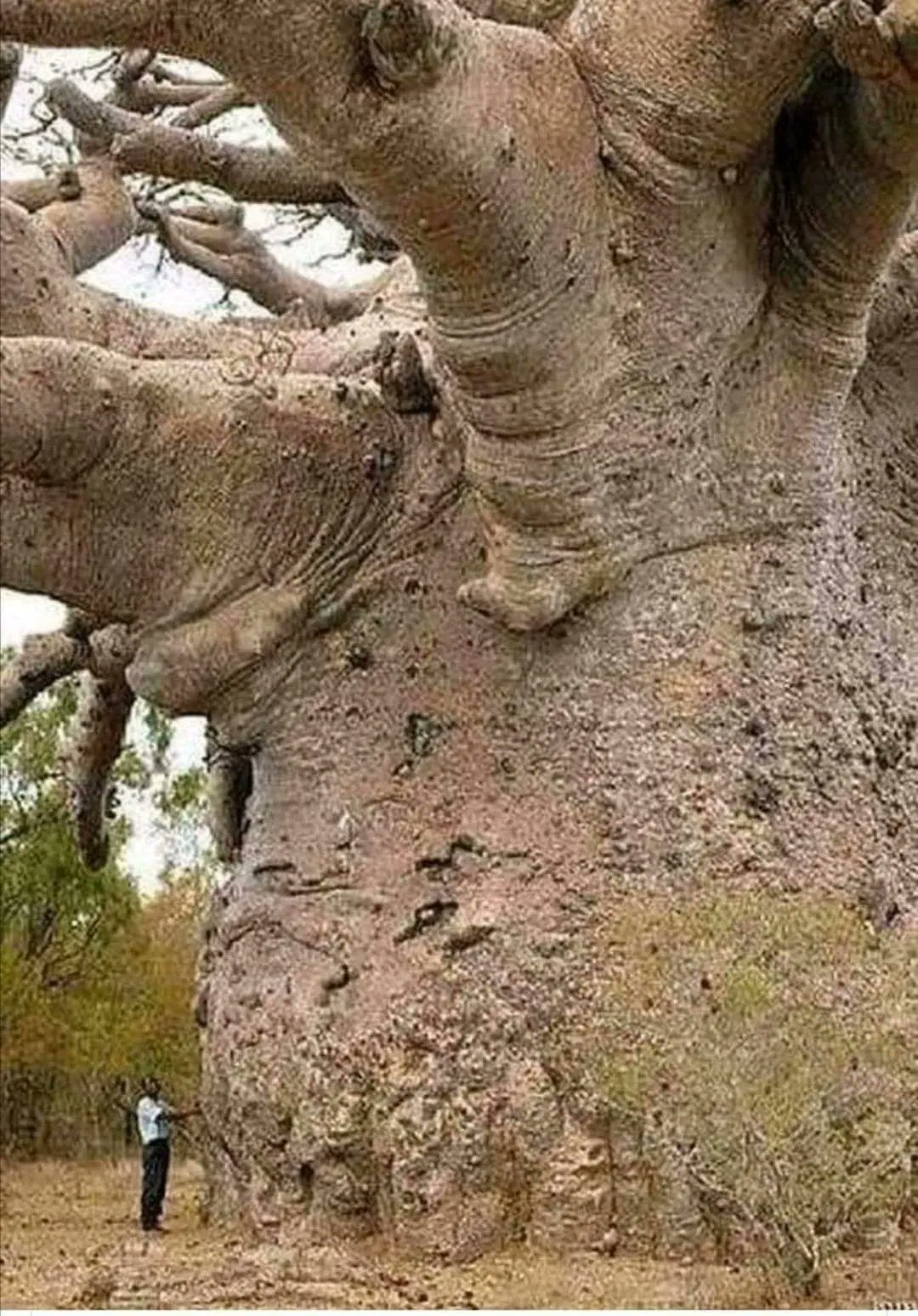
There is no verified 6,000-year-old tree in Tanzania (or anywhere else). This is a long-running, repeatedly debunked viral claim that pairs a photo of a large African baobab (Adansonia digitata) with an exaggerated age and incorrect or uncertain location.
The Viral Claim and Why It’s Incorrect
The exact phrasing you used (“Oldest tree in the world. 6000 years. Tanzania. Africa.”) and the associated image have circulated on social media for years (documented since at least 2004). Early versions often attributed the photo to Senegal rather than Tanzania. Fact-checkers including Snopes, AFP, PesaCheck, and others have rated it false or miscaptioned.
Key points:
- No individual tree anywhere has been scientifically verified at 6,000 years or older.
- The pictured tree is a baobab. These are famous for massive girth, water-storing trunks, gnarled bark, and multi-stem architecture that can make them look extraordinarily ancient even when they are “only” centuries to a couple of millennia old.
- Baobab wood is soft/fibrous and does not form reliable annual rings the way many temperate trees do, so ages come primarily from radiocarbon dating of wood samples rather than simple ring counts.
- The oldest confirmed baobab was the Panke tree in Zimbabwe, radiocarbon-dated to roughly 2,450 years old before it died around 2011. Other large specimens have been dated in the 1,000–2,100+ year range. Claims of 3,000+ or higher for living baobabs remain unconfirmed at the extreme end and none approach 6,000.
Older popular estimates (including for trees like the Sunland Baobab) that once floated higher ages were later revised downward by carbon dating.
Actual Oldest Known Trees
The verified record holders are Great Basin bristlecone pines (Pinus longaeva) in the high mountains of the western United States (California/Nevada area):
- The named tree Methuselah is approximately 4,850+ years old (cross-dated via tree-ring analysis).
- An unnamed living bristlecone is reported as even older (around 5,000+ years in some accounts).
- A previously cut specimen known as Prometheus was nearly 5,000 years old when felled in 1964.
These ages come from careful dendrochronology (coring and cross-dating rings against regional chronologies). Locations of the oldest living individuals are kept secret or restricted to protect them from damage or vandalism.
Other notable contenders and long-lived trees include:
- Certain Fitzroya cupressoides (alerce/Patagonian cypress) in Chile, with estimates for some individuals reaching into the 3,600–5,000+ year range depending on the specimen and method (one high-profile candidate, sometimes called Gran Abuelo/Alerce Milenario, has been modeled around 5,000+ years but is not as straightforwardly confirmed as the bristlecones).
- Giant sequoias and other conifers that commonly exceed 2,000–3,000 years.
- Clonal organisms (genetically identical colonies connected by roots, such as Old Tjikko, a Norway spruce in Sweden with a root system estimated near 9,500 years, or certain aspen or other clonal systems) can be far older, but these are not single individual stems in the same sense.
Baobabs remain among the longest-lived angiosperms (flowering plants), which is impressive in its own right, but they do not hold the overall record for individual non-clonal trees.
Trees in Tanzania / Africa
Tanzania has impressive and culturally significant trees, including large baobabs (especially notable in places like Tarangire National Park). Some local specimens are reasonably estimated in the multi-century to low-thousands range, consistent with the species’ known longevity, but none are verified at anything approaching 6,000 years.
A more recent and scientifically interesting discovery involves Tessmannia princeps, a newly described rainforest tree species from the Udzungwa Mountains area in Tanzania. Based on growth-ring density in fallen material and the trees’ size/structure, some mature individuals have been estimated potentially up to around 2,000–3,000 years old. This is still preliminary (radiocarbon confirmation would strengthen it) and the population is small and restricted, making the species of conservation interest. It does not approach the viral 6,000-year claim and is not a baobab.
Africa’s tallest known indigenous tree is an Entandrophragma excelsum on the slopes of Kilimanjaro in Tanzania (measured at about 81.5 m), but its estimated age is only around several hundred years.
Why These Claims Persist and Broader Context
Huge, weathered trees with people standing beside them for scale are visually powerful and easily inspire exaggerated age claims. Social media amplifies them. Scientifically, extreme longevity is rare, tends to occur in harsh high-elevation or otherwise stressful environments that slow growth, and is rigorously documented only through methods like cross-dated ring counts or radiocarbon analysis of carefully sampled wood. Climate change and other pressures have also been linked to the recent deaths of some of the largest/oldest known African baobabs.
In short: the 6,000-year Tanzania baobab claim is a myth. The real record holders are ancient bristlecone pines in the western U.S., with other remarkable long-lived trees (including some African species) documented in the 2,000–3,000+ year range under careful scientific scrutiny. Baobabs and Tanzania’s forests remain fascinating for their ecology, cultural importance, and genuine longevity—just not at the extreme age circulating in the viral posts.