





President Volodymyr Zelenskyy confirmed the use of these advanced systems and noted Ukraine’s ongoing efforts to field new interceptor drones. The attack killed multiple people (including at least two at the National Academy of Sciences in central Kyiv) and injured dozens nationwide, underscoring Russia’s evolving aerial campaign and the technological arms race in the skies.
Details of the September 28 attacks
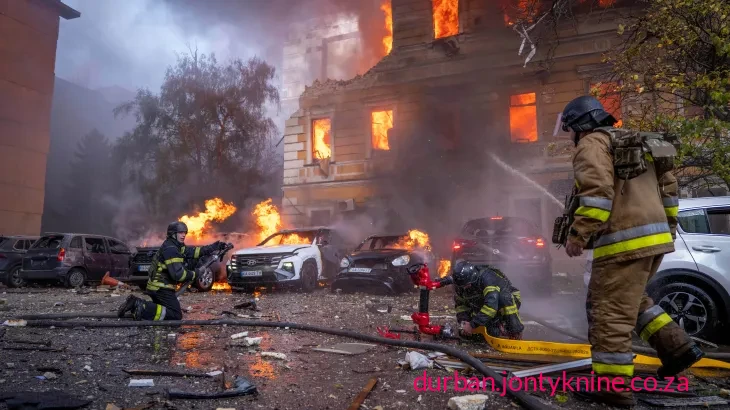
Waves of drones struck central Kyiv in daylight, with black smoke rising over the city. A jet-powered drone hit the historic National Academy of Sciences building (a 19th-century structure housing the Presidium, near the German embassy, National Opera, and other landmarks). Flames engulfed parts of the building; people were seen escaping through windows. Emergency services recovered bodies from the rubble, confirming two deaths there (initial reports noted one, with the toll rising). Among those affected was Volodymyr Horbulin (first vice-president of the academy and former National Security and Defence Council secretary), who sustained minor injuries; his assistant was among the dead. Academy leadership described it as an attack on science and “terrorism,” while noting the institution’s civilian research focus (though it has historical defense-sector ties).
Other Kyiv targets included a pharmaceutical company, petrol stations, and a medical facility (or education complex near the Constitutional Court). Kyiv Mayor Vitali Klitschko reported around 19–24 injured in the capital, with several hospitalized. Across Ukraine, strikes hit civilian facilities, businesses, and infrastructure; reports indicated at least nine deaths and more than 80 injuries nationwide (figures varied slightly by source as updates came in). In Dnipro, a business-center strike killed three and injured around 19. Attacks continued into subsequent hours/days, with further explosions and debris impacts reported in Kyiv.
Ukrainian Air Force and Zelenskyy data indicated a high proportion of jet-powered drones in the wave (e.g., roughly 86–90 of about 120–124 total drones in one accounting, or around 75% in related figures). Interception rates for these were reported around 50–57%, far below the >90% often achieved against older propeller-driven models.
The jet-powered drone threat and Russia’s shift
Russia has scaled up use of jet-powered one-way attack drones (primarily evolved Geran/Shahed variants such as Geran-4 and Geran-5) throughout summer and into September 2026. These replace or supplement the slower piston-engine Geran-2/Shahed types (typically under ~200 km/h). The jet versions fly significantly faster (reports range from ~300–500+ km/h for Geran-4, up toward 600 km/h for Geran-5 in some accounts), higher (several kilometers altitude), and with greater maneuverability or guidance flexibility. Some incorporate Chinese-sourced turbojets; they remain cheaper than full cruise missiles while more capable than legacy drones.
Production and launch rates have surged: Ukrainian data showed hundreds in June rising to ~1,500 in July and ~2,800–2,850 in August, with continued high numbers into September (often mixed with conventional drones in continuous or daytime waves). In some attacks, jet-powered models have comprised half to two-thirds of the drones. This saturates defenses, forces expenditure of scarce high-end interceptors (e.g., Patriots, already strained), and increases the chance that some penetrate to hit energy, logistics, industrial, residential, or symbolic targets. Daytime strikes on central Kyiv mark an escalation in visibility and psychological impact, turning parts of the capital into a more persistent frontline environment.
Russian tactics appear aimed at overwhelming layered defenses, degrading infrastructure and civilian morale, and exploiting gaps created by limited Western air-defense stocks. Zelenskyy has repeatedly labeled such strikes “terrorism” with no genuine military purpose, emphasizing civilian targeting.
Ukraine’s response and interceptor development
Ukraine has struggled with the speed and altitude of the newer drones, which outpace many existing FPV-style or propeller interceptors and mobile gun teams. Conventional air defenses (missiles, fighters, guns) remain effective against some but are costly or limited in number against massed cheap threats. Zelenskyy has publicly noted testing and early combat use of new high-speed interceptors.
Ukrainian industry (supported by programs like Brave1 and multiple private firms) is racing to field faster solutions, including jet-powered or high-speed electric interceptors capable of 350–600+ km/h. Several models have reached combat testing or limited deployment: examples include systems from companies working on Sting variants, Skyfall P1-Sun/Jetkiller upgrades, Zorelit, and others, plus at least four promising designs under Armed Forces evaluation (with more manufacturers in the pipeline). Successes have been claimed against Geran-type targets, including video of interceptors closing on jet-powered drones. Challenges remain around mass production, cost, tactics, training, and scaling to match Russian launch volumes. Zelenskyy has referenced dozens of companies involved and the need for rapid iteration.
Broader context includes ongoing shortages of advanced Western systems (Patriot interceptors constrained partly by other global demands), Ukraine’s own long-range drone and missile strikes into Russia, and diplomatic efforts (including UN-related activity around the period). The drone arms race continues to define much of the aerial dimension of the war more than four years in, with both sides iterating rapidly on propulsion, guidance, production, and countermeasures.
Implications and outlook
These attacks highlight Russia’s ability to adapt production and tactics despite sanctions (sourcing engines and components), the vulnerability of urban centers even far from the front, and the economic asymmetry of cheap mass drones versus expensive interceptors. For Ukraine, success depends on accelerating interceptor production and deployment, maintaining Western support for air defense and other systems, and continuing asymmetric long-range strikes. Civilian tolls and infrastructure damage accumulate, while the psychological effect of frequent daytime alerts and visible strikes on central Kyiv intensifies pressure. Further waves are likely as Russia sustains high launch rates; Ukraine’s testing-to-production timeline for effective counters will be a key near-term variable.