


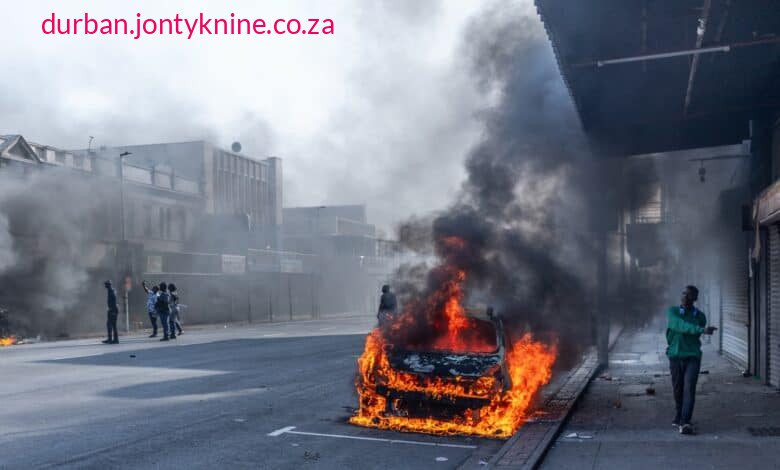
Recent anti-immigrant protests in Durban (primarily 8–10 October 2026) involved violence, vehicle arson, shop looting, and clashes, but the dominant pattern reported by police and multiple outlets was anti-migrant protesters (including March and March supporters and others) targeting foreign nationals and their businesses, not the reverse as the headline frames it.
What happened
Unrest broke out on Thursday 8 October 2026 in Durban’s CBD and near Home Affairs/refugee reception offices (and simultaneously in Soweto), amid protests against a Constitutional Court ruling and a related Home Affairs directive that allowed certain people who entered illegally to apply for asylum. Protesters demanded an end to asylum processing. Violence escalated with 14 vehicles torched in Durban (plus more in Soweto), buildings damaged or set alight, shops looted (especially those perceived as foreign-owned), windows smashed, and people assaulted.
Police used rubber bullets, tear gas, and stun grenades. By 10–11 October, the army/SANDF was deployed after calls for support; 19 suspects were arrested (mostly for public violence and malicious damage to property, many described as students), with four earlier arrests linked to attempted murder and discharging a firearm in public. Three foreign nationals were arrested in connection with an alleged assault on a protester. Home Affairs later withdrew the directive amid the disorder.
The “protesters attacked and shot by foreign nationals” claim
Police and contemporaneous reporting describe the spark as an alleged assault on a demonstrator by foreign nationals (one account specified a broken leg). Three foreigners were arrested over that incident. Some protesters and secondary reports claimed a demonstrator had been shot by a foreign national, which they said justified retaliation (torching cars, attacking people and property).
However, GroundUp (which initially reported a person “reportedly shot” and taken to hospital near Dr Pixley KaSeme Street) later corrected this after police confirmation: the person was assaulted and hospitalised, not shot. The three immigrants arrested for the assaults were found not to have had a gun. Early police statements also emphasised the assault on a protester rather than a confirmed shooting by foreigners as the trigger.
There were mutual clashes and some reports of foreigners throwing objects or accusations that they possessed firearms (leading to further attacks by protesters). Gunshots were reported in related Soweto confrontations. Overall, the bulk of documented violence, injuries to immigrants, property destruction, and looting ran in the direction of protesters targeting foreigners, consistent with longer-running tensions linked to groups like March and March.
Broader context and nuances
- Longer pattern in Durban: Months of tension, including earlier clashes (e.g., September 2026 “clean-up” actions by March and March supporters against immigrant encampments outside Home Affairs), assaults, displacement, and a civil-society database of hundreds of immigrant testimonies alleging violence, intimidation, looting of businesses/homes, and inadequate police protection. March and March has presented itself as opposing only illegal immigration and supporting lawful residence, but critics document vigilantism.
- Underlying drivers: High unemployment, competition for jobs/services/housing, frustration with immigration enforcement and asylum backlogs, politicisation ahead of local elections, and a court ruling that expanded access to asylum applications regardless of illegal entry (while still requiring individual assessment). Similar xenophobic/Afrophobic violence has recurred in South Africa for years.
- Consequences: Businesses closed, immigrants displaced or injured, opportunistic crime mixed with targeted attacks, and government responses including directive withdrawal, heavy policing, and troop deployment. Both South African residents and foreign nationals (many documented or asylum-seeking) were affected; reliable sources emphasise that collective punishment and vigilantism are illegal and counterproductive.
The headline reverses the primary direction of the recent violence and elevates an unconfirmed or corrected “shooting” claim into the central framing. Confirmed elements include an alleged assault by foreigners on a protester that helped ignite broader unrest, mutual clashes, and extensive anti-foreigner attacks, arson, and looting by protesters. Full investigations into specific assaults, any firearms use, and the exact sequence remain ongoing with police. For the most accurate picture, primary police statements (e.g., from KZN spokesperson Col. Robert Netshiunda) and on-the-ground reporting from outlets such as GroundUp, BBC, and Sunday Times provide the clearest contemporaneous record.