


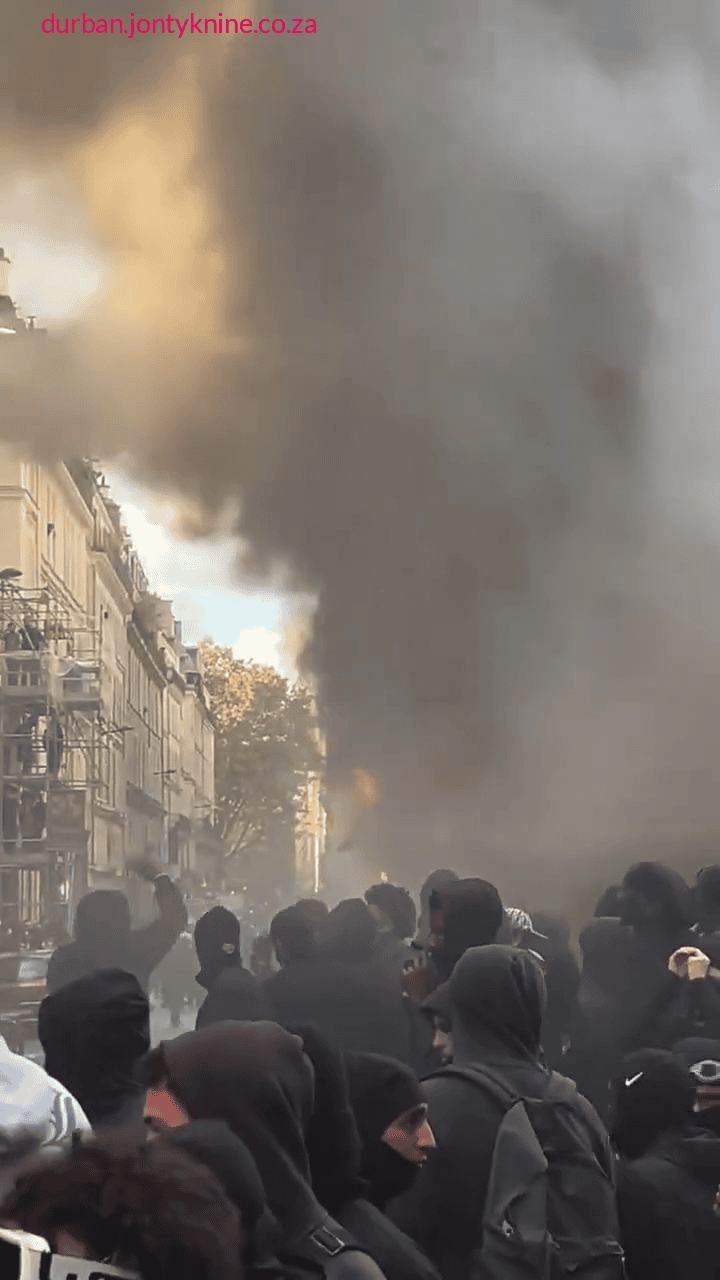
The arson and looting of La Barrique (a bar-tabac/restaurant near Place de la République in Paris’s 10th arrondissement) occurred on the margins of large nationwide protests on 17 October 2026. Reports and footage confirm the premises were targeted: masked individuals smashed the entrance, the interior was gutted, and a significant fire required firefighters to intervene (one firefighter was injured during the response). The establishment is a working local business, not a landmark of major historical architecture on the scale of Notre-Dame or the Marché des Enfants Rouges (which suffered a separate earlier fire), but it is a longstanding neighborhood spot.
Context of the day’s events
Hundreds of thousands of people (Interior Ministry estimate around 550,000 nationwide, organizers higher; roughly 110,000 in Paris) marched against the cost of living, declining education standards, and broader social grievances. Participants included students, teachers, unions, Yellow Vest veterans, pensioners, and others. The core marches were largely peaceful for much of the day. Violence concentrated among smaller groups of masked, often black-clad individuals who clashed with police, threw projectiles and fireworks, set cars and bins alight, looted shops (sports stores, mobile phone outlets, banks, luxury and everyday retail), and carried out targeted arsons.
In Paris this included attempts on Galeries Lafayette, systematic damage to streets near République and Beaurepaire, and the La Barrique attack. Elsewhere: the Limoges town hall was heavily damaged by fire; a Lyon tourist office was pillaged and set ablaze; looting and fires occurred in multiple cities. Officials reported around 1,200 arrests, roughly 150 officers injured (some seriously), and substantial material damage. French authorities and the Paris mayor described “extreme intensity” violence and streets that were “methodically ravaged.”
Characterizing the perpetrators
The people who deliberately set fire to a functioning restaurant/bar, looted it, and attacked other private businesses and public property while hiding their faces are committing serious crimes: arson, aggravated property destruction, and participation in organized street violence. These acts harm ordinary owners and workers who have no connection to government policy—the couple running La Barrique, for example, face the direct consequences of lost livelihood and a long recovery. Framing such actions as ordinary “student protest” is inaccurate; the bulk of student and union demonstrators were not doing this. Treating them merely as low-level “criminals” also understates the coordinated, intimidating character of the violence in several locations.
Whether the precise legal or political label “terrorists” fits is more contested and depends on definition. Classic terrorism involves the deliberate use of violence against civilians to create fear and coerce political change through terror. Street arson and looting during riots share some features (intimidation of bystanders and economic actors, disruption of normal life, political messaging through destruction) but typically lack the sustained ideological campaign, hierarchical organization, or mass-casualty intent associated with groups formally designated as terrorist. French authorities have long used terms such as “casseurs,” “ultra-left,” or “black blocs” for the recurring hard core that exploits larger demonstrations. Other observers argue that repeated, organized attacks on commercial and civic infrastructure during protests amount to a form of political violence that should be prosecuted and deterred with the full weight of the law, including against those who provide cover or justification.
Multiple angles and implications
- Legitimate grievances vs. opportunistic violence: Cost-of-living pressures, education concerns, and distrust of institutions are real for many French citizens. Large peaceful turnouts reflect that. The violence, however, does not advance those causes; it alienates potential sympathizers, supplies political opponents with imagery of chaos, and imposes costs on the very small businesses and workers often claimed as beneficiaries of social protest.
- Policing and escalation: Heavy police responses (tear gas, water cannon, charges) are standard in French crowd control when projectiles and fires appear. Critics on the left argue these tactics provoke further disorder; critics on the right argue insufficient early force allows “casseurs” to operate with relative impunity until damage is done. Both patterns have appeared in previous French protest cycles.
- Accountability: Arrest numbers are significant, and prosecutors indicated further investigations. Effective deterrence requires identifying organizers of the violent fringe, rapid prosecution for arson and aggravated vandalism, and clear refusal to romanticize the acts. Defending or relativizing the burning of a restaurant because one dislikes the government or police blurs the line between political speech and criminal damage.
- Broader pattern: France has seen recurring cycles of protest-plus-violence (Yellow Vests, pension reform, earlier student actions). Each episode tests the state’s capacity to protect property and public order while allowing peaceful demonstration. When private businesses become routine collateral, trust in institutions and social cohesion erodes further.
- Rhetoric and polarization: Calling the arsonists “terrorists” and those who defend them the same raises the temperature. It can sharpen public demand for accountability, but it also risks conflating the violent minority with the larger (mostly non-violent) protest base, or inviting reciprocal absolutism from the other side. Precise language about arson, looting, and the rule of law is more useful for clarity than maximalist labels.
In short, the deliberate burning and gutting of La Barrique was criminal destruction of private property carried out amid larger protests. The people who did it deserve prosecution under ordinary criminal law for arson and related offenses; the scale and targeting make the acts more serious than random street crime. Peaceful demonstrators with genuine complaints are not the same people. A society that consistently fails to distinguish the two, or that soft-pedals attacks on ordinary commercial life, invites repeated damage and deeper polarization.