





National dams started the season relatively full (~90% overall; uMngeni system around 90%), providing a buffer, but local infrastructure problems make household-level impacts more likely.
Current El Niño context and national outlook
A very strong (potentially record-strength) El Niño is underway in the tropical Pacific, with sea-surface temperature anomalies already exceeding typical strong-event thresholds and forecasts pointing to further intensification (Niño 3.4 anomalies potentially peaking near or above +3°C). The World Meteorological Organization and South African Weather Service (SAWS) indicate a near-certain continuation through at least February 2027.
For South Africa, SAWS seasonal forecasts for October–December 2026 and November 2026–January 2027 favour below-normal rainfall and above-normal temperatures over most of the country, with a higher frequency of heatwaves (potentially severe, especially around the December–January peak). El Niño does not guarantee drought every time—historical exceptions such as 1997/98 produced near- or above-normal rainfall in parts of the summer-rainfall region—but the statistical association is clear, and the current event’s strength raises concern.
National dam levels offered a better starting point than before the 2015/16 drought (~60% then vs ~90% in early October 2026), and soil moisture was improved after prior rains. This cushions irrigated agriculture somewhat, but rain-fed systems, livestock, and municipal distribution networks remain exposed.
Specific implications for Durban / eThekwini and KwaZulu-Natal
Durban sits in a summer-rainfall region that typically receives most of its precipitation from October/November onward. Reduced rainfall would lower inflows into dams and rivers that feed the uMngeni-uThukela system (the main bulk supplier for eThekwini). Higher temperatures increase evaporation from open water bodies and raise household and agricultural demand.
Key local vulnerabilities (highlighted by the Department of Water and Sanitation and local experts):
- Very high non-revenue water and physical losses: eThekwini reports non-revenue water around 56% and physical losses around 40% (leaks, illegal connections, etc.). Per-capita consumption remains high (~250 litres/day vs an international average of ~173 litres).
- Ageing infrastructure, large unresolved fault backlogs, inadequate storage/pumping capacity, and recent operational issues (e.g., pump failures at Durban Heights Waterworks causing temporary bulk-supply reductions to parts of the city).
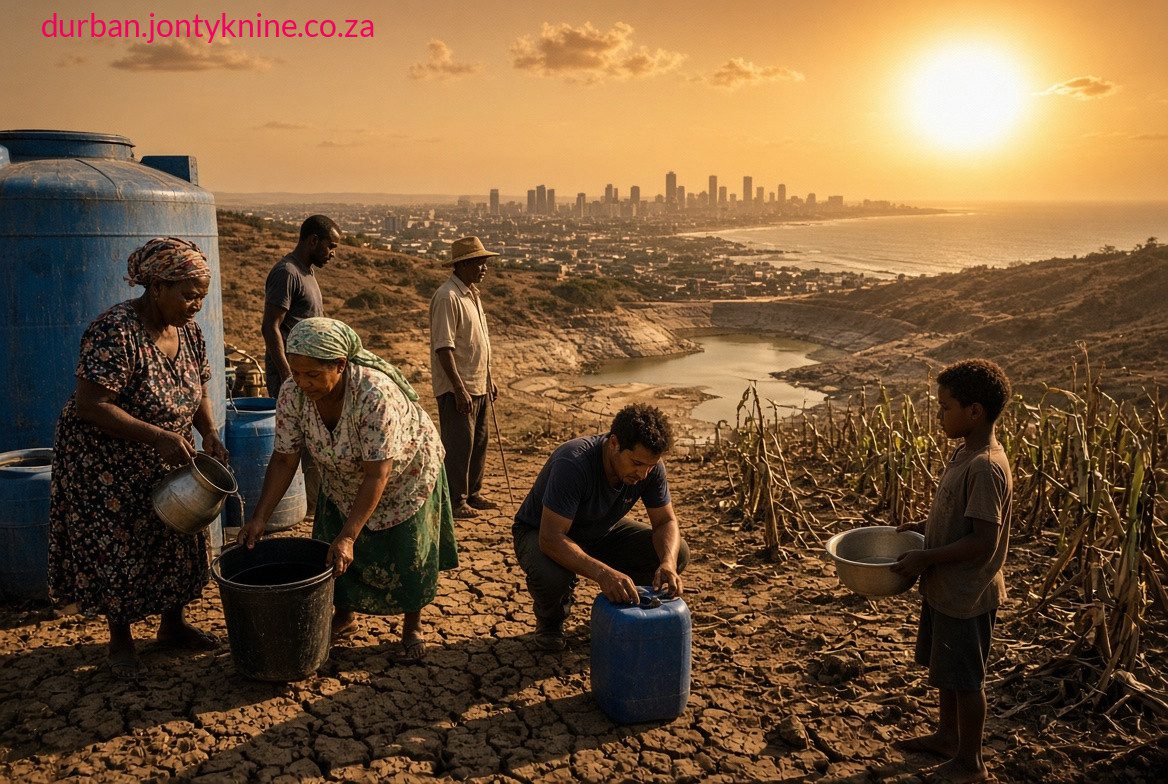
- Result: Even with reasonably full bulk dams, spikes in demand during heatwaves can trigger prolonged local outages or pressure drops. Officials have explicitly flagged a high risk of intensified seasonal demand peaks and prolonged water-supply disruptions in eThekwini between October 2026 and March 2027.
Professor Sheena Kumari Pillai (Durban University of Technology, SARChI Chair in Wastewater Treatment and Reuse) has repeatedly warned that KwaZulu-Natal is vulnerable: less summer rain reduces dam and river inflows while heat drives up demand and evaporation. South Africa already has low average rainfall (roughly half the global average), so any further reduction compounds stress. She and others urge proactive conservation rather than waiting for crisis levels.
KwaZulu-Natal Cooperative Governance and Traditional Affairs has also called on communities and farmers to prepare, noting concerns for children, older persons, and residents of informal settlements under expected above-normal temperatures lasting into early 2027. Note that one local report mentioned above-normal rainfall alongside heatwaves; the dominant national and most provincial signals remain for drier-than-normal conditions, but spatial variability is possible.
Heat impacts are already visible: SAWS linked recent heatwaves affecting parts of KwaZulu-Natal (and neighbouring provinces) partly to the strengthening El Niño, with temperatures potentially reaching dangerous levels. Heat stress is particularly acute for people in informal housing with limited cooling options, outdoor workers, the elderly, young children, and those with pre-existing health conditions. Higher temperatures can also affect indoor air quality and respiratory health.
Secondary effects for residents:
- Possible water restrictions or intermittent supply, especially during heat peaks.
- Upward pressure on food prices if regional crop and livestock production suffers (Durban-area farmers are already adopting water-saving techniques such as boreholes, tanks, mulching, precision irrigation, and drought-tolerant crops).
- Greater reliance on water tankers in affected areas (already a feature of eThekwini’s challenges).
- Potential compounding of existing socio-economic stresses (poverty, inadequate infrastructure) rather than the creation of entirely new ones.
Nuances and uncertainties
- High bulk dam levels provide a buffer, so a full-scale regional drought is not inevitable. Impacts will depend on the precise timing, intensity, and distribution of any rainfall deficits and heat extremes, plus how quickly municipalities reduce losses and demand.
- Not every El Niño produces identical outcomes; monitoring short-range SAWS forecasts remains essential.
- Climate change amplifies the background warming, so heatwaves under this El Niño could be more intense than in past comparable events.
- Coastal location may moderate some extreme inland heat, but humidity and urban heat-island effects still matter.
Practical preparation advice for Durban households
Authorities and experts recommend acting now:
- Fix leaks promptly and reduce non-essential use (gardens, pools, car washing).
- Store water safely (clean containers, rainwater harvesting where feasible).
- Reuse greywater appropriately for non-drinking purposes.
- Grow drought-resistant vegetables or establish small household/community food gardens to buffer potential price rises.
- Stay hydrated, limit outdoor activity during peak heat, check on vulnerable neighbours, and follow SAWS heat and weather alerts.
- Support or pressure the municipality on reducing losses and enforcing demand management early if needed.
In summary, Durban residents should expect a hotter summer with elevated chances of water-supply interruptions driven more by local system inefficiencies interacting with higher demand and lower rainfall than by empty dams alone. Preparation focused on conservation, storage, heat safety, and monitoring official forecasts will meaningfully reduce personal and household risk. The situation remains dynamic—SAWS and the Department of Water and Sanitation continue close monitoring.