






“Black ray” most commonly refers to certain rays (cartilaginous fishes related to sharks) that are either characteristically dark/black or exhibit melanism (an all-black or nearly all-black color morph). It is not a single standardized species name, so context matters.
Melanistic (Black) Manta Rays
These are not a separate species but color variants of reef manta rays (Mobula alfredi) and sometimes giant manta rays (Mobula birostris).
Typical mantas are dark gray on the back and mostly white underneath. Melanistic individuals are almost entirely black on both sides, often with a variable white blaze or patch on the underside that helps identify individuals.
- Melanism results from increased melanin production.
- Frequency varies sharply by location: up to ~40% in some Indo-Pacific populations (e.g., Raja Ampat, Indonesia) and around 10–16% in places like eastern Australia or Ecuador, while absent in others.
- Lady Elliot Island (southern Great Barrier Reef) is notable for relatively high numbers of black individuals; researchers have documented frequently sighted melanistic mantas there, including some of the oldest known.
- Studies indicate survival rates are similar to normally colored mantas, suggesting predators do not preferentially target the darker form despite reduced camouflage against the water surface when viewed from below. Genetic drift rather than strong natural selection appears to drive local differences in frequency.
Black mantas are striking underwater—large dark silhouettes (often 3–4+ m wingspan in reef populations)—and are occasionally photographed by divers and researchers.
Blotched Fantail Ray / Black-Spotted / Blackblotched Stingray
This is a large, legitimately dark-patterned species: Taeniurops meyeni (formerly Taeniura meyeni). Common names include blotched fantail ray, black-spotted ray, black-blotched stingray, giant reef ray, and speckled stingray.
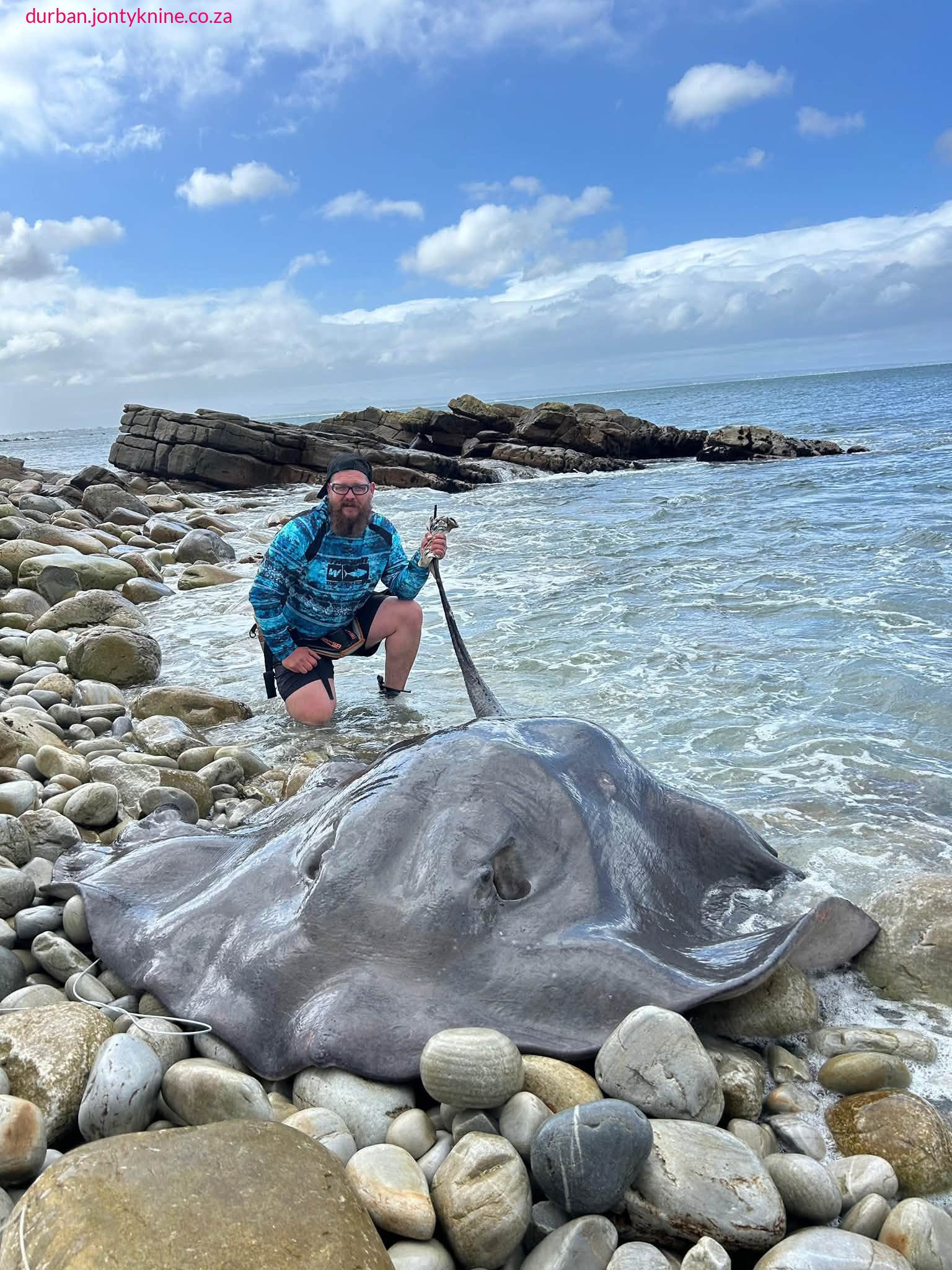
- Disc is nearly circular, up to about 1.8 m (nearly 6 ft) wide; total length can exceed 3 m and weight can reach ~150 kg.
- Dorsal surface is brownish to grayish or purplish with a distinctive mottled pattern of black, gray, and white blotches/spots; the pattern continues onto the relatively short, demarcated tail, which becomes darker distally. Underside is pale/white.
- Tail has a deep ventral skin fold and one or two serrated, venomous spines used for defense.
- Range: Indo-Pacific coastal waters (Red Sea and East Africa to southern Japan, Australia, Micronesia, etc.). Often found on or near reefs, resting under coral ledges by day.
- Feeds by excavating sand for crustaceans, molluscs, and small fishes. Viviparous (live-bearing), producing up to about seven young.
- IUCN status is Vulnerable; it is taken in coastal fisheries as target or bycatch.