






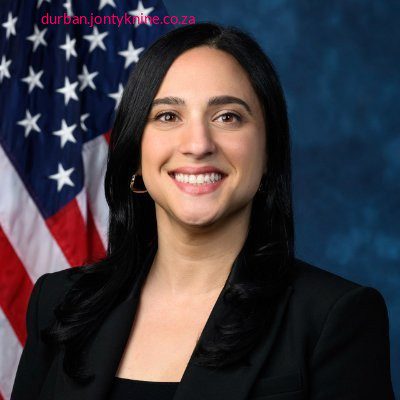
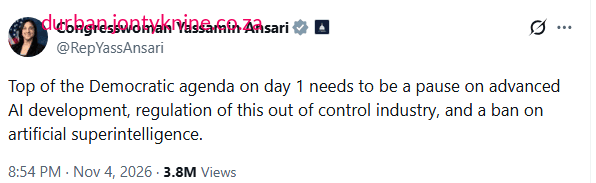
Top of the Democratic agenda on day 1 needs to be a pause on advanced AI development, regulation of this out of control industry, and a ban on artificial superintelligence.
Treating a pause on advanced AI, heavy regulation of the industry, and a ban on artificial superintelligence as the top item for any party’s Day 1 agenda is a poor prioritization of risks, feasibility, and opportunity cost.
Real risks exist, but they are not the only (or even the most immediate) ones
Advanced AI systems already pose concrete problems: misuse for cyber attacks, disinformation, bioweapon design assistance, labor disruption, and concentration of power. Catastrophic misalignment or uncontrolled superintelligence is a serious long-term concern that serious researchers (including some at xAI’s peer labs) take seriously. Ignoring those risks would be reckless.
However, framing the entire industry as “out of control” and demanding an immediate development pause + ASI ban as the highest priority overstates both the current capability level and the tractability of the proposed solutions. Today’s frontier models are powerful tools, not autonomous agents on the verge of recursive self-improvement into god-like systems. Treating them as such leads to policy that is mostly theater.
Feasibility problems are severe
- A unilateral U.S. (or Democratic) pause does almost nothing. China, Russia, and well-funded private actors will not pause. Compute, talent, and open-source weights already diffuse. A domestic pause mainly cedes the lead.
- “Ban artificial superintelligence” is not operationalizable. There is no clean technical definition that regulators can enforce without either being toothless or becoming a broad prior-restraint regime on research, compute, and algorithms. Enforcement would require extreme surveillance of labs, cloud providers, and eventually researchers—creating its own concentration-of-power risks.
- Regulation of “this out of control industry” is already happening in fragmented form (export controls, safety evaluations, liability discussions). The harder question is whether the regulation is competent or captured. Blanket slowdowns often favor incumbents who can afford compliance while harming smaller competitors and open research.
Opportunity costs are high
Scientific progress, economic growth, medical discovery, energy, and national security all benefit from continued capability advances under realistic safety practices. Treating AI development as the singular existential threat that must be frozen on Day 1 crowds out attention to nearer-term problems (debt, energy abundance, education, biosecurity, great-power competition) that governments actually have more levers over.
A more coherent approach prioritizes:
- Differential technological progress on alignment, interpretability, and control techniques.
- Compute governance and verification that is technically grounded rather than performative.
- Liability and transparency rules that scale with demonstrated risk instead of preemptively criminalizing research.
- International coordination that is realistic about adversarial incentives, not wishful thinking about global pauses.
Concern about uncontrolled AI is legitimate. Making an industry-wide development freeze and ASI prohibition the top partisan Day-1 demand is not a serious risk-management strategy; it is more likely to produce symbolic legislation, slower domestic progress, and little actual reduction in the underlying risks.

CCP right now