



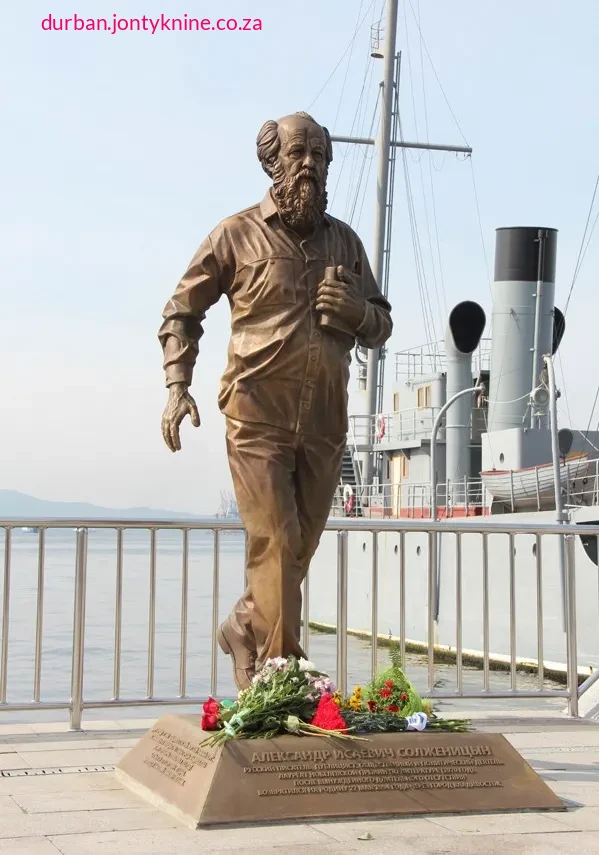
The next day, city officials had it temporarily returned to the original waterfront site. Officials stated that the monument (over 2.6 meters / about 8.5 feet tall) was too large for the new square: it “visually overloads the small recreational zone,” restricts views, and does not fit the layout. Architects are to modify the square before any permanent relocation. No new firm date was given at the time.
Background
- The statue (by sculptor Pyotr Chegodayev), depicting Solzhenitsyn stepping forward as if from a ship’s gangway, was unveiled in 2015. Solzhenitsyn passed through Vladivostok by plane in 1994 on his return to Russia from exile.
- Relocation had been planned since March 2026, prompted by requests from Pacific Fleet leadership and veterans. They argued it was thematically out of place among naval/World War II memorials and warships on the embankment. Historians and local experts had also criticized the location, noting he arrived by air rather than by sea. The statue is not a protected cultural heritage object.
The episode was widely reported by Russian and international outlets (including The Moscow Times, Meduza, Interfax, and local Vladivostok sources) as a short-lived relocation mishap. The statue remains (or remained, as of the reports) back on the embankment pending further work on the alternative site.
Aleksandr Isayevich Solzhenitsyn (11 December 1918 – 3 August 2008) was a Russian novelist, historian, and outspoken critic of the Soviet system. He is best known for exposing the horrors of the Gulag labor camps and for receiving the 1970 Nobel Prize in Literature.
Early Life and Education
He was born in Kislovodsk in the Caucasus region of Russia. His father, an artillery officer in World War I, died in a hunting accident before Aleksandr was born, so he was raised by his mother in modest circumstances. The family later moved to Rostov-on-Don.
He studied mathematics and physics at Rostov University (graduating with distinction in 1941) while also taking correspondence courses in literature. As a young man he initially embraced Marxism-Leninism, though he later returned to the Russian Orthodox faith of his family.
World War II and Arrest
During World War II he served as a captain of artillery in the Red Army and was decorated for bravery. In February 1945 he was arrested by Soviet counter-intelligence for criticizing Joseph Stalin in private letters to a friend. He was sentenced (in absentia) to eight years in the labor camps followed by permanent internal exile.
Imprisonment and Exile
He spent years in various camps and prisons, including a special prison for scientists and a hard-labor camp in Ekibastuz, Kazakhstan (the setting for One Day in the Life of Ivan Denisovich). After his release in 1953 (the day Stalin’s death was announced), he was sent into internal exile in Kazakhstan until 1956. During this period he was also treated for cancer, an experience that later informed his novel Cancer Ward. He was rehabilitated in 1956–57 and settled in Ryazan, where he worked as a mathematics teacher while writing in secret.
Literary Breakthrough and Conflict with the Regime
In 1962, under Nikita Khrushchev’s brief cultural thaw, his short novel One Day in the Life of Ivan Denisovich was published in the Soviet journal Novy Mir. It became a sensation as the first major work about the camps to appear openly in the USSR.
Later works—including The First Circle, Cancer Ward, and August 1914—could only be published abroad. His monumental three-volume nonfiction work The Gulag Archipelago (published in the West in 1973) documented the entire Soviet forced-labor system. It led to his arrest, the stripping of his Soviet citizenship, and expulsion from the USSR in February 1974.
Exile and Return
He lived in Switzerland briefly, then settled in Cavendish, Vermont, in the United States for nearly 20 years. There he continued writing, including further volumes of his historical cycle The Red Wheel. He was highly critical of both Soviet communism and aspects of Western materialism and secularism.
Soviet citizenship was restored in 1990. In 1994 he returned to Russia, where he lived near Moscow. He continued writing and speaking on Russian history, culture, and politics until his death from heart failure on 3 August 2008 at the age of 89.
Legacy
Solzhenitsyn is widely regarded as one of the most important Russian writers of the 20th century and a key moral voice against totalitarianism. His major works include:
- One Day in the Life of Ivan Denisovich (1962)
- The First Circle (1968)
- Cancer Ward (1968)
- The Gulag Archipelago (1973–75)
- The Red Wheel historical cycle
He received the Nobel Prize in Literature in 1970 “for the ethical force with which he has pursued the indispensable traditions of Russian literature.”