




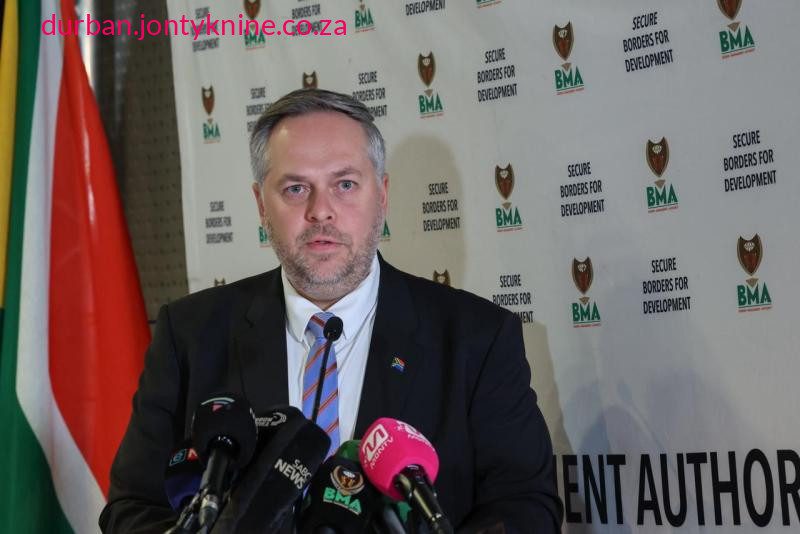
Home Affairs (under DA Minister Leon Schreiber in the Government of National Unity) has expanded adult passport applications to 480 bank branches nationwide, tripling access points from 228 departmental offices to 708 total locations. There is no formal admission in the official announcements that the department “has not got the ability to run Home Affairs”; the move is framed as a deliberate digital transformation and capacity-expansion strategy under the “Home Affairs @ Home” / Digital Partnership programme.
What was announced (18–19 November 2026)
Minister Schreiber stated that South Africans aged 18 and older can now apply for (or renew) adult passports at participating bank branches—primarily 412 Capitec and 68 Absa locations—without prior bookings, paperwork, or standing in traditional Home Affairs queues. The process is described as taking roughly five minutes and relies on secure digital/biometric capture (photo, fingerprints, signature) integrated with departmental systems.
Key points from the department and minister:
- This more than triples the national passport service footprint overnight.
- It follows the earlier successful rollout of Smart ID replacement services at banks (launched 9 March 2026). That programme has already processed more than 1.16 million applications and is live at 833 branches (exceeding the previous 750-branch target months ahead of schedule).
- The same partnership model is being used. Citizens can locate participating branches and check available services via the official portal: myhomeaffairsonline.dha.gov.za.
- Next phases planned include first-time Smart ID applications, passport services for minors, and secure home/courier delivery of documents.
Schreiber has repeatedly emphasised eliminating the need for queues rather than merely shortening them, improving access (especially for people in rural or underserved areas who previously faced long travel times), and modernising a department long associated with capacity constraints, system downtime, and frustration.
Context on capacity and the “inability” framing
The Department of Home Affairs has long faced documented structural problems: severe understaffing in many regions, limited physical footprint relative to population, legacy IT systems, power/connectivity issues, and historical reliance on a small number of offices. Schreiber and earlier reports have publicly acknowledged these constraints (e.g., staffing levels far below ideal, the impossibility of forcing tens of millions of people through a few hundred offices). The bank partnership is presented as a pragmatic response: leveraging the existing national branch network of banks (which already handle biometrics and secure customer interactions) instead of trying to build hundreds of new Home Affairs facilities quickly.
Critics interpret the outsourcing/partnership differently. Some opposition voices (including the African Transformation Movement/ATM) have questioned the model, raised concerns about private-sector involvement and potential links to political donors (noting reported DA funding connections involving entities linked to a Capitec co-founder), and argued that government should strengthen its own capacity rather than hand key services to banks. On social media and in political commentary, the expansion is sometimes characterised as an admission that the department cannot deliver core services itself. Supporters counter that the reforms are delivering measurable results (volume of Smart IDs processed, rapid expansion of access points) where previous approaches stalled.
Practical details for users
- Eligibility (current phase): Adult (18+) passport applications/renewals at the listed Absa and Capitec branches. Smart ID replacements (and green-book conversions) are available more widely across participating banks (Absa, Capitec, FNB, Standard Bank and others).
- Process: Generally walk-in or via bank app/website where supported; biometric capture at the branch; no traditional paperwork or Home Affairs queue required for the bank channel.
- Fees: Standard departmental passport fees apply (commonly cited around R600 for a standard adult tourist passport and R1,200 for the maxi/48-page version, with possible small bank service fees in some cases—confirm at the branch or via the official portal).
- Always verify the exact branch list and services on the official Home Affairs site, as the network continues to expand and not every branch of a participating bank necessarily offers every service.
This is one of the more visible service-delivery reforms associated with the DA’s role in the GNU. It addresses long-standing citizen complaints about queues and access while attracting the usual political debate about privatisation versus public-sector capacity-building. For the latest branch list or status of an application, the departmental portal remains the authoritative source.