


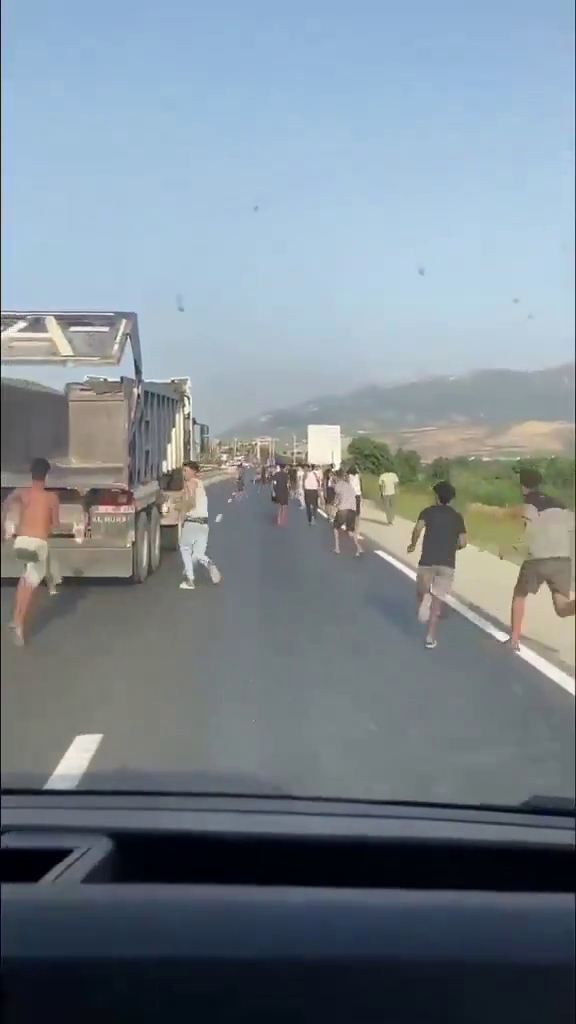
On 30 July 2026, video footage circulated widely showing dozens of young men climbing out of an open AL BURAQ dump truck on a highway near the Spanish enclave of Ceuta. A Moroccan gendarme stood nearby as the men disembarked. The clip, filmed amid a sharp surge of crossings into the territory, quickly became a focal point for claims of organised facilitation on the Moroccan side.
That same day, Spanish authorities reported a major influx into Ceuta. Estimates varied: Spanish state television TVE put the figure for the day in the range of 2,000–3,000 people, while other official and local accounts spoke of roughly 1,500 arrivals over the preceding week that then accelerated sharply, with peaks described by one Ceuta official as around 200 people per minute at the height of the surge. Most arrivals were young Moroccan men; women, children and some non-Moroccans were also present. Many swam or used inflatable rings and other flotation devices around the Tarajal breakwater; others breached or went around fencing. At least nine bodies were recovered in Ceuta that day, adding to a toll of around 60 migrant deaths recorded in the area in recent months.
Ceuta’s leadership described the situation as an absolute humanitarian and social emergency. Reception facilities were overwhelmed, with unaccompanied minors’ centres reported operating far beyond capacity and hundreds of people sleeping outdoors. Local authorities appealed for a national emergency declaration, temporary border closure measures and military reinforcement. The Spanish government responded by deploying armed forces units to support the Civil Guard, along with additional specialised police (around 200 officers in total reinforcements cited in some reports) and other assets including divers and a support vessel. Interior Minister Fernando Grande-Marlaska was scheduled to visit, and Prime Minister Pedro Sánchez planned to travel to the enclave. Officials stated that those who entered illegally would be subject to deportation processes.
The truck video fuelled intense online discussion. Some posts asserted that the men were largely “military-age” and linked them to a royal pardon issued the previous day. On 29 July 2026, coinciding with Throne Day celebrations marking the anniversary of King Mohammed VI’s accession, the Moroccan Ministry of Justice announced a royal pardon for 1,788 people convicted by courts across the kingdom. Of these, 1,679 were detainees: nine received pardons covering the remainder of their sentences, 1,668 had terms reduced, one death sentence was commuted to life imprisonment, and one life sentence was reduced to a fixed term. A further 109 people not in custody benefited from various forms of relief on prison terms or fines. Claims that the bulk of those transported were newly freed criminals remain unconfirmed; the official breakdown shows limited full releases among detainees, with the majority receiving sentence reductions rather than immediate freedom. Morocco has blamed smugglers for migration pressures and has not publicly confirmed any organised transport linked to the crossings. Spanish and international reporting has not independently verified a direct pipeline from the pardons to the border trucks.
This episode fits a longer pattern. Ceuta and Melilla are the European Union’s only land borders with Africa. They have repeatedly seen mass attempts—swimming, fence-scaling, or rushing official crossing points—often involving predominantly young men from Morocco and sub-Saharan Africa. The May 2021 crisis, when around 10,000 people entered Ceuta in a short period amid diplomatic tensions between Rabat and Madrid, remains the clearest recent precedent. Morocco’s cooperation on border control has long functioned as a lever in bilateral relations, including over Western Sahara recognition and other diplomatic files. When relations are strained, enforcement on the Moroccan side has sometimes appeared to ease; when they improve, pressure typically rises again. Commercial normalisation steps, such as limited authorised truck crossings in recent years, have proceeded in parallel with these security dynamics.
Spanish opposition figures framed the July 2026 events as a serious national security problem and an unprecedented influx. Local Civil Guard representatives described the border as having “totally collapsed” under the pressure. Human rights and migrant advocacy voices highlighted the humanitarian cost—drownings, overcrowding, and the vulnerability of families and minors—while noting that many of those arriving seek economic opportunity or escape from difficult conditions. A Spanish Supreme Court ruling that restricts immediate returns of people intercepted at sea (as opposed to land entries) has been cited by Ceuta officials as complicating rapid management of sea arrivals.
Several angles remain unresolved or contested. The precise degree of Moroccan state involvement versus private smuggling networks is disputed; the presence of a uniformed gendarme in the truck footage is cited by critics as evidence of facilitation, while Moroccan authorities have historically attributed surges to organised crime. Numbers fluctuate across sources and are hard to pin down in real time amid chaotic conditions. The demographic profile—heavily weighted toward young men—is consistent with many Mediterranean and land-border migration flows into Europe, yet it intensifies political debates about integration capacity, security screening, and the distinction between asylum claims and economic migration. For Ceuta’s roughly 80,000–85,000 residents, the immediate practical effects include strained public services, temporary business closures in some accounts, and heightened local tension.
Broader European implications are already visible in the political reaction. Migration remains a high-salience issue across the EU, with southern member states arguing for stronger external border management, burden-sharing, and returns agreements. Morocco’s role as a key partner in containing flows from the Sahel and West Africa gives it significant leverage. Periodic large-scale crossings serve as reminders of how quickly the status quo can shift when control on the Moroccan side loosens, whether deliberately or through overwhelmed enforcement.
As of 31 July 2026, Spanish reinforcements were arriving, local authorities continued to manage the reception crisis, and diplomatic and operational coordination with Morocco would determine whether the surge subsided or continued. The truck video and the scale of the day’s crossings have made the episode particularly visible, crystallising long-running questions about border sovereignty, the use of migration as geopolitical pressure, the human risks of irregular journeys, and the capacity of small enclaves to absorb sudden inflows. Further official tallies, returns data, and any Moroccan statements will clarify the picture in the coming days.