



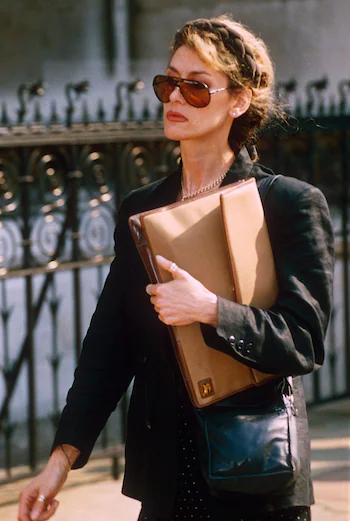
Background and Rise
Allan (born Isabel Janet Allan in the UK on 11 September 1952; adopted and raised in South Africa) became a star columnist for the Sunday Times (South Africa’s largest-circulation weekly) from 1980. Known for witty, glamorous profiles and social reporting under columns such as “Just Jani,” “Jani Allan’s Week,” and later “Face to Face,” she was voted the “most admired person in South Africa” in a 1987 Gallup poll commissioned by her paper. She interviewed major figures across politics and culture amid the late-apartheid era.
Connection to the AWB and Eugène Terre’Blanche
In late 1987/early 1988, her editor Tertius Myburgh assigned her to interview Terre’Blanche, the charismatic, neo-Nazi-leaning leader of the AWB (a far-right Afrikaner nationalist group that advocated a whites-only volkstaat, used Nazi-style symbolism, and opposed both the National Party government and the ANC). Allan later said she had known little about him beforehand.
Her January 1988 Sunday Times “Face to Face” profile included highly personal, admiring language: “Look, the man’s no mimsy. To be honest, he’s a hunk… Right now I’ve got to remind myself to breathe. I’m impaled on the blue flames of his blowtorch eyes.” She attended some AWB events and rallies (at her editor’s direction, she later said) and conducted further interviews. Rumours of a personal relationship intensified after she was photographed with him at the Paardekraal Monument in December 1988 (an incident in which Terre’Blanche allegedly drove his BMW through the gates; he was later acquitted on related charges). Allan publicly denied any affair, published a front-page denial (“The REAL story of me and ET and the SAP”), and took an injunction against him after he allegedly harassed her (including turning up drunk).
The allegations severely damaged both: they undermined Terre’Blanche’s image among his morally conservative followers and cost Allan her high-profile status. In July 1989 a bomb (linked to a breakaway AWB-related extremist, Cornelius Lottering of the Orde van die Dood) exploded outside her Sandton apartment; she was unhurt but fled to London for safety. She later claimed surveillance by multiple intelligence agencies and that the scandal itself may have been orchestrated (or exploited) by South African state intelligence and/or her editor to discredit Terre’Blanche and the far right at a politically sensitive moment. Some journalists have long alleged Myburgh had ties to apartheid-era intelligence structures. Allan also later claimed she had been unknowingly used in other intelligence-related contexts.
She always denied a sexual relationship, describing any contacts as journalistic and later calling Terre’Blanche “as mad as a balloon.” The affair claims became one of South Africa’s most notorious media scandals of the era. Terre’Blanche was murdered on his farm in 2010.
British Newspaper and Media Involvement / “Interference”
After fleeing to Britain in 1989, Allan worked intermittently (including for the London Sunday Times bureau and later freelancing for outlets such as the Evening Standard, Daily Mail, Spectator, and others). British media repeated and amplified the affair allegations.
- She successfully sued and obtained out-of-court settlements (reportedly around £35,000–£40,000 total) from the Evening Standard and Options magazine for repeating the claims.
- Writs against the Daily Mail and Sunday Telegraph were also issued (outcomes less prominently reported).
- The major battle was her 1992 High Court libel action against Channel 4 over Nick Broomfield’s documentary The Leader, His Driver and the Driver’s Wife (1991), which she claimed portrayed her as a “woman of easy virtue” by implying an affair with Terre’Blanche. Private Eye dubbed it the “libel case of the century.” It featured intense media coverage in both Britain and South Africa, with witnesses flown in from South Africa. Key (and highly lurid) testimony came from her former flatmate Linda Shaw, who claimed to have observed sexual activity through a keyhole. Other witnesses described finding a drunken Terre’Blanche in her flat in underpants. Allan’s personal notebook (with explicit entries about another relationship) was mysteriously produced mid-trial. Channel 4 (defended by George Carman QC) argued the programme did not clearly allege an affair or that any such allegation would be true. Allan (represented by Charles Gray QC, with Peter Carter-Ruck involved) lost: the jury found no libel. She faced costs estimated at £300,000+ (or higher in some reports). The judge did not definitively rule on whether an affair occurred.
The trial was surrounded by reports of dirty tricks, leaks, threats, a burgled flat, intercepted calls, and other irregularities on multiple sides, leading to police involvement. Some contemporary reporting and later accounts (including Allan’s memoir Jani Confidential, 2015) framed elements of the British media coverage and the case itself within broader political intrigue tied back to South African intelligence efforts to neutralise the AWB.
Allan’s South African Sunday Times column had already been cancelled after she “became the story.” The British legal and media battles further cemented her public image around the scandal, which she later described as lasting “slut-shaming.” She returned to South Africa in the mid-1990s (radio, web columns, speechwriting for Mangosuthu Buthelezi), later moved to the US, and continued occasional writing until her death from cancer on 25 July 2023 in Pennsylvania.
Nuances and Broader Context
The episode sat at the intersection of late-apartheid politics, media sensationalism, personal ambition, intelligence operations, and gender dynamics. Allan’s own later accounts emphasised being used as a pawn (by her editor and possibly state actors) rather than a willing participant in any romance. Critics and some witnesses presented a different picture. The AWB connection destroyed her peak celebrity status in South Africa and defined much of her subsequent public identity, even as she rebuilt a lower-profile career. British media amplified and commercialised the story, turning a South African political-media scandal into international tabloid and courtroom theatre, with lasting reputational and financial costs for her. Primary sources include contemporary reporting, court coverage, Allan’s memoir, and obituaries; definitive proof of the precise nature of her relationship with Terre’Blanche (or of full intelligence orchestration) remains contested and unresolved in public records.