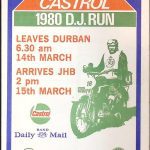
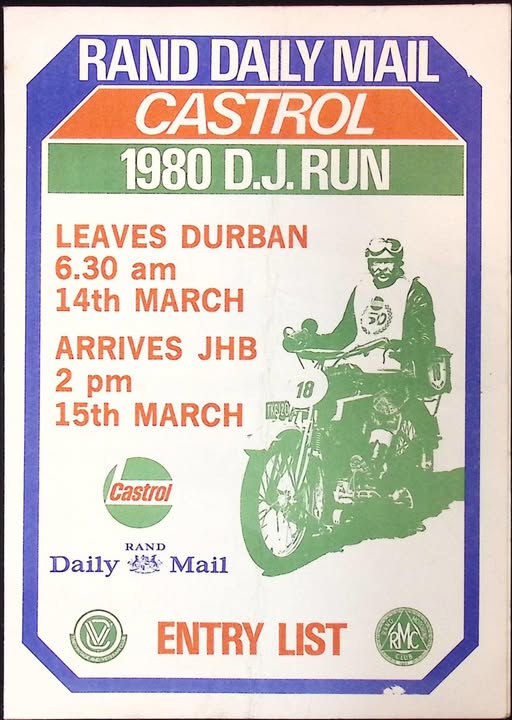
The 1980 DJ Run (also known as the 10th Rand Daily Mail-Castrol D-J Commemorative Run) was the annual classic/historic motorcycle regularity rally from Durban to Johannesburg, South Africa, limited to pre-1937 machines.
It formed part of the long-running series that commemorates the original public-road races held between the two cities from 1913 to 1936 (with gaps for World War I). Those early events were flat-out handicap races over rough dirt roads (with farm gates to open/close, limited tar, dust, and mechanical unreliability), often covering roughly 400 miles/640+ km over one or two days and attracting international interest. Authorities banned racing on public roads after 1936 due to rising speeds and traffic.
Revival as a Regularity Rally
In 1969–1970, enthusiasts (led by the late Dick Osborne) revived it as a commemorative regularity trial rather than a pure race. Eligibility was restricted to motorcycles (and sidecar combinations) manufactured on or before 31 December 1936—the cut-off matching the last original race. The format uses set average speeds over timed sections, with hidden marshals/checkpoints; riders accumulate penalty seconds for being early or late. Speedometers/rev counters are typically not allowed (or restricted), so competitors estimate pace carefully. It remains a two-day event with an overnight stop (historically Newcastle), following routes close to the original. The prize is the historic Schlesinger Vase (a silver trophy first presented in 1914).
The commemorative series began in 1970 and has run nearly every year since (exceptions include 1974 for fuel restrictions and 2021 for COVID). By 1980 it was already established as South Africa’s premier vintage motorcycle event, with international status under bodies such as what became FIM Africa/MSA.
1980 Specifics
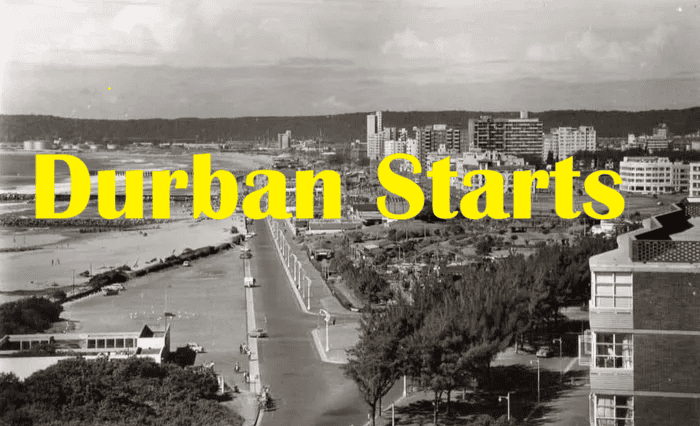
- Start: Early morning in Durban (around 6:15 a.m.).
- Notable participants and machines (from contemporary reports/photos in The Automobilist): Max Hertz (first off at Newcastle); Miss C. Burbury on a 1929 AJS; Carl Pingle on a 1913 Rudge Multi; Harold Freeman on a 1928 Sunbeam; Mr and Mrs K. Linley on a 1936 Velocette and sidecar; André Deetlefs on a 1913 750 cc Rudge Multi. Background figures included Mike Bosman, Dawn Basset, and Len Bassett.
- Results (overall, by total error/penalty points):
- 1st: Peter Aneck-Hahn on a 1936 Ariel (232 seconds error)
- 2nd: Doug Brodie on a 1933 Sunbeam (358)
- 3rd: Willie Grobler on a 1935 Rudge (398)
Photos from the event capture the start atmosphere in Durban, waiting riders at Newcastle, and the winner on his Ariel. The rally tested both the reliability of these historic machines (often British singles like Ariel, Sunbeam, Rudge, AJS, Velocette, BSA, Norton, etc.) and the riders’ skill at maintaining precise averages over long distances on varying roads.
Broader Context and Continuity
The event emphasizes preservation, camaraderie, and the challenge of keeping pre-WWII motorcycles running reliably over hundreds of kilometres. Finish rates are generally high relative to the age of the bikes, and it attracts families, multi-generational riders, and occasional overseas entrants. Related awards often cover categories such as best woman rider, oldest machine/rider to finish, youngest rider, first-timers, and sidecars. It continues today (sponsored in recent years by iTOO and others), still limited to pre-1937 bikes, with routes typically starting near Hillcrest/Durban area and finishing in the Johannesburg/Benoni/Ekurhuleni region.
Primary historical documentation is maintained on sites such as vvc.co.za/dj.co.za (year-by-year pages with photos, reports, and results) and djrally.co.za. Contributions of stories, clippings, or images are encouraged by the organisers (Vintage and Veteran Club of South Africa and related groups). The 1980 edition fits squarely in the early decades of the modern commemorative era, when the event solidified its status as a unique test of historic motorcycles.