




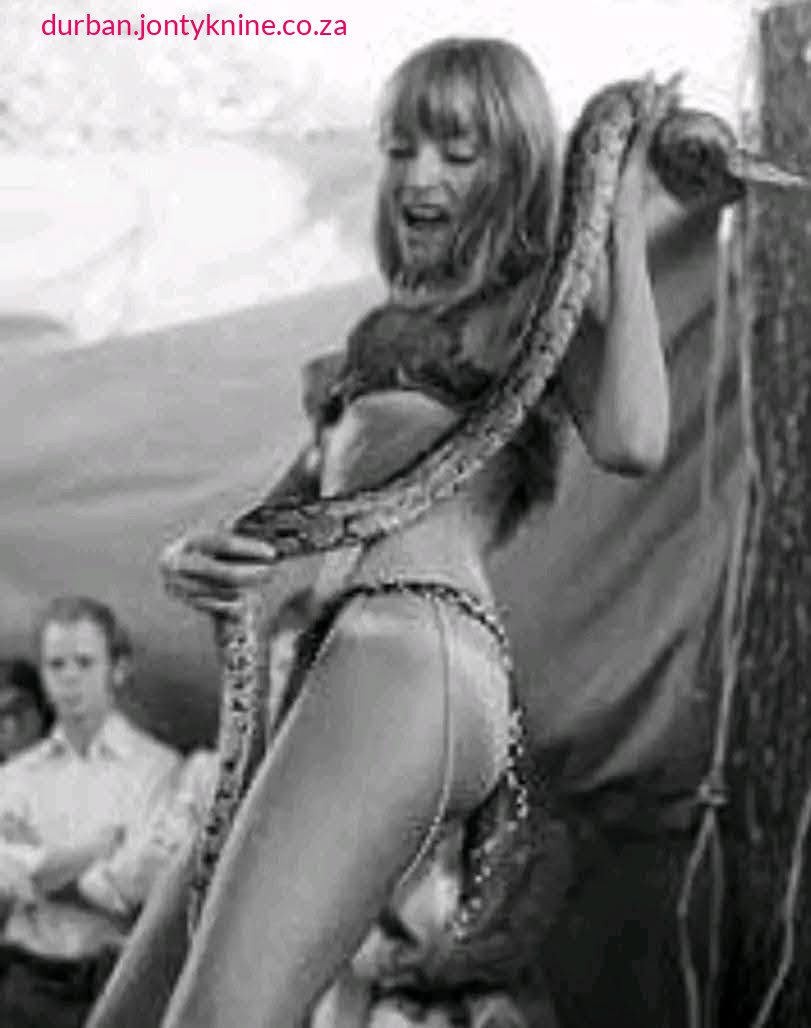
She became the era’s most notorious and widely publicised exotic dancer under apartheid’s strict Calvinist moral codes and censorship. Her signature act involved dancing with a succession of pythons she called “Oupa” (Afrikaans for “grandpa”), including a roughly 3-metre-long one. She used the snake as a distinctive “logo” or brand to stand out; at one point she kept multiple pythons under the same name partly because of permit restrictions. The non-venomous python was draped around her body during performances. She developed various theatrical routines, including costumes referencing Afrikaner/Voortrekker imagery that she would strip out of (a pointed jab at nationalism), a devil hand puppet, and at least one controversial 1973 performance in the conservative town of Volksrust where she painted herself black, wore an afro wig, and danced to drums.
Kemp started dancing while training as a teacher (initially in Potchefstroom, later at Goudstad Teachers’ Training College in Johannesburg). She began with go-go dancing and evolved into full exotic/strip acts, often in hotels or private/invite-only settings to try to navigate indecency laws (the rules required performers not to leave the stage wearing less than they arrived in, so she sometimes started minimally clothed and “got dressed” as part of a narrative). She was frequently arrested by the Vice Squad for public indecency—sometimes before she even began stripping—and became a major media figure. In 1975 she was named Rapport newspaper’s Newsmaker of the Year. Cabinet ministers and moralists criticised her heavily (some even blamed her for droughts in exaggerated rhetoric). Police were often present at shows, sometimes in the front row, and she has described the constant stress and harassment.
Her fame led to the 1976 semi-biographical exploitation film Snake Dancer (directed by Dirk de Villiers), in which she played herself. The film depicts her background, the rise of her act with the python, clashes with authorities, and personal conflicts; it was made amid the heavy publicity around her arrests and performances. It remains a cult curiosity associated with her.
By the end of the 1970s/into the 1980s she left the stage, completed teacher training, taught, married (including to Karl Koczwara), and later became a born-again Christian involved in ministry work with children, vulnerable people, sex workers, and addicts. She has spoken in later interviews about the period with a mix of reflection on the freedom and artistic expression she found in the dancing versus the legal and social pressures of the time.
Contemporary accounts and later profiles consistently describe her as the standout South African stripper of that conservative era precisely because of the python act and the resulting scandals, media saturation, and cultural provocation. No other performer from the same late-1970s/early-1980s South African scene matches this specific combination of fame and snake-on-stage routine in the available historical coverage.