



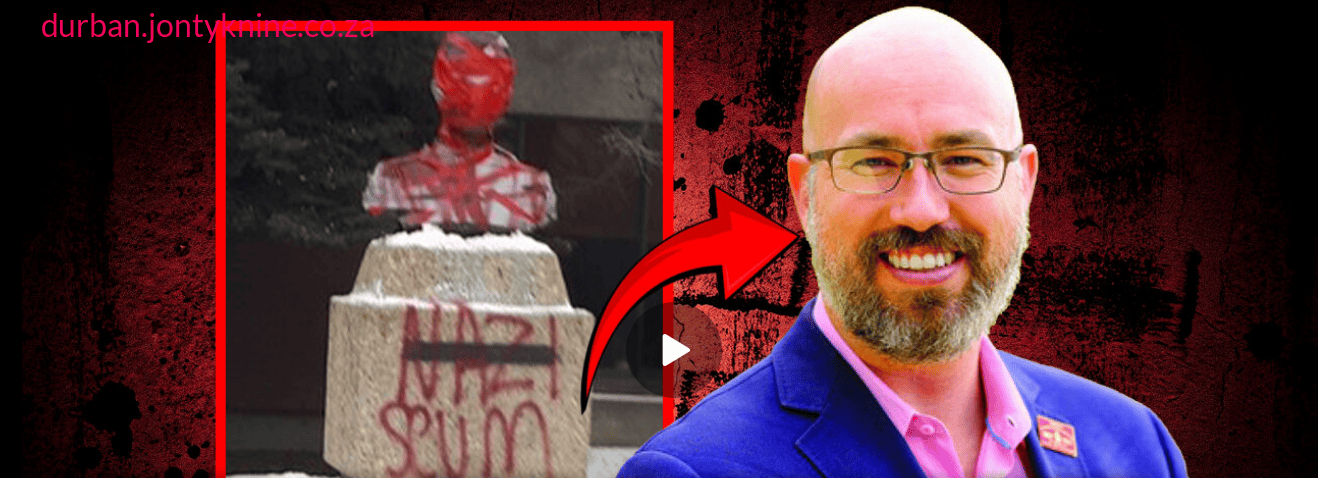
In the early hours of August 10, 2021, Kinney rode his bike to the Ukrainian Youth Unity Complex in Edmonton, hopped a fence, and sprayed the graffiti on the bronze bust and its plinth. Security cameras recorded the act. Roughly eight hours later, cameras caught him returning to photograph the damage. He then emailed the complex staff, claiming Progress Report had received photos from an “unknown person or persons,” seeking comment, and asking whether Shukhevych was a Nazi or Nazi collaborator, with a tight deadline. His outlet published a story framing the vandalism that way.
He was charged years later (around 2022) with mischief (and a more serious count related to a war memorial involving a second site, a memorial to the 14th Waffen SS Galizien division that had also been marked with “Nazi Monument” and similar text). Kinney pleaded not guilty for years, portrayed the case as political persecution by the Edmonton Police Service (with whom he had a long adversarial relationship as a critic of the force; they revoked his media credentials), and raised roughly $35,000 via GoFundMe while insisting on his innocence. The case dragged on; he was due for a jury trial when he changed his plea. Sentencing is scheduled for January 25, 2027; prosecutors are expected to drop the heavier war-memorial charge (which carries up to 10 years).
The Progress Report board issued a statement calling the combination of committing the act and falsely reporting it “a cardinal breach of journalistic ethics and not acceptable behavior within any media organization.” They noted Kinney had always maintained innocence (and they had trusted him), that he had left journalism/the organization in spring 2025, and that he would not return. They also stated they were “not troubled by the statue’s defacing” itself, describing Shukhevych as a Nazi collaborator (officer in the Nachtigall Battalion and 201st SS battalion, implicated in wartime massacres).
Broader context and debates
Roman Shukhevych was a leading figure in the Organization of Ukrainian Nationalists (OUN) and Ukrainian Insurgent Army (UPA). He fought for Ukrainian independence against the Soviets but also collaborated with German forces; units under or associated with him have been linked by historians to killings of Jews, Poles, and others during World War II. The Galizien (SS Galicia) division was a Ukrainian unit within the Waffen-SS. These monuments have long been contested: Jewish organizations (Friends of Simon Wiesenthal Center, B’nai Brith Canada, local federations), some academics (e.g., University of Alberta’s John-Paul Himka), and others have called for their removal as honors to Nazi collaborators or mass murderers. Segments of the Ukrainian diaspora in Canada (especially in Edmonton, which has a large Ukrainian-descended population) often view the figures primarily through the lens of anti-Soviet resistance and reject or downplay the collaboration and atrocity charges as Russian propaganda or incomplete history.
The case intersected with larger Canadian controversies, including the 2023 House of Commons standing ovation for Yaroslav Hunka (a Galizien veteran) during Volodymyr Zelensky’s visit—an episode that embarrassed Parliament and prompted temporary scrutiny of how Canada has handled WWII-era figures. A similar Galizien memorial in Oakville, Ontario, was later removed; Edmonton’s have remained points of friction. Kinney’s actions and reporting occurred against this backdrop of polarized historical memory.
The episode highlights classic journalistic ethics problems (staging or committing a newsworthy act then presenting it as independent reporting) alongside questions of activism, selective focus on historical figures, and how legal and cultural battles over memory play out in diaspora communities. Coverage has appeared across outlets including the Jewish Telegraphic Agency / Times of Israel, Edmonton Journal reporting, Rebel News, and others, with framing varying by outlet’s orientation. Kinney and his lawyer did not comment publicly after the plea.