




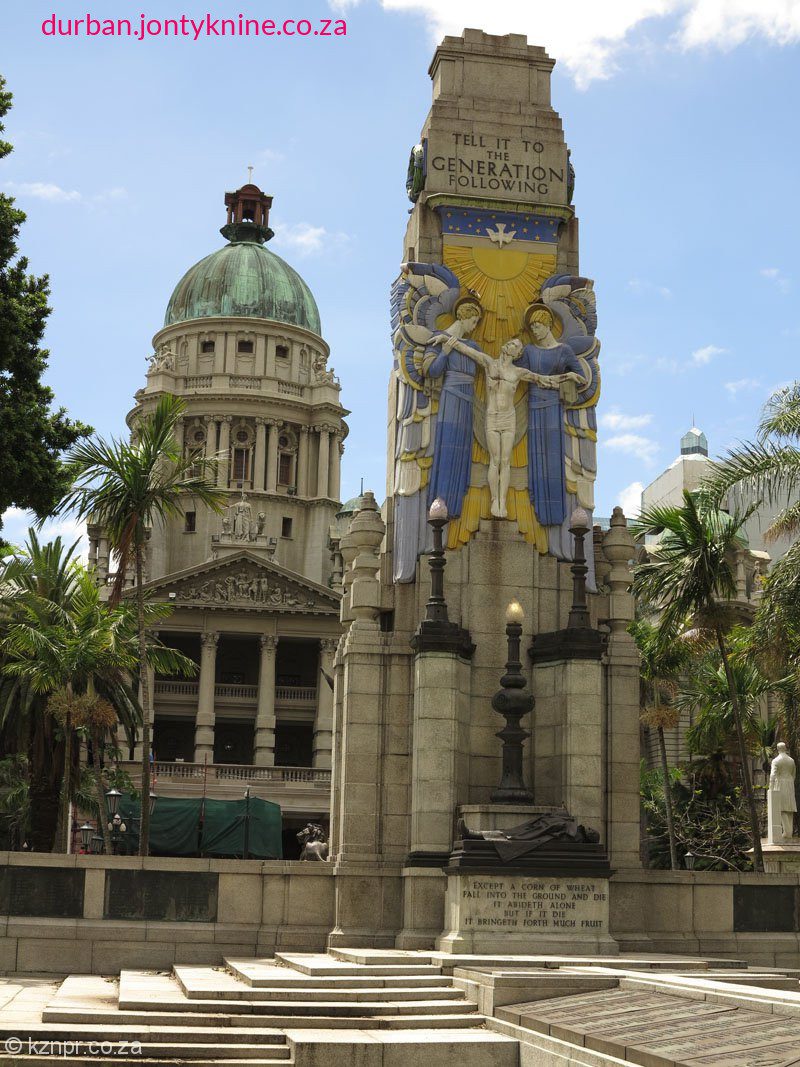
Located in Farewell Square (also associated with Gardiner/Dorothy Nyembe Street and the Town Gardens area near City Hall), the roughly 11-metre-high granite structure commemorates soldiers from Durban who died in World War I. It functions as a true cenotaph—an “empty tomb”—representing those buried elsewhere and serving as a focal point for public mourning and remembrance.
Origins and delays
After the war, Durban debated a permanent memorial while smaller towns erected theirs more quickly. A temporary cenotaph was put up in the interim (noted around the 1922 wreath-laying). Proposed sites included areas behind the Old Court House, parts of Victoria Park, and near King’s House before the Town Gardens location was chosen. Cost and design arguments prolonged the process—councillors clashed over ornate versus simpler schemes, and some questioned spending the money at all (one optimistically hoped wars between peoples would end). The mayor noted that a War Memorial Fund, started by local sportsmen and supported by public donations, existed specifically for the purpose.
In September 1923 the Town Council capped the cost at £20,000. On 9 December 1923, Governor-General Prince Arthur of Connaught laid the foundation stone while the Durban Light Infantry band played Chopin’s Funeral March. Construction was slow; the memorial was only finished and unveiled in March 1926 (some accounts specify 7 March). Col. George Molyneux (former commanding officer of the Durban Light Infantry) performed the unveiling, and the mayor inaugurated the Light of Remembrance.
Design and Art Deco character
A 1921 architectural competition was won by the Cape Town firm Eagle, Pilkington and McQueen. Primary credit is usually given to H.L. Gordon Pilkington (1886–1968), who spent time in Durban (roughly 1923–1925) overseeing the protracted work and even travelled to England in 1924 to help advance the ceramic production.
The design blends neoclassical stone elements (granite structure, pillars with electric torches, granite urns) with strong early Art Deco features. The standout is the large-scale glazed ceramic (faience) decoration in bold sky blue, bright yellow/white, and other vivid colours: two angels raising the soul of a dead soldier against a sunburst background, topped by a green ceramic wreath. The inscription “Tell it to the generation following” appears prominently (with an additional biblical verse on the monument). A metal/bronze figure of a fallen soldier lies on a plinth in front.
The ceramics were produced in England by the Poole Pottery (Carter, Stabler & Adams), involving Harold and Phoebe Stabler; John Adams—who had headed the Durban School of Art/Natal Technical College ceramics work around 1915–1921 and then joined the Poole firm—played a key supervisory or design role. The Egyptian-inspired palette and angular, colourful treatment drew from the era’s Egyptomania following the 1922 Tutankhamun discovery and anticipated fuller Art Deco. Contemporary critics were startled by the brightness (one compared it to inserting jazz into a funeral march; another complained the blue clashed with the Durban sky), yet it is now recognised as unique among WWI memorials for its colour and scale of faience, and as one of Durban’s finest Art Deco works.
In July 1929 a pair of large bronze Art Deco lions (modelled by Percy Metcalfe, a WWI veteran and noted coin designer, at about £400 each) were added on high plinths to guard the entrance and symbolise courage. After WWII, “Gates of Memory” were installed; King George VI and Queen Elizabeth (with Princesses Elizabeth and Margaret) ceremonially opened them during the 1947 royal visit. WWII name plaques were later added to the flanking walls (unveiled 1955). Queen Elizabeth II laid a wreath there in 1999 during a Commonwealth meeting—one of the few times she was abroad on Remembrance Sunday.
Later history and condition
The monument has faced challenges, including a 1981 bombing that slightly damaged a granite basin and the 2017 theft/damage of multiple bronze plaques (some still unrepaired years later). It remains a central site for annual Remembrance services (though heavy rain in 2026 forced one indoors to City Hall).
Its combination of sombre purpose, uplifting colour, Egyptian-tinged Deco ceramics, neoclassical framing, and guarding lions makes it a striking and distinctive landmark that continues to stand out a century on.