




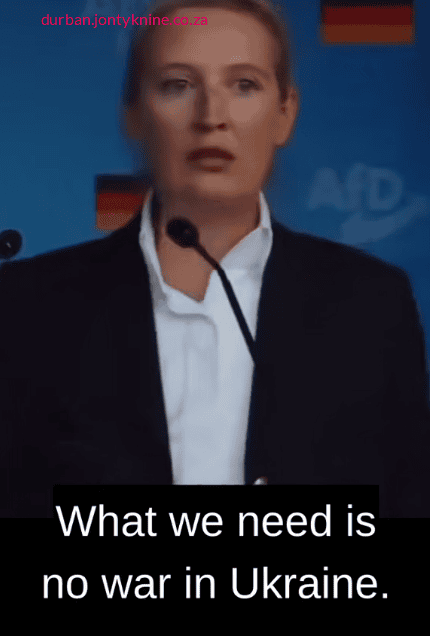
“We don’t need a war in Ukraine.
Peace in Ukraine is in the interest of Germany.
I don’t want German soldiers and weapons sent to Ukraine.
I am ashamed that, after the Second World War, German tanks are once again being used against Russia.
That is a disgrace for our country”
(Alice Weidel, AFD)
This fits her and the AfD’s broader, consistent position:
Germany should prioritize its own interests (“Germany first”), stop or sharply reduce military/financial support for what she has called an “already lost war,” and push for negotiations that take Russian security concerns into account.
She has repeatedly opposed sending German soldiers or further heavy weapons, cited the economic cost (Germany having spent large sums while facing debt and energy pressures), and called for restoring cheaper Russian energy supplies.
The historical framing (German tanks again facing Russia) is a deliberate appeal to German post-WWII sensitivities and is part of AfD rhetoric that treats continued involvement as dangerous entanglement rather than necessary defense of a European partner under attack.
Critics (mainstream German parties, much of European media, and Ukrainian supporters) reject this as echoing Kremlin talking points, understating Russia’s responsibility for the full-scale invasion, and risking a settlement on Russian terms that leaves Ukraine weaker and sets a precedent for further aggression. Supporters of Weidel’s line argue that endless aid without a realistic path to victory drains German resources, raises escalation risks for Germany itself, and ignores the limits of what Ukraine can achieve against a larger nuclear-armed neighbor.