




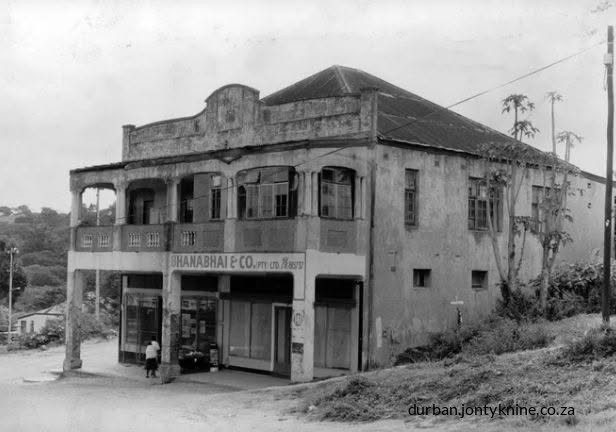
Hanabhai & Co
Share this... Whatsapp Facebook0 Twitter Threads Pinterest0 Linkedin0 Reddit0 Wechat Line TelegramBluesky“Hanabhai” (or close variants)…


The days that were
Cato Manor (also known as Umkhumbane after the river that runs through it) is a historically significant area about 5–8 km west of Durban’s city centre in KwaZulu-Natal, South Africa. It is frequently compared to District Six in Cape Town and Sophiatown in Johannesburg as a major site of forced removals under apartheid’s Group Areas Act. Its history spans pre-colonial settlement, colonial land grants, multi-racial informal settlement and vibrant hybrid culture, racial violence, intense resistance to removals, near-total clearance, and post-apartheid redevelopment mixed with ongoing land claims, informal settlement struggles, and social challenges.
The earliest recorded occupation dates to around 1650, when the Nqondo clan lived in the area. They were replaced by the Ntuli clan around 1730 (details of the transition are unclear).
In 1843 (some sources cite 1844 or 1845), the land was granted to George Christopher Cato, Durban’s first mayor (recognised as such in 1854/1865 depending on the account), as compensation for beachfront property expropriated for military use and as recognition of his community service. Cato and his descendants farmed it until the early 20th century. In 1914, the farm was subdivided and sold to prominent (mostly white) residents who developed country estates. These landowners leased or sold plots to Indian market gardeners—many former indentured labourers from the sugar plantations or their descendants—who became the area’s first substantial settler community after the colonial grant.
From the late 1920s, African families (prohibited from owning urban land under Union laws) began renting plots from Indian landowners and building shacks, especially along the Umkhumbane River. Industrialisation and urbanisation accelerated this: by 1932, when Cato Manor was incorporated into the Borough of Durban, over 500 shacks existed and the settlements were deemed “illegal.”
World War II brought a major boom in Durban’s economy and labour demand. The African population surged; by the mid-to-late 1940s estimates ranged from ~17,000–30,000 shack dwellers. Indians and Africans lived in close proximity, interacting in work and social life. A distinctive hybrid Afro-Indian culture developed, with shared spaces, shebeens, market gardening, informal trade, and cultural exchange. Cato Manor/Umkhumbane became known as a place of relative freedom and economic enterprise for Africans, including home-brewed beer (utshwala/sorghum beer and stronger shimeyane) sold by women (“shebeen queens”), which was a vital livelihood.
Tensions existed alongside the vibrancy: African tenants accused Indian landlords of high rents and overcrowding. White interests sometimes exploited or fuelled these divisions. Famous residents and figures associated with the area over time included trade unionist A.W.G. Champion (who called it a place where Africans could “breathe the air of freedom”), journalist Nat Nakasa, musician Sipho Gumede, activist Florence Mkhize, playwright Ronnie Govender (born there; his At the Edge and Other Cato Manor Stories draws heavily on it), and others. Alan Paton wrote a play set in Umkhumbane.
On 13 January 1949, an incident in Grey Street (an Indian stallholder punishing an African boy accused of stealing) sparked widespread anti-Indian violence that spread to Cato Manor. Over two days there was murder, looting, arson, and destruction of shops, homes, and buildings. Official figures record 137 deaths and thousands injured; the events made international headlines. Many Indian landowners and traders lost properties; African shack-lords and traders largely took their place. After the riots, some Indian landlords returned to collect rents or lease entire plots, leading to further densification. By around 1950 there were roughly 6,000 shacks housing 45,000–50,000 people.
Key apartheid laws followed in 1950 (Group Areas Act, Population Registration Act, etc.). In 1952 the Durban City Council acquired land from Indian owners to create an Emergency Camp (later known as Umkhumbane) for the homeless/African residents, providing limited basic services. It quickly became overcrowded. Municipal control of beer (via the long-standing “Durban system” of municipal beer halls, rooted in the Native Beer Act) threatened women’s brewing livelihoods and generated deep resentment.
Cato Manor became a centre of political activity. Chief Albert Luthuli and the ANC (including the Women’s League) mobilised there, linking local grievances (passes, beer, removals) to the broader anti-apartheid struggle. In 1958 it was proclaimed a white group area under the Group Areas Act (despite local debates and some earlier municipal hesitation). Removals began in March 1958 under Sighart Bourquin (Director of Bantu Administration). Africans were directed toward distant townships such as KwaMashu, Umlazi, and Lamontville; Indians mainly to Chatsworth (and later Phoenix). Resistance was strong: legal challenges, reconstruction of demolished shacks, and protests.
Tensions peaked in June 1959. Women (led in part by figures such as Florence Mkhize and Dorothy Nyembe, with ANC Women’s League involvement) protested municipal beer halls, which symbolised both economic control and the broader system. On or around 17 June, women forced their way into a beer hall, destroyed equipment, and attacked drinkers. Riots spread; police used force (including shooting); buses and municipal property were targeted. Casualties included deaths and dozens injured. Raids on illegal liquor intensified.
On 23/24 January 1960, a mob attacked and killed nine policemen (four white, five black) in the Emergency Camp in a particularly brutal incident. This shocked authorities and public opinion and is widely seen as breaking the back of organised resistance. Rapid clearance followed. The last shack was demolished on 31 August 1964. Estimates of total people removed range from roughly 80,000–160,000 (or higher in some accounts); it was one of South Africa’s largest urban forced removals. By 1968 the area was largely vacant except for a few houses, shops, the beer hall, and Hindu temples. Some portions were later allocated for limited white development (e.g., Stella Hills) or institutional use (University of Natal).
In the late 1970s the remaining residents formed the Cato Manor Residents’ Association to resist further removals and racially exclusive development. Portions were de-proclaimed as white and gazetted for Indian occupation in 1979–80. Informal settlers began returning in the 1980s and especially the early 1990s as apartheid controls weakened and people sought proximity to the city and jobs. The area saw further political upheaval in the final years of apartheid.
After 1994, the Cato Manor Development Forum led to the Cato Manor Development Association (CMDA). It was designated a Presidential Lead Project under the Reconstruction and Development Programme, receiving significant funding. Large-scale infrastructure, housing, and facilities followed: schools, the iNkosi Albert Luthuli Central Hospital (opened 2002), community radio (Siyaya FM), a visitor/heritage centre, tourism trails (inaugurated by Nelson Mandela), peace festivals, and private investment. Population estimates in later years have been around 90,000–100,000.
Land restitution has been complex and incomplete. Thousands of claims (over 2,600 by the mid-1990s) were lodged under the Restitution of Land Rights Act. Many claimants sought restoration, but the municipality and CMDA used Section 34 applications and development priorities (especially low-cost housing) to limit physical return of original properties in favour of alternative land or financial compensation. Some compensation awards have been made (including multi-million-rand court victories for specific families decades later), but critics argue restitution was subordinated to housing delivery and urban planning goals. Conflict between original claimants’ rights and the needs of new informal settlers has been a recurring theme.
Contemporary issues include persistent informal settlements (e.g., Cato Crest, eKhenana/Abahlali baseMjondolo-linked sites), housing shortages, service delivery problems, political violence and assassinations of activists, and land invasions or plot-selling disputes. The area remains contested due to its proximity to the city centre and historical symbolism. Heritage efforts continue (museums, trails, cultural sites including temples and a crypt linked to Zulu royalty), emphasising both the hybrid past and the trauma of removals.
Cato Manor illustrates several layers of South African urban history: the long arc of dispossession (from African chiefdoms through colonial grants to apartheid), the emergence of multi-racial informal urbanism and hybrid culture under constraint, the “Durban system” of labour and liquor control, inter-group tensions (notably African-Indian in 1949, though both suffered under Group Areas), women’s economic agency and resistance (beer protests), and the limits of post-apartheid restitution and development. It was both a site of relative autonomy and enterprise and of poverty, overcrowding, and state violence. Memories of 1949 still influence race relations in some accounts, while the 1959–60 events marked a turning point in local resistance just before Sharpeville. Redevelopment has delivered infrastructure and opportunities but has not fully resolved competing claims to the land or the deeper socio-economic legacies of forced removal and inequality.
Primary sources for this overview include detailed timelines and place histories from South African History Online, contemporary accounts of the riots and removals, academic analyses of Group Areas implementation in Durban, and reports on restitution and recent development. Figures (populations, deaths, numbers removed) vary slightly across sources due to the informal nature of the settlements and incomplete records, but the overall trajectory is consistent.