

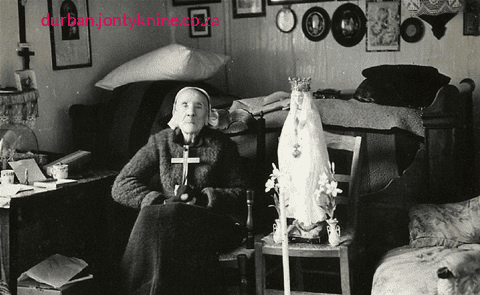
Marie-Julie Jahenny (1850–1941), known as the “Breton Stigmatist” or the mystic of La Fraudais, was a French Catholic mystic, stigmatist, and Third Order Franciscan whose reported divine revelations form one of the largest bodies of private prophetic material associated with 19th- and early 20th-century Catholic apocalypticism.
She was born on 12 February 1850 in the hamlet of Coyault near Blain (Loire-Atlantique), Brittany, the eldest of five children of pious peasant parents, Charles Jahenny and Marie Boya. The family later settled at La Fraudais, where she spent nearly her entire life and died on 4 March 1941 at age 91. She received little formal schooling (about six months) but could read. From childhood she showed deep piety.
Mystical Life and Phenomena
In February 1873, after a serious illness, she reported an apparition of the Virgin Mary. On 15 March the Virgin asked if she would accept the same sufferings as her Son; she consented. On 21 March 1873 (a Friday), in the presence of witnesses including priests, she received the stigmata of the five wounds of Christ. Over the following months and years she received additional marks: the Crown of Thorns, the shoulder wound from carrying the Cross, scourging marks, rope marks on the wrists, and a mystical ring (espousal ring) on her finger during reported mystical nuptials in 1874. She also experienced inedia (living for long periods on the Eucharist alone), mystical communions, diabolical attacks, and frequent ecstasies.
Witnesses recorded more than 3,000 ecstasies between 1873 and 1941. Marie-Julie herself did not write them down; her confessor (Abbé David in the early years) and later lay friends (notably the Charbonnier brothers and others) transcribed the words spoken during the states of ecstasy. These form the “Journal of La Fraudais” (about 30 notebooks from the early period) and later collections. The material is extensive, dispersed, and not fully published in a critical scholarly edition.
Church Status and Investigations
Bishop Félix Fournier of Nantes investigated early on. Physician Dr. Antoine Imbert-Gourbeyre examined her and found no fraud. On 6 June 1875 Bishop Fournier wrote positively, affirming the supernatural character of the phenomena and her sincerity and growth in virtue. He remained supportive until his death in 1877.
After Fournier’s death, subsequent bishops of Nantes became more cautious or restrictive. She faced periods of suspicion, temporary denial of the sacraments (roughly 1877–1888 under Bishop Le Coq), and later restrictions on pilgrims. Medical opinions were not unanimous (earlier local doctors had been more skeptical). The diocese of Nantes has never issued a formal decree of approval or condemnation of the prophecies themselves. A 2019 diocesan statement clarified that the Association of Friends of Marie-Julie Jahenny operates without official diocesan links, that publications are not validated by the diocese, and that a theological examination invites prudence. Her house at La Fraudais can be visited, but the diocese does not provide pastoral care for it as an official sanctuary. The phenomena and messages remain private revelations without formal Church recognition of their content.
(Note: The Palmarian Catholic Church, a schismatic group, has “canonized” her; this has no standing in the Roman Catholic Church.)
Major Themes of the Revelations
The messages emphasize reparation for sins (especially of France and the clergy), love of the Cross and the Sacred Heart, devotion to the Precious Blood and Holy Wounds, and warnings of coming chastisements followed by restoration. Key recurring elements include:
Crisis in the Church and society
Warnings of widespread loss of faith, scandals, liturgical changes or a “horrible religion”/altered Mass containing words offensive to Christ, persecution of the faithful, and moral decay. Some passages speak of men preparing a second form of celebration that would test the faith of the priesthood.
Chastisements on France and the world
Civil war and revolution in France (especially destruction or near-destruction of Paris), foreign invasions (including references interpreted by followers as involving Russia and Islamic forces), natural disasters, plagues/unknown diseases, famine, and social upheaval. Brittany is repeatedly presented as a place of relative refuge. Some prophecies are claimed by devotees to have been fulfilled in outline (return of Alsace-Lorraine, the two World Wars, the Algerian War, mass migration and cultural shifts in Europe).
The Great Monarch and the Angelic Pontiff
One of the most frequent themes is the coming of a Catholic “Great Monarch” (often called Henri de la Croix / Henry of the Cross, or linked by early supporters to the legitimist claimant Henri, Count of Chambord). He is described as a miracle king chosen from birth, restorer of the throne and altar in France, bearer of the lily and white flag, who will liberate the country and work with a holy “Angelic Pontiff” to restore the Church after the crisis. The triumph of France is said to precede or accompany the triumph of the Church.
The Three Days of Darkness
This is the best-known element associated with her (though not unique to her; it appears in other private revelations such as those linked to Blessed Anna Maria Taigi). According to the recorded messages:
- It will last three days less one night (Thursday–Saturday, days of the Blessed Sacrament, the Cross, and Our Lady).
- Continuous supernatural darkness; the only light comes from blessed pure beeswax candles (one suffices for the period in homes of the faithful; they give no light in the homes of the impious).
- Hell is loosed; demons appear in hideous forms; horrible blasphemies are heard.
- People must stay indoors, windows closed; going outside is fatal.
- Massive loss of life (variously described as three-quarters of the world’s population or half of France); the earth becomes like a vast cemetery.
- It is preceded by signs (including an earlier, shorter period of darkness or obscurity of the sun, red rain or clouds, storms, etc.) and forms the climax of a longer sequence of warnings and lesser chastisements.
Protective sacramentals and remedies
- The Purple Scapular of Benediction and Protection (to be worn and displayed in homes for protection during the end times and Three Days).
- The Cross of Pardon.
- Blessed beeswax candles.
- Certain natural remedies (e.g., hawthorn leaves mentioned for unknown diseases).
- Strong emphasis on the Rosary, the Holy Wounds chaplet, devotion to the Sacred Heart, the Immaculate Heart, and the Cross. Three principal “shelters” are named: the Divine Heart, the Divine Cross, and the Immaculate Mother.
Divine Mercy and spiritual counsel
Alongside the severe warnings there are repeated calls to trust in Divine Mercy, the value of a good will even amid distractions in prayer, the necessity of reparation and suffering united to Christ, and the promise that those who remain faithful will be protected and used to rebuild after the purification.
Sources and Transmission
The primary modern English compilation is We Are Warned: The Prophecies of Marie-Julie Jahenny (compiled, translated, and edited by E.A. Bucchianeri, 2011; freely available online via Internet Archive and Academia.edu). It draws on French notebooks, earlier publications by the Marquis de La Franquerie (who founded the Association of Friends of Marie-Julie Jahenny in 1958), and other collections. French sources include various Recueils d’extases and works such as Les Prophéties de La Fraudais. Because the transcripts were made by multiple hands over decades, questions of literal accuracy, possible interpolations, and chronological ordering remain live issues among researchers.
Context and Caution
Private revelations, even when associated with authentic mystical phenomena approved at a local level, do not form part of the deposit of faith. Catholics are free to give or withhold assent provided the content does not contradict dogma or morals. The messages mix spiritual exhortation, political-monarchical hopes typical of 19th-century French legitimism, and dramatic apocalyptic imagery. Some elements have been interpreted retrospectively as fulfilled; others remain future-oriented or contested. The 2019 diocesan caution and the absence of a full critical edition underline the need for prudence.
Marie-Julie herself is presented in the sources as a victim soul whose mission was to suffer for the conversion of sinners, warn of coming trials so that people would not be taken by surprise, and point toward the eventual restoration of Christendom under a holy king and pope. Her house at La Fraudais continues to attract visitors interested in her life and messages, and the Association of Friends continues to promote the texts and related sacramentals.