






The claim that they could “soon outthink” conventional neural networks is an optimistic framing of real progress, but it is currently more aspirational than demonstrated for general or large-scale tasks.
What brain organoids actually are
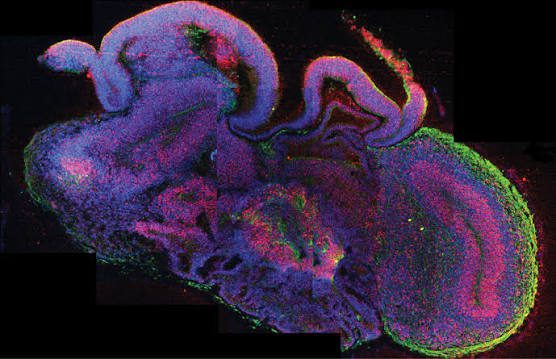
Brain organoids are three-dimensional clusters of cells derived from human pluripotent stem cells (embryonic or induced). They self-organize into structures that recapitulate aspects of early human brain development: layered cortical-like organization, diverse cell types (neurons, astrocytes, etc.), spontaneous electrical activity, synapse formation, and functional neural networks. They are typically pea- or lentil-sized (hundreds of micrometers to a few millimeters) and contain on the order of tens of thousands to a few million cells—orders of magnitude smaller than a human brain (~86 billion neurons).
They are grown in specialized media and can be maintained for weeks to months in standard setups. A major 2026 advance extended viability dramatically: Harvard/Broad Institute researchers kept cortical organoids alive and developing for more than five years (some observed nearly six), showing progressive maturation that tracks real human developmental timelines (gene expression resembling fetal stages, then newborn-like patterns), epigenetic “memory” of developmental age (including DNA methylation clocks), and even signs of cellular aging such as myelination. When cells from differently aged organoids were mixed into “chimeroids,” they retained memory of their prior developmental stage. This longevity opens windows into later developmental and aging processes previously inaccessible.
Organoids are used primarily for modeling neurodevelopment, disease (Rett syndrome, Alzheimer’s, autism, epilepsy, fragile X, etc.), drug screening, and studying circuit assembly. Recent technical improvements include using food additives like xanthan gum to prevent clumping and enable production of thousands of relatively uniform organoids at scale.
From modeling to computing: Organoid intelligence
The leap to computation involves interfacing organoids (or simpler 2D neuronal cultures) with multi-electrode arrays (MEAs). Electrodes deliver patterned electrical stimuli as “input” and record spiking activity as “output.” Closed-loop feedback—rewarding desirable activity patterns and disrupting undesirable ones—exploits the tissue’s intrinsic plasticity so networks rewire and improve performance on tasks. This draws on ideas like the free-energy principle (minimizing prediction error/surprise).
Key demonstrations include:
- DishBrain / Cortical Labs (2022 onward): ~800,000 human (or mouse) neurons on an MEA learned to play a simplified Pong by receiving structured feedback for successful hits and random noise for misses. Learning emerged within minutes of real-time play. Human cells often outperformed mouse cells. Later work showed these biological networks could exceed deep reinforcement learning algorithms (DQN, A2C, PPO) in sample efficiency under limited-data, real-time constraints—learning faster and more robustly from fewer examples. The company commercialized the CL1 biological computer (~$35,000 unit; cloud access available) and has demonstrated rudimentary control in environments like Doom. A 2026 prototype biological data center rack in Singapore integrated 20 CL1 units (millions of neurons total) drawing only ~850–1,000 W.
- Brainoware and reservoir computing: Organoids used as living reservoirs for speech recognition (speaker identification) and nonlinear time-series prediction, with unsupervised adaptation of functional connectivity.
- Closed-loop control tasks (2026): Cortical organoids trained via adaptive electrical feedback to solve the classic cart-pole balancing problem (an engineering benchmark). Success rates rose dramatically under targeted feedback (around 46% proficient sessions) versus random or no feedback (a few percent), demonstrating short-term goal-directed plasticity even without dopamine, sensory organs, or a body.
- Other platforms: FinalSpark’s Neuroplatform lets researchers rent access to organoid-based systems (~$500/month range in earlier reports) for tasks such as Braille recognition. Groups at UC Santa Cruz, Johns Hopkins, and elsewhere are building interactive systems, organoid-specific benchmarks, and even Turing-test analogs while monitoring for signs of more complex cognition.
The theoretical appeal is biological: brains integrate memory and computation at synapses, operate massively in parallel, handle noisy/sparse/uncertain data gracefully, and consume ~20 W for human-level capability. Silicon systems (especially large neural nets) separate memory and compute (von Neumann bottleneck), require vast data and energy for training/inference, and scale power-hungry data centers. Estimates suggest biological tissue could be millions to billions of times more energy-efficient for certain workloads; even current prototypes use watts rather than the kilowatts-to-megawatts of GPU clusters.
Can they “outthink” neural networks soon?
Not in the broad sense of replacing or surpassing large language models or general AI systems in the near term. Current organoid systems excel at narrow, adaptive, low-data, real-time control or reservoir tasks and show superior sample efficiency and energy use in those niches. They do not yet match silicon nets on complex pattern recognition, language, long-horizon planning, or high-dimensional optimization at scale. Scale is the core bottleneck: organoids remain tiny, lack vascularization for larger sizes, have limited cell-type diversity and long-range connectivity compared with a real brain, and cultures still face viability, variability, and maintenance challenges (though multi-year cultures help). Interfacing bandwidth, decoding complex activity, and reliable training protocols are active research problems.
“Outthink” is therefore relative. Biological networks may outperform artificial ones on energy, data efficiency, continuous online learning, and robustness to noise—precisely the areas where silicon AI is most costly and brittle. Hybrid bio-silicon systems are a more realistic near-term path. Commercial efforts (Cortical Labs, FinalSpark, academic platforms) are already treating living neural tissue as a compute substrate that can be rented or deployed alongside conventional hardware.
Nuances, challenges, and implications
- Scientific value is already high: Better disease models, insights into learning and circuit self-organization, and potential drug screening that reduces animal use.
- Technical hurdles: Standardization, scaling volume and complexity (adding sensory organoids, vascularization, immune components), long-term stability, and mapping organoid dynamics to useful algorithms.
- Ethical considerations: As organoids grow more complex and exhibit adaptive, goal-directed behavior, questions arise about sentience, moral status, consent (stem-cell origins), dual-use risks, and whether/when consciousness-like properties could emerge. Researchers are developing monitoring frameworks and organoid-specific ethical guidelines; current systems are widely viewed as non-sentient, but the trajectory invites caution.
- Broader implications: If scalable, OI could reduce the enormous energy footprint of AI, enable edge biocomputing in low-power settings, accelerate neuroscience and personalized medicine, and potentially yield forms of intelligence that complement (rather than purely imitate) silicon approaches. It also raises questions about what “intelligence” means when the substrate is living, plastic, and metabolically constrained tissue rather than optimized digital code.
In short, the premise is factually grounded: mini human brains are being grown globally, they form functional networks, and closed-loop experiments show they can learn adaptive tasks with striking efficiency. Claims of imminent superiority over neural networks capture genuine advantages in energy and sample efficiency but overstate current generality and scale. The field is moving quickly from pure biology into hybrid biocomputing; the next few years will clarify how far living neural tissue can be pushed as a practical computing medium.