


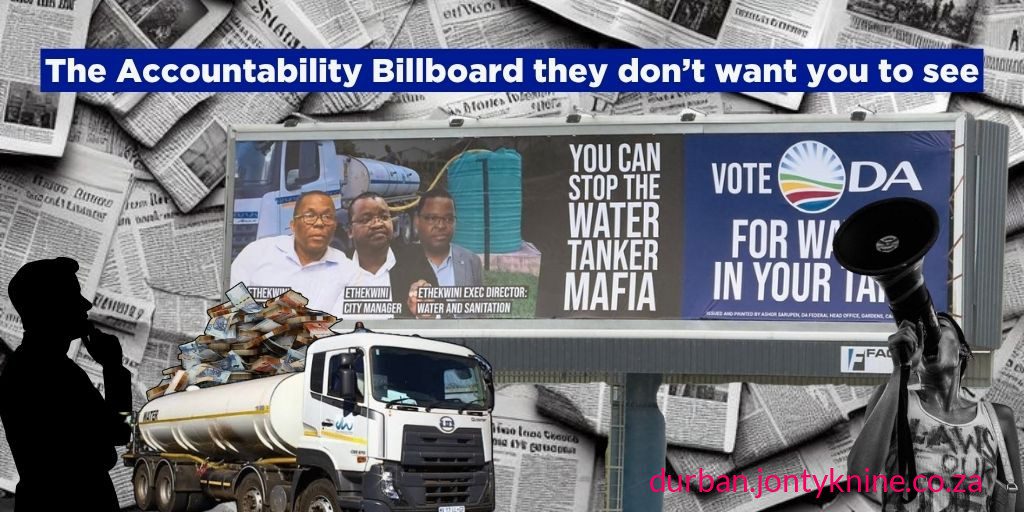
The billboard was unveiled on 28 September 2026 along the N2 highway near Newlands East / Riverhorse Valley / Sea Cow Lake in Durban. It featured photographs of:
- eThekwini Mayor Cyril Xaba
- City Manager Musa Mbhele
- Executive Director of Water and Sanitation Ednick Msweli
The main message read: “You can stop the water tanker mafia. Vote DA for water in your taps.”
It formed part of the DA’s campaign ahead of the 4 November 2026 local government elections. DA eThekwini mayoral candidate Haniff Hoosen and DA KwaZulu-Natal leader Sithembiso Ngema launched it. The party argued that the water crisis had worsened under these leaders’ watch, with roughly 13,000 active leaks wasting an estimated 21 billion litres of drinking water per month (about 65% water losses or ~700 million litres daily). The DA claimed this infrastructure failure had created dependence on water tankers, allowing “tanker interests” (described as a mafia) to benefit from hundreds of millions of rands in taxpayer money while residents faced dry taps.
Parliamentary records cited in coverage show eThekwini spent about R1.8 billion on water tanker services over five years, rising sharply from R102.6 million in 2020/21 to R814.8 million in 2024/25. The municipality has said it invested around R345 million in its own tanker fleet (318 operational, with more expected) to bring the service in-house and rejected “mafia” claims.
Legal Threat and Initial Defiance
On 30 September 2026, lawyers for Xaba, Mbhele and Msweli (Venns Attorneys) sent a letter of demand. It argued that placing the officials’ photos next to the “water tanker mafia” wording was defamatory, implied they were involved in organised criminal activity, harmed their dignity and reputation, and was designed to undermine them ahead of the elections. The letter demanded removal of the billboard and related materials within 24 hours, a public apology and retraction, and warned of High Court action if ignored.
Hoosen and the DA initially refused. They stated the billboard would stay unless a court ordered its removal. They maintained it did not accuse the individuals of being mafia members but held the political and administrative leadership accountable for the infrastructure collapse that enabled tanker dependence. Hoosen said the city was spending resources fighting a billboard instead of fixing pipes and that residents needed accountability, not censorship.
Removal and Reactions
The billboard was removed around 1–2 October 2026 (after roughly 2–4 days). Accounts differ slightly on the exact mechanism:
- Some reports (including from the municipality) state the DA removed it after receiving the letter of demand.
- The DA said its position was that it would not remove the billboard, yet it came down anyway. One report alleged the property owner requested removal after harassment; others left the precise authority or actor unclear.
eThekwini Municipality spokesperson Senzelwe (or Senzo) Mzila welcomed the removal, saying robust political debate is essential but must not cross into personal defamation or undermine the dignity of officials serving the city. City Manager Mbhele emphasised that public servants must be able to fulfil their duties with integrity intact.
Hoosen responded critically: “The city has chosen to fight a billboard, threatening legal action to defend incompetence, rather than spending the money on fixing the pipes.” He reiterated that the billboard exposed officials who failed to prevent the crisis, that the “water tanker mafia” had raked in hundreds of millions, and that the election choice was between taps and tankers. The DA framed the episode as officials fearing accountability.
Broader Context and Implications
This episode sits against eThekwini’s long-running water challenges—ageing infrastructure, high non-revenue water losses, intermittent supply, and heavy reliance on tankers as a stopgap. The DA has made “taps not tankers” a central campaign theme, presenting its own water recovery plan focused on leak repairs, infrastructure rebuild, technical capacity and reduced tanker dependence. The municipality points to investments in its own fleet and rejects organised-crime framing of the tanker system.
The dispute highlights tensions common in South African local politics: the line between legitimate political accountability messaging and potential defamation when naming specific office-bearers; the use of legal threats in election periods; and the practical difficulties of service delivery in a large metro with significant infrastructure backlogs. No court order appears to have been issued before the removal, and as of the latest reports (around 2–3 October 2026) it remained unclear whether further litigation would follow or whether the DA planned alternative campaign materials on the same theme.
In short, a high-profile DA campaign billboard targeting eThekwini’s leadership over the water crisis was taken down shortly after a formal legal demand from the mayor and senior officials, amid competing narratives of accountability versus defamation.